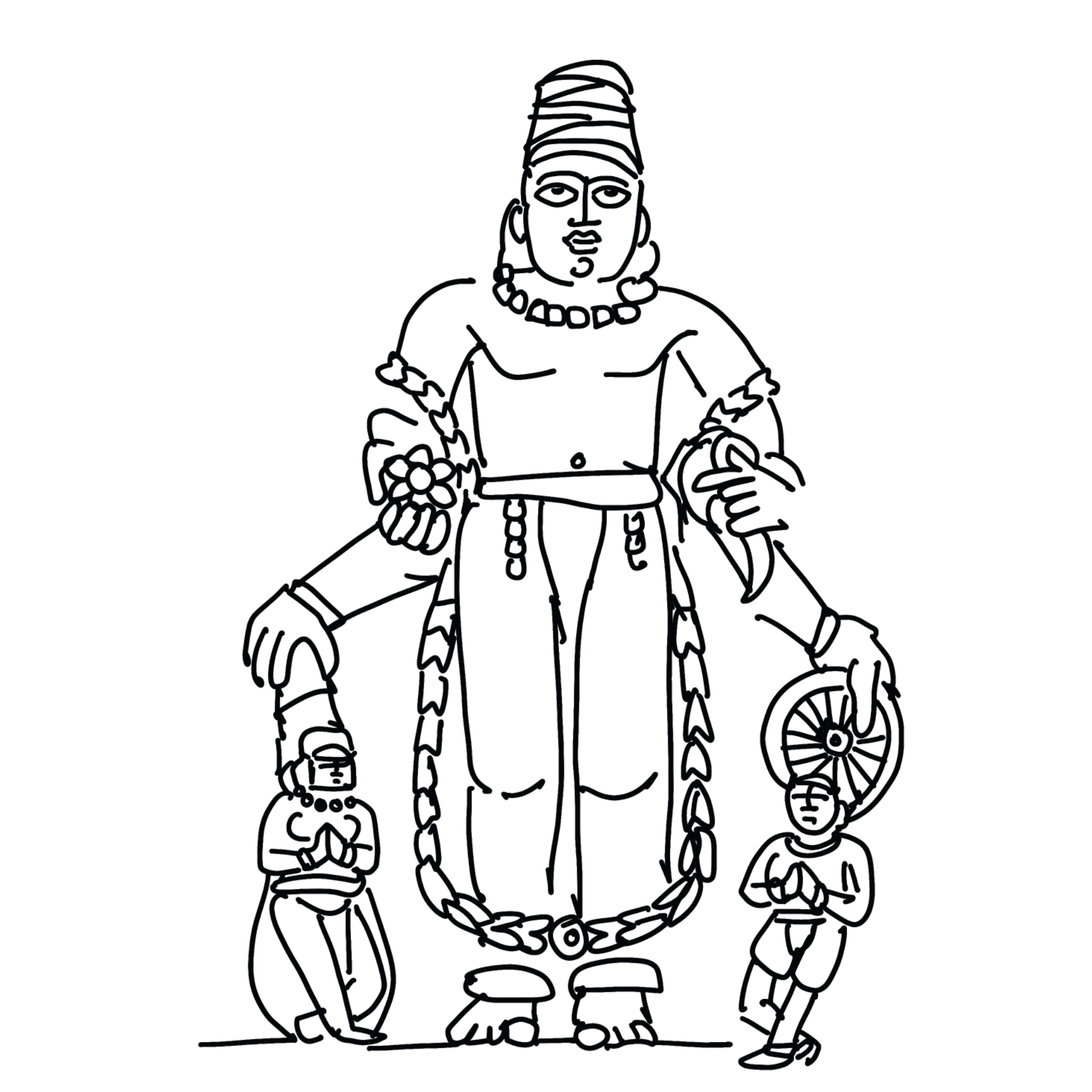
Vashishta is amongst the seven celestial sages. He is the last star of the Great Bear Constellation. This star is a binary star. The other part of the pair is Arundhati, his wife. Together they symbolise happy conjugal life – Hindu newlyweds are advised to look at these stars after the wedding to ensure to bring good luck into their own married life.
Vashishta is sometimes considered a mind-born son of Brahma. In other stories, he is born when Mitra and Varuna release semen at the sight of Urvashi, the apsara. The semen falls into two pots from which are born Vashishta and Agastya.
Vashishta’s story comes to us from the Rig Veda; he participates in the famous battle of the 10 kings, and in later literature he is shown as a rival of Vishwamitra. While Vashishta is born a rishi, Vishwamitra is a king who makes himself tishi. When he observes the magical powers of Vashishta’s cow Surabhi, he realises that the magical powers obtained through spiritual practices are greater than the physical weapons that he possesses.
The rivalry between Vishwamitra and Vashishta is rather violent, culminating in the death of Vasishtha’s son Shakti. At the death of his son, Vashishta is so heartbroken that he tries to kill himself by jumping from the mountains and and into rivers, but each time the mountains and the rivers refuses to let him be killed. He finally returns home and learns that his widowed daughter-in-law was pregnant. The unborn child gives Vashishta hope and a reason to live.
When Shakti’s son was born, he is named Parasara. He is furious to learn about how his father’s death. He decides to kill Vishwamitra and his sons and all those who participated in the killing of his father, but Vashishta stops him, teaching him that death is function of destiny. We are killed by fate, not by enemies. Punishing enemies will not change fate.
Link with the epics
Vashishta and Vishwamitra later become the teachers of Ram making them a part of the epic Ramayana. Across India we find temples of Vashishta, as far away as Manali in Himachal Pradesh, Rishikesh in Uttarakhand, in Guwahati in Assam and in Kerala.
In many of these temples, on Guru Purnima it is said, Ram goes to visit his teachers making them. Thus, Vashishta is strongly linked with the Ramayana tradition.
Vashishta’s son Parashara and his grandson Vyasa are linked with the Mahabharata traditions. Parashara has relations with a fisherwoman called Gandhavati and she bears him a child on a river island who is named Krishna Dwaipayana, who later becomes famous as Vyasa. Vyasa is famous for codifying the four Vedas and passing them on to his four students. He then proceeds to explain the Vedic principles in the form of a story called the Mahabharata that is written down by Ganesha.
Vyasa not only composed the Mahabharata. The events of the epic are part of his own life. He makes the widowed queens Ambika and Ambalika pregnant. From this union are born Pandu and Dhritarashtra,whose children are the Pandavas and the Kauravas.
Vyasa is also present at the time of death of the heroes. He is present when Satyavati renounces the world. He is present at the end of the Kurukshetra war to console Gandhari whose children have been killed. It is he who had earlier blessed Gandhari that she would bear a hundred sons. He is also present when Krishna finally dies at Dwaraka, having witnessed the annihilation of his clan.
He is thus present at all sorrowful events of the Mahabharata. Like his grandfather Vashishta, he talks about the futility of anger and war and preaches the doctrine of dharma, which means fulfilling social obligations, being responsible, without submitting to passion or taking revenge.
Vyasa has another son, by his wife Shuka; this son does not want to be part of this world. First he refuses to leave his mother’s womb. But then his father tells him of the pain he was causing his mother so he leaves his mother’s womb and rises heavenwards.
But then Vyasa describes how Krishna looks. To experience Krishna, says Vyasa, you have to engage with the world. So Suka becomes part of this world. He is visualised as one with a parrot head who remembers the Veda and shares the story of Krishna’s life, the Bhagavata, with Parikshit, the grandson of the Pandava, as he awaits his inevitable death.
He too learns about the futility of revenge and the importance of accepting fate and filling the world with love.
In the generations from Vasishta through Vyasa to Shuka we see a shift in the Vedic world from valuing wisdom to celebrating love, from intellect to emotion, from gyan to bhakti.