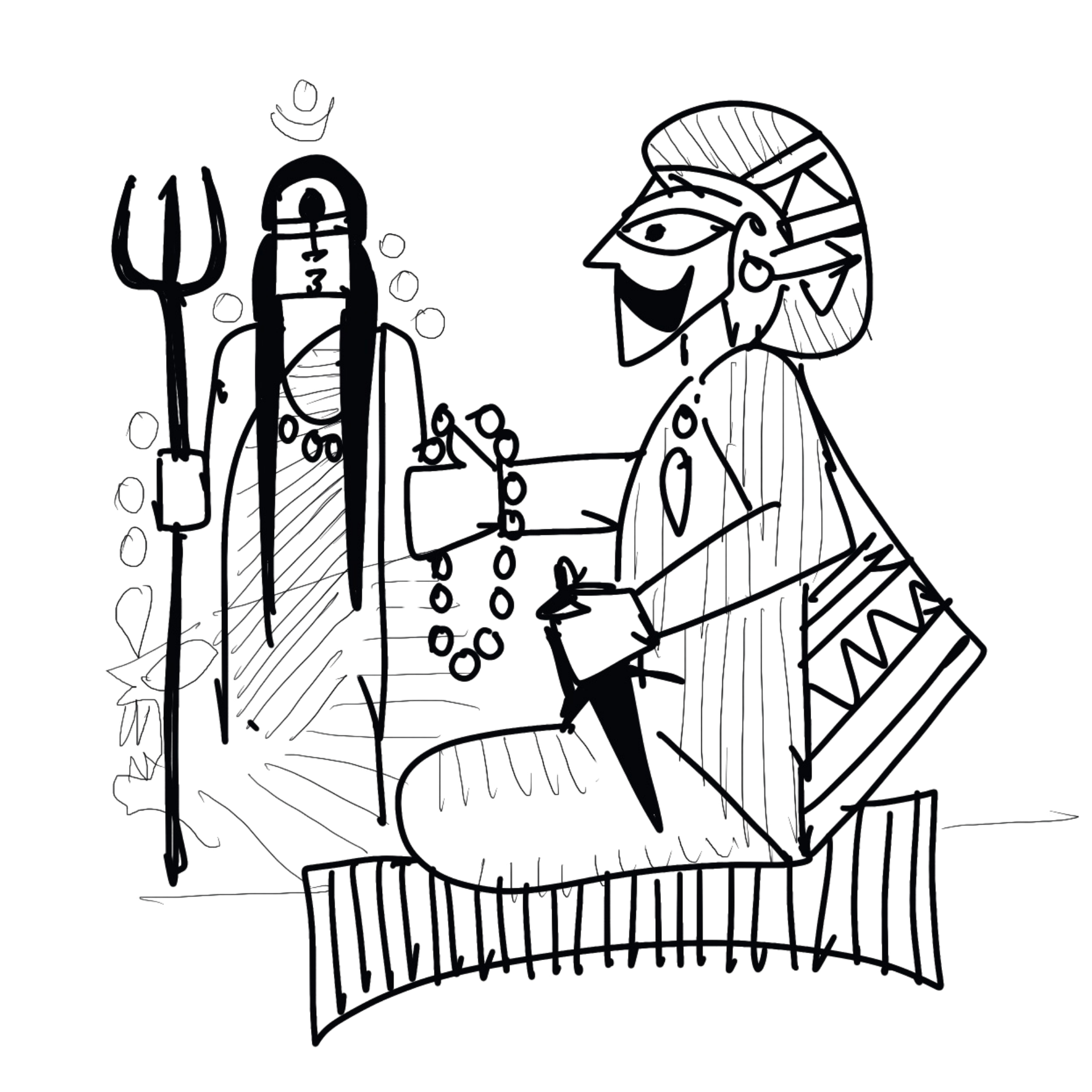
A tiny fragment of the Indian population was literate in medieval times. But a large portion knew poetry, composed poetry and transmitted poetry. These poems are thus major cultural outputs. In medieval times, about 1000 years ago, two kinds of poetry emerged: the Tantric Charyapada of eastern India and the Bhakti Alvar–Nayanar poetry of South India.
The Charyapada was composed roughly between the 8th and 12th centuries by Buddhist tantric teachers known as siddhas. The Tamil bhakti poets mostly belong to the 6th–9th centuries. Their hymns were later compiled into canonical collections such as the Nalayira Divya Prabandham and the Tevaram. The Charyapada, by comparison, is not a devotional canon in the same institutional sense but a scattered set of mystical songs preserved in a later manuscript.
This Charyapada verse by Luipada emphasises controlling the restless mind.
“The body is like the finest tree, with five branches.
Darkness enters the restless mind.
Strengthen the quantity of Great Bliss, says Luyi…
Learn from asking the Guru.
Embrace the wings of the Void.”
Here is an example of Tamil Alvar poetry where the poetess Andal reveals her passionate longing for Lord Vishnu.
“If there is even mere talk of offering this,
my body to mortal men,
then I cannot live.
It is equal in violence to a forest jackal
stealthily entering and sniffing at the
sacrificial food.”
Language and literary structure
The most striking difference lies in language structure. Tamil bhakti poetry uses a mature Dravidian literary language with established grammar, poetic conventions, and metres. Tamil literature had already developed sophisticated forms during the earlier Sangam period. The Alvar and Nayanar poets therefore write within a recognisable literary framework even when their tone is emotional and devotional.
The language of the Charyapada, by contrast, is linguistically unstable. It belongs to the transitional stage between Apabhramsha and early eastern Indo-Aryan languages. Grammar is simpler and less standardised. Many forms look like early Bengali or Assamese, but they are not yet fixed. In linguistic terms, the Charyapada reflects the birth of new regional languages, whereas Tamil bhakti poetry represents the continuity of an already established literary culture.
Clarity versus concealment
Another major contrast lies in clarity versus concealment. The Tamil bhakti poets speak openly and passionately about their devotion to Shiva or Vishnu. The hymns describe temples, rituals, sacred geography, and emotional surrender to a personal deity. Their language is meant to be heard and understood by a wide audience.
The Charyapada works very differently. Its poets deliberately use Sandhya-bhasha, or twilight language. Every day images conceal tantric teachings. A boat may symbolise spiritual practice, a woman may represent wisdom, and a house with nine doors may refer to the human body. This coded style reflects the secretive nature of tantric traditions, where knowledge was often transmitted only to initiated disciples.
Thus, the Tamil bhakti poets are communicative and public, while the Charyapada poets are cryptic and esoteric.
Social worlds and imagery
The social worlds reflected in the languages also differ. Tamil bhakti poetry often celebrates temple worship. The poets praise specific temples across Tamil Nadu and describe the deity residing there. Their songs helped create a sacred geography linking shrines such as Srirangam, Chidambaram, Madurai, and Tirupati. Over time, these hymns became part of the temple liturgy.
The Charyapada rarely refers to temples. Its imagery is drawn instead from village life – fishermen, hunters, farmers, boats, rivers, craftsmen, and wandering yogis. The language reflects a more marginal world of tantric practitioners moving between monasteries, forests, and rural communities.
Religious orientation
The religious tone also differs. The Alvars and Nayanars emphasise devotion, surrender, and emotional intimacy with God. Their poems are filled with love, longing, and ecstatic praise. The deity is personal and present in temple images.
In the Charyapada, the focus is not devotional worship but inner realisation. The language speaks of the body, the mind, and the transformation of consciousness. Even when the imagery involves men and women, food, or household activities, the meaning often relates to yogic processes or mystical insight.
The contrast between the two traditions therefore reveals two different pathways of religious vernacularisation in India. In the South, a mature regional language became the vehicle for public devotional religion centred on temples. In the East, a transitional vernacular became the medium for mystical poetry that circulated among small tantric communities.
Both movements demonstrate that by the early medieval period, the religious imagination of India was no longer confined to Sanskrit alone.