
Ashoka is a historical figure, who ruled around 260 BC, 2,300 years ago, and is famous for writing his own edicts on pillars and rocks. These could be propaganda materials to whitewash his reign, but it remains the first clearly articulated royal epigraphy of India. Here, Ashoka admires Buddhism, but propagates a dhamma all his own, based on remarkably secular ideas. He is against killing animals, but does not condemn rape, theft of murder, though. Later Buddhist legends would describe Ashoka as a patron of Buddhism, the builder of 84,000 stupas.
By contrast, Yudhishthira is a mythological figure, whose story comes from the epic Mahabharata. For Hindus who identify themselves as Sanatanis, Yudhishthira is a historical figure who lived around 3000 BCE, absence of archaeological evidence notwithstanding. They reject one historianʼs claim that the Mahabharata dialogues of remorse over battlefield violence were the Brahmin response to Ashokan edicts.
The oldest manuscripts of the Mahabharata are dated to a century after Ashokaʼs rule but the story refers to an earlier period, before Kali Yuga, which may be seen as code for a time before the rise of the Buddhist orders and the end of Brahmin patronage following the arrival of foreign kings like Yavanas, Sakas and Kushanas. Inscriptions mentioning Kali Yuga appear only after 400 AD
Ashokan edicts are cited as a rare example of a king showing remorse over the massacre in the Kalinga War. In all probability, this brutal assault was meant to gain access to iron mines and sea ports. According to later Buddhist lore, this war led Ashoka to embrace Buddhism. But this public declaration of remorse happened after he killed his brothers and political rivals, and had expanded his empire to control all the trade routes of India. The edicts were strategically placed near mines, near ports, near markets.
No one in India remembered Ashoka until his capital was discovered by British archaeologists in the 19th century. Orientalists have argued that Brahmins deliberately chose to forget the Buddhist king. There is no reference to Ashoka in the Mahabharata, for example. This argument has naturally provoked Sanatanis who view Ashoka as Buddhist, and so anti-Hindu, rather than secular. They argue that historians selectively present information to portray Buddhist Ashoka as a nobler king than Hindu Yudhishthira.
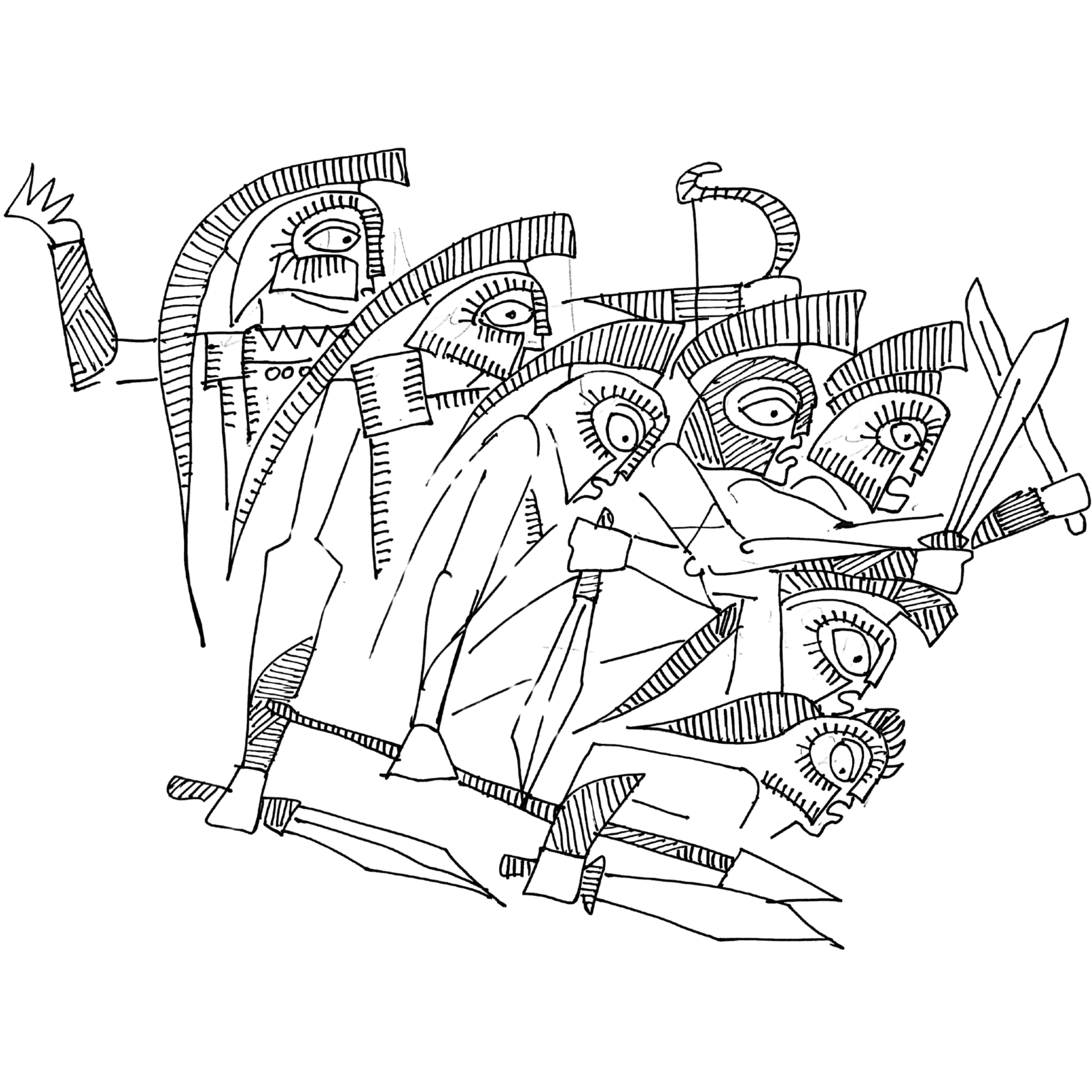
In the Mahabharata, anti-war sentiment is presented both before and after the war. Before the war by Arjuna, Yudhishthiraʼs younger brother, and after the war by Yudhishthira himself. In both cases, Krishna uses many arguments to get the two men to look at the war as their dharma. Dharma here is translated as caste duty. Arjuna and Yudhishthira are warriors and so obliged to fight, to repay the debt of privilege. This is presented in Marxist circles as Krishna justifying violence through casteism.
However, the motivation for Yudhishthiraʼs violence is very different from Ashokaʼs. Yudhishthiraʼs conflict is the outcome of a property dispute within the family. Ashokaʼs violence is driven solely by his ambition, the desire to extract resources from an independent frontier state. Yudhishthiraʼs is rooted in justice and selfpreservation, not the desire to expand territory. To argue that Ashoka was against violence (after winning the war) and Brahmin epics valourise war as caste duty seems more strategic than sincere.
The Mahabharata, or the Gita, is not a justification of violence as many modern historians tend to argue. It is an argument about what constitutes the possessive pronoun “my” and “mine”, who constitutes family and who does not. Significantly, adoption is an important theme in the epic, an idea not found in the Ramayana. The Pandava question (is it dharma to fight family?) is not the same as the Kaurava argument (it is dharma to fight rivals). These have nothing to do with a kingʼs desire to expand his power, and establish an extraction colony.
Creating an imaginary competition between an ambitious historical character seeking redemption and a mythological character facing a family-related moral dilemma is more the realm of mytho-fiction writers, now being appropriated by historians.