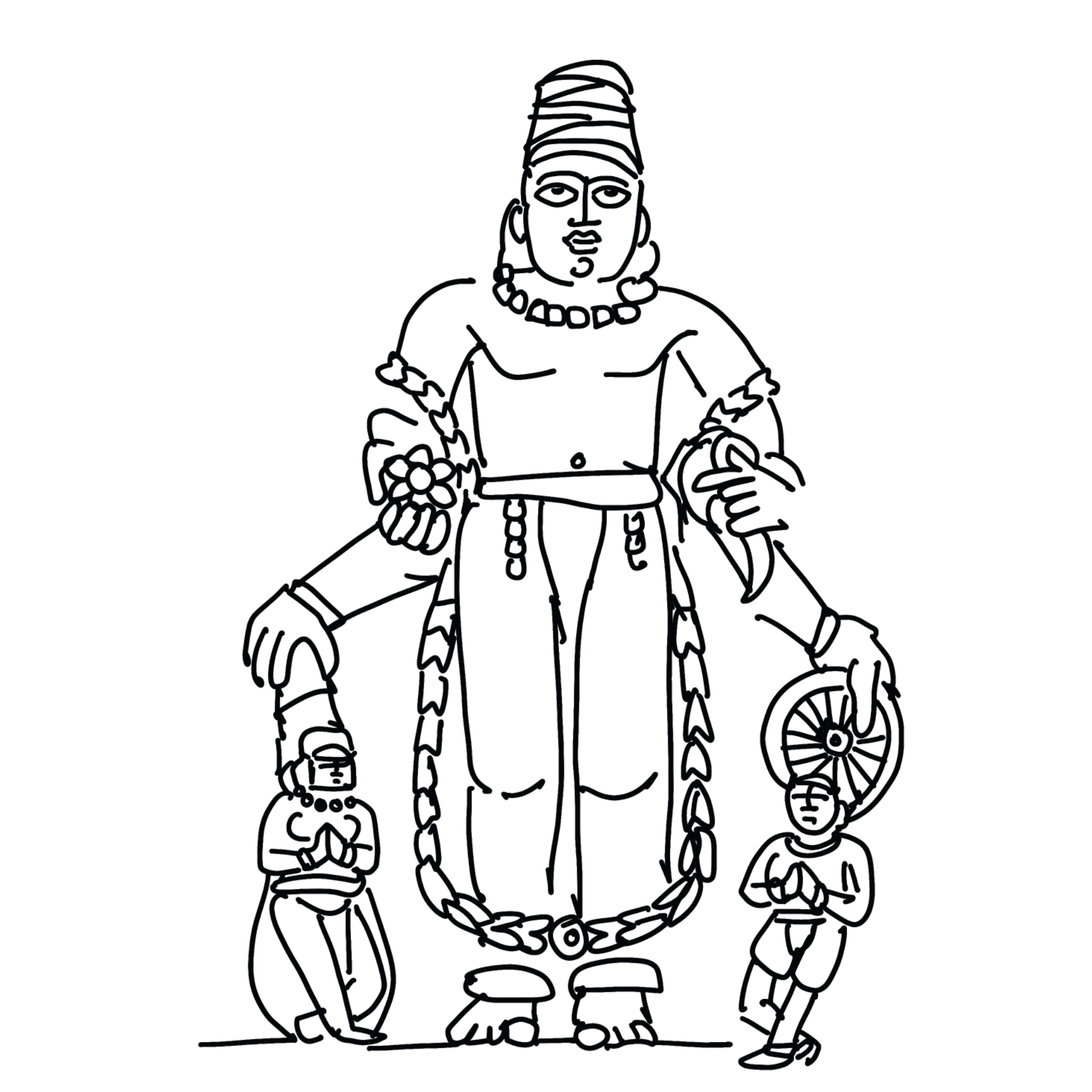
Published in Sunday Midday Mumbai, on 10 May 2009.
Hinduism is based on orthopraxy — greater attention is given to ‘doing’ rather than ‘thinking’ or ‘feeling’. While it is good to understand or experience rituals, it is critical to at the very least just do it. So the high point of the religious activities is ‘darshan’ — looking at the image of God. Hundreds of devotees will throng to see the image of the deity, special preference being given to certain deities at certain times (for example, Siddhi Vinayak of Mumbai on Tuesday especially if that Tuesday coincides with the fourth day of the waning moon).
Darshan is a very simple ritual; one does not have to say any prayer, make any offering, perform any ritual; one is expected to just look at the image of god, and that act of looking is enough to bring about spiritual and/or material upliftment as the case may be.
The word darshan literally means outlook, viewpoint. Technically, it means ‘philosophy’. Thus by looking at the world, one forms an opinion about the world. By looking at a person, one forms an opinion about the person. Better the observation, better the understanding.
Ancient Rishis saw life with such clarity that they wished to share their understanding of the world with the rest of humanity. Their understanding over the years was transmitted via symbols and rituals. If we look at symbols and rituals carefully, profound wisdom can emerge, provided we care to really look and contemplate. Unfortunately, over the years, darshan has been all about looking, and not about contemplating or learning.
Imagine going to a Shiva Temple: the deity within is just a pillar. One can touch the pillar and go around this pillar, but not completely, as the path of circumambulation is blocked by the tip of a leaf-shaped trough called the Gauri-patta or the mark of Gauri (Shiva’s consort). Devotees pour raw milk over the sacred image which flows out via the leaf-shaped trough. The experience is rather different from what happens in a Krishna temple. The temple itself is usually rather grand, like a palace, and access to the deity is restricted. The deity is adorned with flowers and gold and jewels and one can circumambulate around Krishna and his consort, Radha. The offering here is not raw milk but processed milk — either butter or ghee. Why does darshan in either case lead to such a difference in experience?
People have no answer. The ritual is strictly adhered to in the name of tradition (something that ensures its flawless transmission). Every time one visits the temple the experience is repeated — again and again and again. Our senses get the image, but somewhere along the line the mind does not process it. We restrict ourselves to the aesthetics and details of the ritual but fail to see what is being communicated by what is being observed. But every once in while, one devotee actually sees the symbol or ritual, and they provoke a life-changing insight, which is the ultimate aim of darshan.
Let us see what the darshan of Shiva and Krishna can reveal. Shiva is a hermit-god, who shuns all things worldly. Vishnu on the otherhand is a householder god who celebrates all things worldly. Shiva’s temple therefore is rather simple compared to that of Krishna (Vishnu’s earthly incarnation). Shiva shuns even his worldly form, hence the pillar or linga; Krishna on the other hand stands fully formed with his flute. Shiva shuns his wife, Gauri, but she ensures that her presence is felt when she does not allow Shiva’s devotees to go around him completely. By blocking her path, she demands attention, for she represents the world that Shiva shuns. The Gauri-patta is a reminder that one can withdraw from the world, like Shiva, but not completely. It is the material world that gives us our body and this body needs nourishment and care, so even the greatest of hermits cannot totally turn away from the material world. Vishnu on the other hand is always with his consort, Lakshmi — thus Ram is with Sita and Krishna is with Radha. Thus while Vishnu enjoys the world, he is also responsible for his consort/world. One cannot see Vishnu without Laxmi, Ram without Sita, Krishna without Radha, celebration without responsibility. If milk is a metaphor for life (the whole world was churned out of the ocean of life), then Shiva accepts it raw, as it is, while Vishnu demands it be churned and protested, hence he demands butter or ghee. The making of butter or ghee demands effort, which is necessary if one engages with the world.
Thus the darshan of Shiva and Krishna has much to teach us about life. The one teaches us about withdrawing from the world, the latter teaches us about engaging with the world. The question is do we realize these messages that come from our ancestors during ‘darshan’. Are we really looking?