
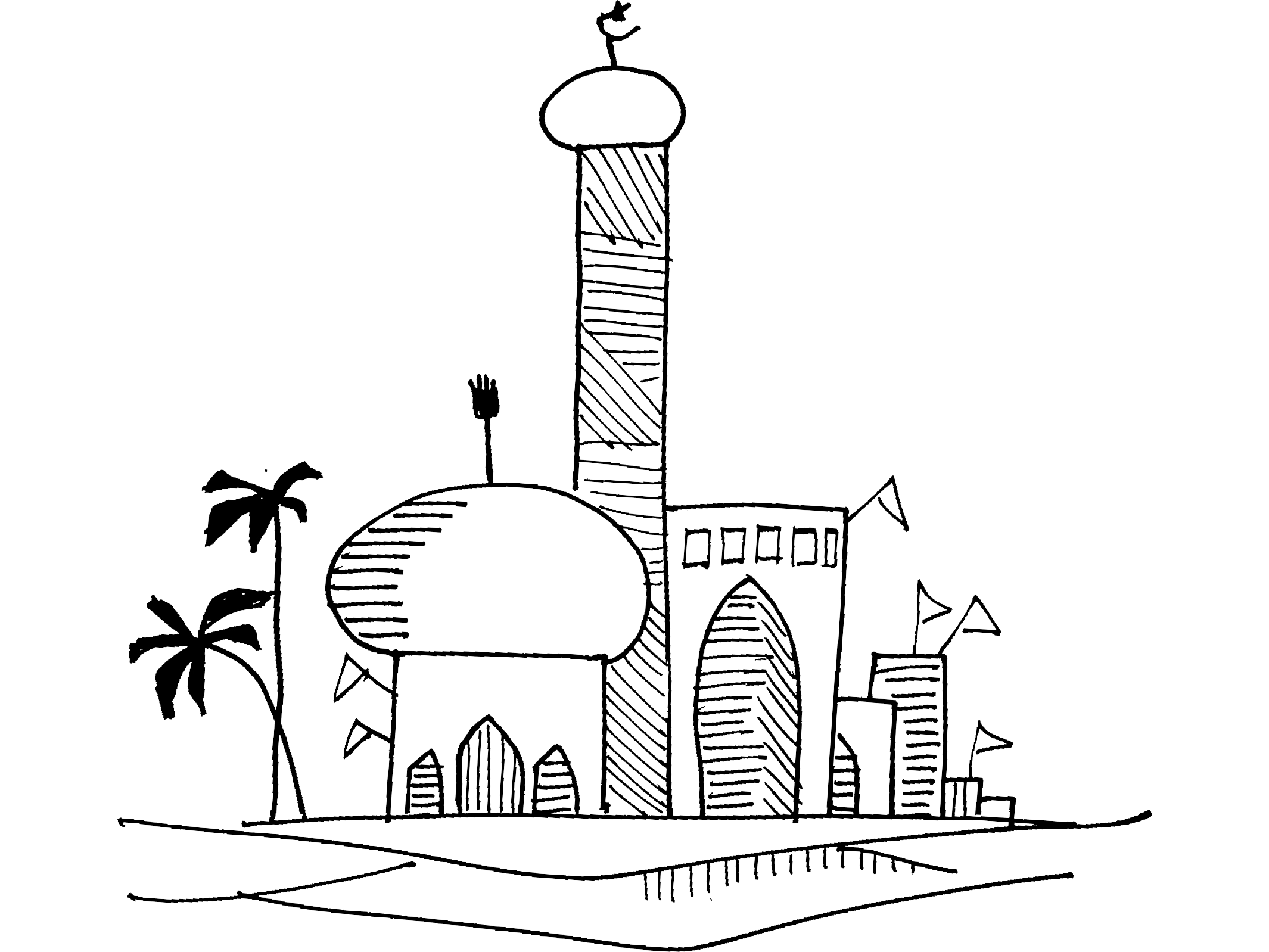
Politicians usually refer to the Islamic period (1000 to 1800) as the Mughal period (1500-1800), but that is not quite correct. Mughals had Mongolian roots, while earlier Muslim rulers of India had Turkish (Ghurids, Mamluks, Khilji, Tughlaq) and Afghan (Lodi, Suri) roots. Mughals followed imperial Persian court rituals. The Turks and Afghans were more tribal, so preferred the egalitarian Arab ways.
There is a tendency to see Muslim rule in India as a homogenous entity. But it has never been so. The Islamic world rose in Arabia but culturally Persia was richer. Persians have a long history of fabulous pre-Islamic kingdoms and dynasties. They value bloodline and so are mostly Shia, characterised by many schools of hereditary teachers, for whom tombs were built. Arabs are mostly Sunni, who do not value bloodline. They seem to be wary of art, architecture and aesthetics, and have shunned tomb-building.
|
Persia had monotheism in the form of Zoroastrianism and Manichaeism long before Arabia. But when Islam spread to Persia, from 700 AD to 900 AD, there was a ‘century of silence’ when old Persian culture was ruthlessly transformed to accommodate Islam. Later on, Persia reemerged as a challenger to Arabic might with the rise of Abbasid Caliphs of Baghdad around 800 AD, and even more powerfully with the rise of Mahmud of Ghazni – the raider from Central Asia who plundered India around 1000 AD. Ghazni was a patron of the poet Ferdowsi who wrote the “Shahnameh” or the “Persian Book of Kings”, the only literary memory of pre-Islamic Persia.
“Gunpowder” kingdoms
The Turks who came from Central Asia (east of Persia) migrated to create the Ottoman Empire in what is modern-day Turkey (west of Persia). They defeated the Mamluks of Egypt. After 1600 AD, the world was dominated by three great Muslim “gunpowder” kingdoms: the Ottomans of Turkey, the Safavids of Persia and the Mughals of India.
Ottomans saw themselves as inheritors of the Caliphate. Safavids were drawn to Sufi masters and Shia ways of being. Mughals called themselves Badshah (world-emperor) and Shahenshah (king of kings) using Persian vocabulary. They differentiated themselves from the earlier Turkish Sultan, who in theory valued the Caliphate. Iltamush was the only Delhi emperor who formally sought recognition from the Caliphate.
Both the Sultans and Badshahs of India loved building grand tombs for members of the royal family, starting with Iltamush, which rivalled the architecture of mosques and dargahs. This was a Persian practice that began with the oldest such tomb Gonbad-e Qabus (1000 AD), built in Persia. This was probably inspired by the tombs of the ancient Achaemenid kings (500 BC), defying Zoroastrian sky burial and Islamic earth burial practices. The Mughal emperor Aurangzeb was the only exception; he avoided building a tomb for himself and chose the Islamic earth burial practice.
Three phases of Islamic rule in India
Islamic rule in India can be divided into three phases. The first phase, from the 10th to the 12th century, was essentially a period of raids. Tribal Turkish warlords like Mahmud of Ghazni (in east Afghanistan) would enter India, attacking cities and centres of wealth and power, particularly temples, to plunder their riches. This led to a significant outflow of silver from India.
The second phase began in the late 12th century when Sultanates were established, beginning with the Ghurid Sultanate. Ghurids were Tajiks from Central Asia. The Qutub Minar was constructed in Delhi during this period, and a similar tower – the Minaret of Jam – was built in Afghanistan, marking the two ends of a great empire ruled by two brothers, Ghiyasuddin Ghori and Muizzuddin Muhammad Ghori.
This was followed by the Mamluks, who were slaves of the Tajiks but hailed from the Turkish region. After them came the Khiljis and the Tughlaqs, both from Central Asia, followed by the Lodhis and the Suris, who came from the Afghan Pashtun regions. These dynasties closely followed the Arab model of kingship and were dependent on the support of the Caliphate, which at that time was based in Baghdad, Iraq.
Why Babur preferred Persian titles
It is important to remember that the Caliphate was originally established in Medina, later moving to Damascus in Syria, before settling in Baghdad in the 8th century, where it thrived for about 500 years. In the 13th century, however, Baghdad was destroyed by the Mongols. While the Mongols invaded many parts of Punjab, they could not reach Delhi due to fierce resistance from the Khiljis and because Genghis Khan dreamt of a one-horned rhino (a Chinese-Buddhist legend) that told him to turn away.
However, a hundred years later, Tamerlane — an Uzbek of Mongol stock — invaded and plundered Delhi in 1399, marking a shift in the structure of Islamic rule. Tamerlane is the English version of the Persian name Timur-al-lang which means “Iron, the lame”.
Babur, the Mughal, was a Timurid on his father’s side and linked to the great Mongol Khan, Genghis, on his mother’s side. He was heavily influenced by Persian culture, as revealed by his love for the char-bagh (square with four quarters) landscape garden he introduced to India. As a result, instead of adopting the title Sultan, he and his descendants preferred Persian titles such as Badshah (ruler) and Shahenshah (king of kings).
Sultan, Badshah and Shahenshah: What These Titles Say About India’s Muslim Rulers

Recent Books
-

Itihasa: A History of Hindu Mythology
Deeply researched and painstakingly put together, this magnum opus by Bharat’s foremost mythologist, Devdutt Pattanaik, explores: how…
-

Flower of India: Ways of Seeing the Lotus
In Flower of India, bestselling author and renowned mythologist Devdutt Pattanaik examines the lotus as one of…
-

Astra Shastra: Weapons of the Hindu Gods
Well-known mythologist Devdutt Pattanaik introduces young readers to the wonderful weapons of Hindu gods with his unique…
Recent Articles
-

The Tragedy of Nandi and Surabhi
Few animals have shaped Hindu imagination as deeply as the bull and the cow. Shiva’s mount is Nandi, the great humped bull, while the divine cow Surabhi symbolizes nourishment and…
-

How Food Practices Created a Network of Trust
Have you ever been curious as to why Jews keep Kosher, Muslims keep Halal, or why Hindu and Jain Banias are strictly vegetarian? All these are trading communities. All have,…
