Published in Devlok, Sunday, Midday, July 24, 2011.
Now that Ram and Ramayana are not yielding political dividends, it is the time of Krishna and Gita to be exploited in the political arena. So now a government wants to impose the ‘song of God’ on all students. And television channels are drawing attention as to how ‘minorities’ are upset.
What about ‘majorities’? Are they happy about it? Encouraged by the media, we assume that the Right-Wing is the voice of the majority? The media implicitly imposes the idea that Right-Wing politicians are the voice of religion. This is done to create good narratives. Good narratives are based on conflicts. Conflicts give us good ratings and sales. What better way to create conflict than to get two right-wing guys with opposing ideologies into the ring. Better still a right-wing hooligan and a left-wing intellectual. And so the story that is told on television and newspapers is driven by the result that is desired — the very thing the Gita warns us against.
At a recent conference I presented my ideas on values. My presentation, as usual, contained calendar art of Hindu gods and goddesses. A well-meaning journalist pounced on me and kept pounding me, to the amusement of the audience. While the audience understood the message, the journalist clearly focused on the medium: Hindu deities ! She saw red.
Like the Pavlovian response of a dog who salivates when a bell rings because long ago the bell was accompanied by food, she imagined me as a saffron-robed Right-wing politician and kept pounding me and felt good about it. It was not a pleasant experience but there was nothing I could do. If I argued or explained, it would only reinforce her view that I was against ‘minorities’. She was the savior, the martyr, the prophet, leading India to the Promised Land. She had imagined me as the brutal Pharoah who enslaves India with religious ideas. I was the nail and she was the self-righteous hammer, gleefully pounding me.
Of course, when I used Biblical metaphors, she was a bit lost. How could this ‘Hindu’ be so comfortable and reverential about a Biblical narrative? This did not fit in her worldview. “People need to be led,” she yelled. And I realized she imagined herself, as a journalist, to be a noble shepherd tending to the sheep of India, while she imagined all politicians as wolves. I saw the wolf within her, but there was no use pointing it out. She would bite my head off.
It is this imagination that is getting out of hand. The imposition of the Gita, like the fight over Ram in the last decade, have nothing to do with Hinduism, and everything to do with politics. But few point this out. The media focuses on the annoyance of ‘minorities’ but never the exasperation of the ‘majorities’. Implicitly, majorities are evil and one needs to be wary of them.
Hinduism has no single leader. In fact, the same holds true for other religions. Both Christianity and Islam have many denominations. As does Judaism and Buddhism. But the media goes after the foulest fundamentalist in religious garb, and cleverly presents them as the voice of the religion. It helps that these self-appointed guardians of the faith are attention-seeking providers of volatile sound bytes. Who can beat reality show style video slaughter, I say?
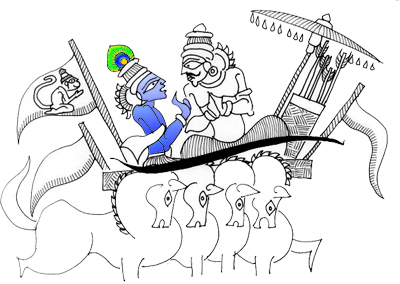
Actions driven by an eye for the results lead to the blood bath and sorrow, says Krishna to Arjuna. Politicians are doing it. Journalists are doing it. Fundamentalists are doing it. For the next few days, everyone will fight over the Gita. Everybody will read the news. But few will actually read the book.