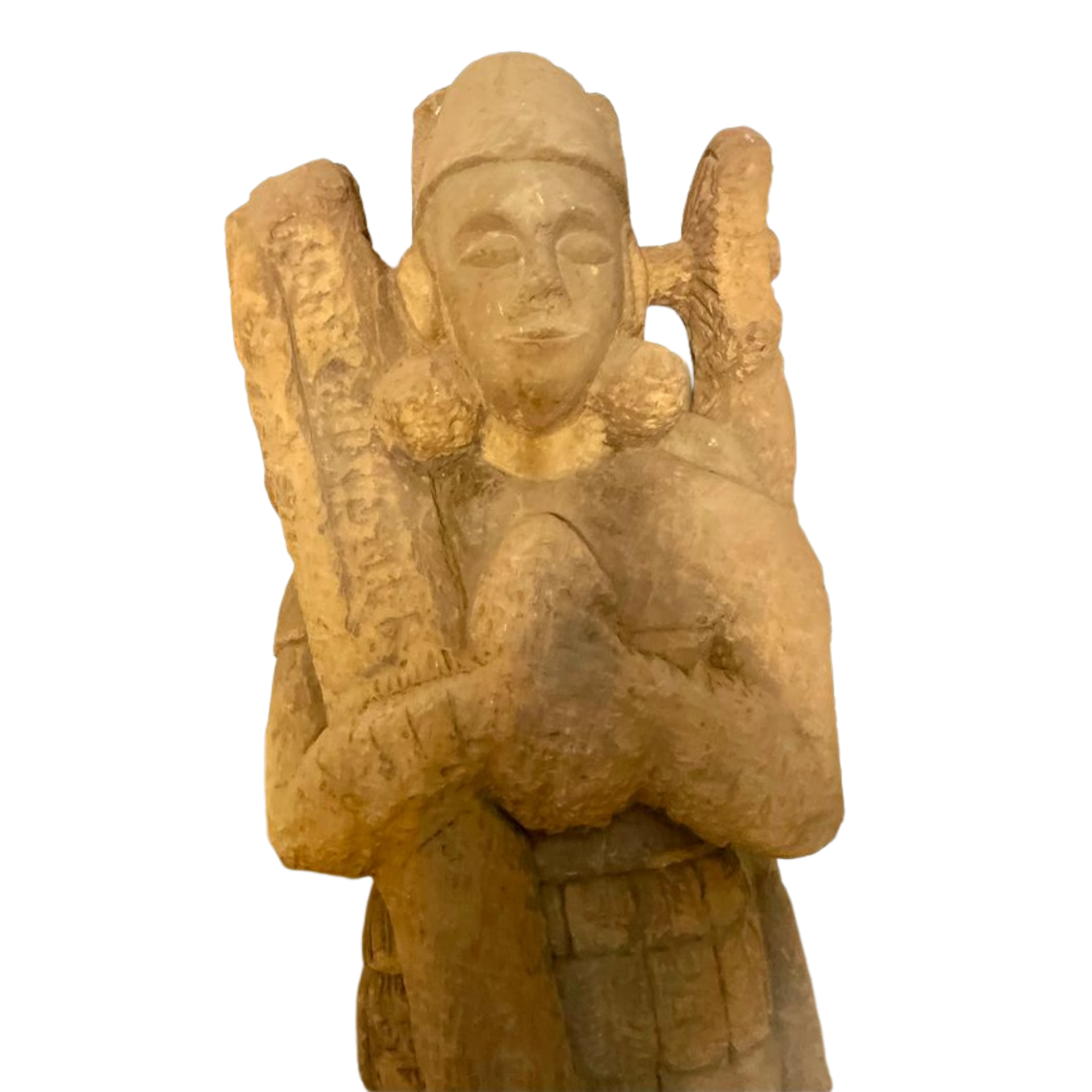
At Malhar, a small town near Bilaspur, Chhattisgarh, we find an image of a soldier with four arms, holding a conch shell, a wheel and a mace. It has been identified as the earliest image of Vishnu. The inscription on the stone has been dated to 200 BC. It records that the image was consecrated by Bharadvaja, the wife of Parnadatta, a governor of the Saurashtra region in the Gupta period. This makes it the earliest example of a woman donor in Indian art.
Malhar lay on an ancient trade route connecting Kaushambi to Puri, a corridor of commerce and culture. In all probability, this is not a Vishnu image. It is an image of Vasudeva-Krishna of the Mahabharata, who displays his four-armed form to Arjuna. The Malhar Vishnu, though simple and rather unremarkable, captures a transitional moment when the heroic Vasudeva was slowly turning into the divine Vishnu of the temples.
Until the identification of the Malhar Vasudeva, the oldest known images of Krishna were small Indo-Greek coins from Afghanistan, also dating to 200 BC, that show two men standing side by side. One holds a mace and a conch, the other a plough and a club. The Greek legends call them Sankarshana and Vasudeva, i.e., Balarama and Krishna. The foreign ‘Yavana’ kings, ruling from Afghanistan and Punjab, saw how popular the Indian hero-gods were and struck coins to honour them. Around the same time, inscriptions on the Heliodorus pillar in Madhya Pradesh (the 2nd century BCE sandstone column built by the Greek ambassador Heliodorus in honour of Vishnu) speak of devotion to Vasudeva-Krishna. This is where the journey begins — of the rise of Vishnu from Vasudeva, 2,200 years ago.
Lab of divine imagery
During the Kushan period, roughly 100 AD, India was a laboratory of divine imagery. Artisans experimented with multi-armed and multi-headed forms. Some made an eight-armed god striding across the sky. Others showed a being with a boar’s head or three bodies fused into one. These were not yet fixed ‘Vishnus’. They were experiments — attempts to make visible the divine energy that older Vedic hymns described abstractly as “the one who strides across the universe”.
By 200 AD, in the workshops of Mathura, artists carved Krishna fighting the horse-demon Keshin, or standing with his brother and sister. A few showed him with four arms, holding the discus and mace described in the Bhagavad Gita. There is an image that suggests the vishwarupa or cosmic form, with animal heads emerging from Krishna’s side. The artists were trying to capture something the poets had begun to imagine — the god who could appear as a man yet reveal himself as cosmic.
By the Gupta period, around 400 AD, this experimentation settled into a standard form: the calm, four-armed Vishnu with discus, conch, mace, and lotus. The cosmic god had a face and posture. The sculptor’s hand had finally caught up with the poet’s imagination. What had once been Krishna’s symbols now belonged to Vishnu. At Deogarh, in U.P., on the walls of the Dashavatara temple there is a four-armed Vishnu reclining on a serpent and another riding an eagle. These are images of Vishnu we are familiar with.
The cowherd hero
Texts supported this change. The Harivamsha, an epilogue to the Mahabharata written around this time, tells of the cowherd Krishna who later reveals himself as Vishnu. Krishna is a child; he has parents. Vishnu is self-created. Sculpture followed the same logic — the youthful, two-armed Krishna fighting demons and lifting mountains; the four-armed Vishnu presiding serenely over the universe. Krishna was the mortal finite avatar of the immortal infinite Vishnu.
Among Krishna’s many adventures, one image became especially popular. The lifting of Mount Govardhana. When Indra, the rain god, punished the cowherds with a storm, Krishna lifted the mountain on his little finger to shelter his people. In this act, Krishna grows to cosmic size, echoing the Vedic Vishnu who takes three giant steps across the world. This moment united the hero of Vrindavan with the god of the Vedas.
The story of Krishna lifting the mountain travelled to the eastern coast of India and thence to Cambodia. Around 700 AD, at Mahabalipuram in Tamil Nadu, artists carved a vast relief on a granite cliff showing Krishna raising Govardhana. This art panel also has the earliest images of cows and calves in India. Before that, we have only images of the humped bull. This stone panel is the earliest suggestion of the cosmic ‘cow’ heaven known as Go-loka.
Art historians are now showing how Vishnu emerged from the hero Vasudeva and not the other way around. From small Indo-Greek coins and modest Malhar and Mathura carvings to grand cliffs of Mahabalipuram, we can trace how a cowherd hero of the Mahabharata became the cosmic preserver of the Puranas.