Dharampal’s book, The Beautiful Tree: Indigenous Indian Education in the Eighteenth Century (1983), is a groundbreaking historical work that used official British colonial archives to challenge the narrative that pre-colonial India was uneducated.
It sought to prove that 18th-century India possessed a widespread, highly inclusive, and decentralised indigenous education system before British policies systematically dismantled it. However, this claim was highly exaggerated.
British administrators, such as William Adam and Thomas Munro, did observe the existence of many village schools, temple schools, gurukuls, maktabs, madrasas, and merchant training centers across India. However, these educational institutions were in spirit very different from the modern education system we know today.
Nature of India’s pre-colonial education system
Yet, it is important to recognise that pre-colonial India did possess many forms of education. India had traditions of learning in grammar, philosophy, mathematics, astronomy, medicine, poetry, commerce, and ritual studies. Temples, monasteries, courts, merchant communities, and village teachers all played a role in preserving and transmitting knowledge. In many places, children learned arithmetic, accounting, and practical skills needed for agriculture and trade.
The modern social media version of this argument often exaggerates the nature of this educational system. The existence of many schools does not automatically mean there was universal education in the modern sense. Most institutions were small, local, and dependent on patronage. Many schools taught only basic literacy or occupational skills to a limited number of students.
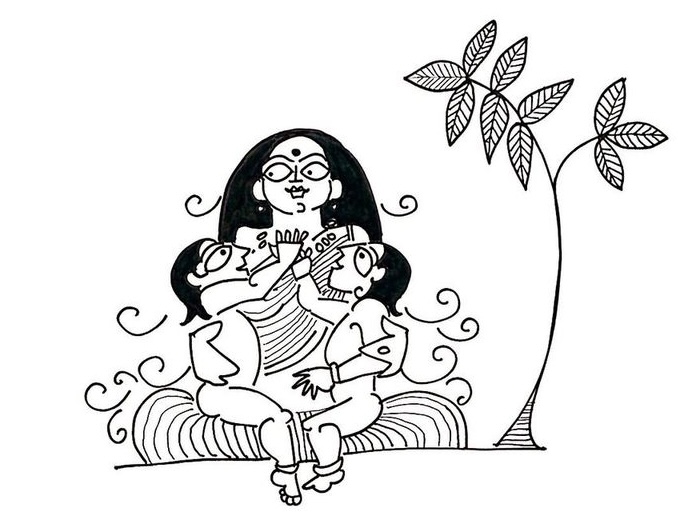
Pre-modern Indian society was organised through caste and hereditary occupations rather than through the modern idea of equal citizenship. Knowledge was distributed according to social roles. Brahmins specialised in ritual and textual learning. Merchants trained children in commerce and bookkeeping. Artisans transmitted technical skills through families and apprenticeships. Agricultural knowledge was passed through household labour. Much education, therefore, happened outside formal schools.
Social media discussions often confuse hereditary skill transmission with mass public education. A blacksmith teaching metallurgy to his son or a priest teaching memorisation to disciples represented an important knowledge system, but it was not the same as a universal schooling system open equally to all people.
Castes, occupation determine access to learning
Access to education was unequal. Colonial surveys themselves showed that students often came mainly from dominant castes, merchant communities, scribal groups, and Brahmins. Some lower caste communities did attend village schools, especially in commercially active regions, but access remained uneven. Women’s education was also limited in most regions, though there were exceptions.
Colonial writers themselves misunderstood Indian education because they looked mainly for centralised institutions similar to European state schools. Since Indian learning was decentralised and embedded within caste and occupational networks, colonial observers often underestimated its complexity and spread.
Nationalist writers later reacted against colonial stereotypes and tried to show that India had a rich educational tradition before British rule. This correction was important because colonial narratives often portrayed Indians as ignorant or uncivilised. However, some nationalist arguments went too far in presenting pre-colonial India as having a nearly universal and egalitarian school system.
Between colonial stereotypes and modern claims
British rule did weaken many older institutions. Revenue policies disrupted temple economies and local patronage networks that supported teachers and scholars. Persian education declined after English became dominant in administration. Colonial education created new elites trained in English law and bureaucracy. In this sense, many indigenous systems lost support and prestige under colonial rule.
The British also introduced a different model of education based on centralised administration, examinations, certification, and the modern idea of mass literacy. This system had its own inequalities, but it differed fundamentally from older caste-based systems of knowledge transmission.
The historical reality lies between two extremes. Colonial stereotypes that India lacked education were incorrect. But modern social media claims that India had a universal public school system before the British are also misleading. Pre-colonial India had a dense and sophisticated ecosystem of learning traditions, but these traditions were deeply shaped by caste hierarchy, occupation, gender, and local patronage rather than by the modern ideal of equal public education for all.