Published in First City, New Delhi, March 2008.
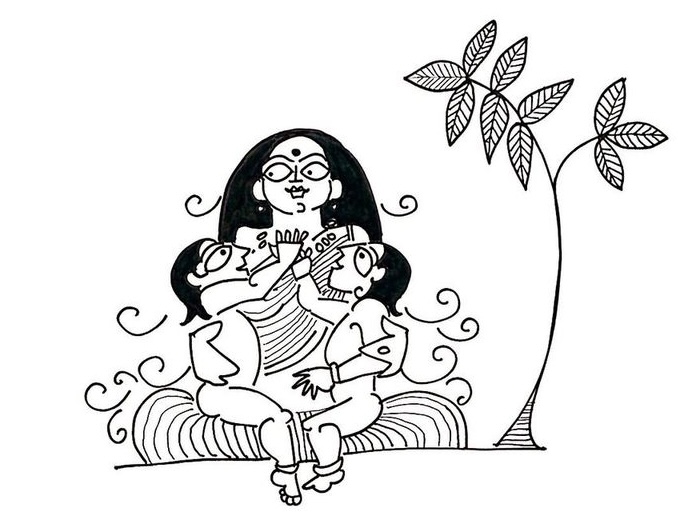
Five thousand years ago, the kingdoms of Sumeria and Akkad flourished in the land once called Mesopotamia, the land between the two rivers, and now called Iraq. Inanna was the Sumerian goddess of sexual love, fertility, and warfare. The Akkadians called her Ishtar.
According to one story, Inanna tricked the ‘Mes’ (pronounced “mays”) from the father-god Enki who was worshipped in the city of Eridu. The ‘Mes’ represented everything from ‘truth’, to weaving, to prostitution. Inanna traveled to Enki’s city Eridu, and by getting him drunk got him to give her hundreds of Mes that she took to her city of Uruk. Enki, sobering up, sent mighty Abgallu (sea monsters) to stop her boat as it sailed the Euphrates to retrieve his gifts, but she gave him the slip. This story may represent the historic transfer of power from Eridu to Uruk.
Most curious is perhaps the story of Inanna’s descent to the underworld. In Sumer the Underworld was a dreary, dark place; a home to deceased heroes and ordinary people alike. Based on their behavior they could be afforded better treatment or positions in the underworld.
Inanna’s reason for visiting the underworld is unclear. The reason she gives to the gatekeeper of the underworld is that she wants to attend her brother-in-law Gud-gal-ana’s funeral rites. However, this may be a ruse; Inanna may have been intending to conquer the underworld. Ereshkigal, queen of the underworld and Inanna’s sister, may have suspected this, which could explain her treatment of Inanna. Before she left, Inanna instructed her minister Ninshubur to plead with the gods Enlil, Nanna, and Enki to save her if anything went wrong. Inanna dressed elaborately for the visit. Her garments, unsuitable for a funeral, along with Inanna’s haughty behavior made the queen of the Underworld suspicious. Following Ereshkigal’s instructions, the gatekeeper told Inanna she could enter the first gate of the underworld, but she had to hand over her lapis lazuli measuring rod. She asked why and was told ‘It is just the ways of the Underworld’. She obliged and passed through. Inanna passed through a total of seven gates, each time removing a piece of clothing or jewelry she had been wearing at the start of her journey. When she arrived in front of her sister she was stark naked. Vulnerable, Ereshkigal turned Inanna a corpse and hung her on a hook.
Ereshkigal’s hate for Inanna could be inferred through other myths. Ereshkigal cannot leave her kingdom of the Underworld to join the other ‘living’ Gods and they can not visit her in the Underworld or else they can never return. Inanna symbolized sex and fertility and was the polar opposite of her sister.
Three days and three nights passed and Ninshubur following instructions went to Enlil, Nanna, and Enki’s temples and demanded they save the Goddess of Love. The first two gods refused saying it was her own mess but Enki was deeply troubled and agreed to help. He created two sexless figures (neither male nor female) named gala-tura and the kur-jara. He instructed they were to appease Ereshkigal and when asked what they wanted they were to ask for Inanna’s corpse and sprinkle it with the food and water of life.
Things went as Enki said and the gala-tura and the kur-jara were able to revive Inanna. Demons of Ereshkigal’s followed Inanna out of the underworld and demanded she wasn’t free to go until someone took her place. They first came upon Ninshubur and asked to take her place. Inanna refused saying she had helped her as she had asked. They next came upon Cara, Inanna’s beautician, still in mourning. The demons said they would take him but Inanna refused for he had been there for her. They next came upon Lulal also in mourning. The demons offered to take him but Inanna refused. They next came upon Dumuzi, Inanna’s husband. He was sitting in nice clothing and enjoying himself despite his wife supposedly still being missing in the underworld. Inanna wasn’t happy and said the demons could take him. Dumuzi tried to escape his fate but a fly told Inanna and the demons where he was. It was then decreed that Dumuzi spent half the year in the underworld and his sister take the other half.
A popular interpretation is that she may have been associated with the vegetation god, Dumuzi. Inanna symbolized life, love, and fertility. When she went to the underworld the crops ceased to grow and the animals ceased to procreate. Her death was similar to ‘winter’ when the crops had not grown yet. They were in essence ‘dead’. Some scholars suggest that the 2 creatures Enki sent to free her symbolized ‘water’ and ‘fertilizer’ as to revive the plants and make them grow again. With Inanna’s rebirth the crops began to grow and live.
The Inanna and Dumuzi story prefigures those of Cybele and Attis (Anatolia), of Aphrodite and Adonis (Greece), of Demeter and Persephone (Greek), of Hadad and Anat (Persia), of Osiris and Isis (Egypt) – all of them tales of a young god or goddess who dies, and a mother or spouse goddess who mourns him.
While the mythology concerning Inanna’s marriage to Dumuzi shows the sensual side of this cosmic force, she is often a terrifying goddess full of wrath and vengeance. Those who dare to reject her are destroyed. The Meopotamian hero, Gilgamesh, experiences her wrath after he rejects her advances and humiliates her, calling her, among other insulting things, a “shoe that mangles its owner’s foot”. She leaves one to die when she is tired of him, changes the gardener into a toad, turned the shepherd into a wolf. “Your price is too high,” Gilgamesh says hoping to avoid a similar fate, only to pay later for his rejection with the death of his soul mate, Enkidu. Even Dumuzi feels her wrath when he is ‘elected’ to take her place in the underworld.
It is said that this goddess of love and war would drag young men out of the taverns to have sex with them. Thus despite her association with mating and fertility of humans and animals and plants, Inanna was not a gentle and loving mother goddess, and she was rarely associated with childbirth. She was typically associated with rain, storms and the planet Venus. She was the raw power of nature, both desired and feared.