When the Mughals were ruling North India (1600-1800), the Nayaka (Telugu) rulers of Peninsular South India (Tamil and Kannada speaking regions) gave us a literary tradition far more radical than we usually give it credit for: a space where women could want, speak, and write their desires—boldly, unapologetically, erotically.
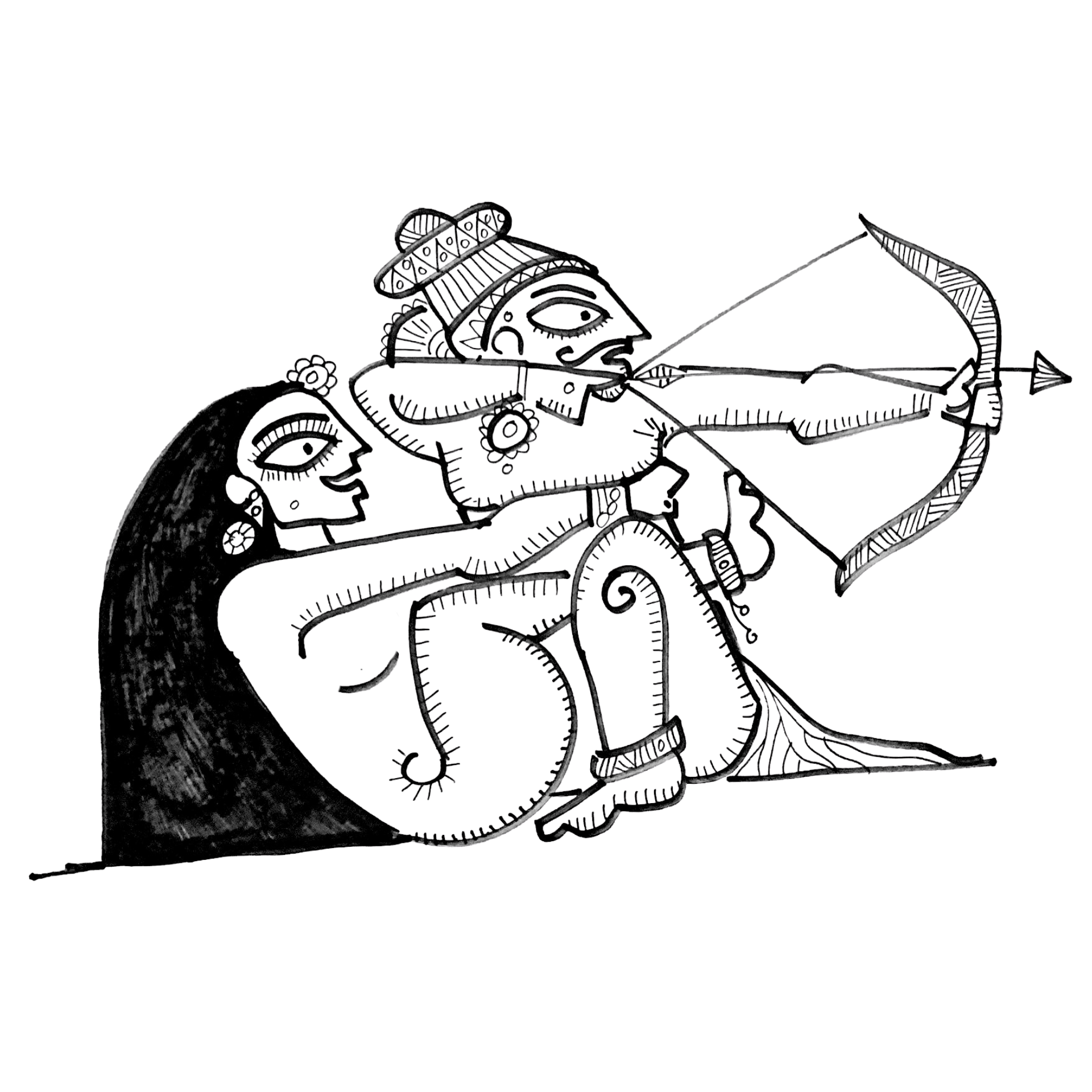
This isn’t the India of sanitised mythologies or prudish moralists. This is the India of Muddapalini’s Radha, pacing outside a bedroom while Krishna makes love to another woman—a woman she herself trained in the arts of pleasure. And it’s the India of Ahalya, not trapped in stone for infidelity, but aching for intimacy and encouraged by a female friend to go after it. It’s the India of Tara (wife of Rishi Brihaspati) caught in a scandalous extra-marital affair with Shashanka or Chandra (moon-god), not punished but praised in poetry dripping with erotic detail.
We were never a culture of shame. We were made into one. Not just by the British. But also by their Brahmin collaborators. Both found common cause in attacking powerful rich independent Hindu women, the women who gave India its musical and dance heritage.
Social media is full of ‘historians’ mourning the sack of Vijayanagara in 1565 by Deccani Muslim sultans. But few talk about the Nayaka chiefs who stepped into the vacuum and who are responsible for nearly two-thirds (60-70 per cent) of the 600 major gopurams (gateways) we see in the region. We assume the gopurams were built by the Cholas or the Pandyas, but most of them were built, restored and expanded only after 1600 AD by these Nayakas who were not Kshatriyas, but Shudras.
As per Brahmin lore, the classical four-fold caste structure (chatur-varna dharma) existed only in Arya-varta (Yamuna-Ganga doab). It did not exist south of the Vindhyas. Caste was introduced by migration of mythical sages such as Agastya. When Parashuram came South, he gave land to Brahmins. He got the Shudras to work on the land. The right-handed castes were the land-owning ‘jati’ and the left-handed caste were the traders and service-providing ‘jati’. Thus in the South, the caste layers are different. Not the Brahmin, Kshatriya, Vaishya, Shudra and Chandala, but Brahmin, right-hand Shudra, left-hand Shudra, and Chandala.
The Nayakas came from the so-called left-hand groups, traders, merchants, mercantile-entrepreneurs and adventurers (variously known as Balija, Kapu, Telaga, Gavarai, Setty, Naidu, among others). They were very different from Yadavas, Kakatiyas and Hoyasalas who were herdsmen. These new Nayaka rulers did not descend from gods—but they became gods, using the power of cash. This was an ecosystem that valued mobile assets (varaha coins, food charity) far more than fixed assets (land-grants). Naturally, the king and trader and courtesan were more powerful than landed peasants and temple-managing Brahmins. This was the age when legends were told of Raja Vikramaditya, celebrated not because he fought wars, but because he was an intrepid adventurer, generous investor and a sound judge.
This was the age of a group of women, we now refer to as courtesans for want of a better word, who composed songs about desire free from the fetters of law and custom. These women were hospitality service providers, who were not obliged to marry, who traded their music and dancing and poetry and erotic skills for gold, and whose wealth was transmitted through daughters, not sons. To have the love of a courtesan indicated two things: you were rich and you were refined in artistic tastes. These women, and their patrons, created a whole new erotic sensibility in Telugu poetry. Later, in British times, they were mocked as temple prostitutes.
The most striking part of the Nayaka literary landscape was the way mythologies were reclaimed and retold. Stories once served as cautionary tales about women’s sexuality—Ahalya seduced by Indra, Tara cheating on her husband with Chandra, Radha caught in jealous longing. These were reimagined as privileging women’s desires.
In the Ahalya-Indra retelling, Ahalya isn’t fooled by Indra. Her friend, a nun, urges her to pursue her desire. In the Tara-Chandra retelling, Tara is not chastised for cheating her husband. It is Tara’s unborn child who is cursed for revealing that he is Chandra’s son by blood and Brihaspati’s son by law. And the courtesan-poet, Muddapalini, who authored Radhika Santvanam, goes even further. She writes a full-blown erotic manual disguised as a love triangle. Radha teaches Ila—Krishna’s bride—how to sexually satisfy him. Her work was banned by later Brahmins.
These erotic works were, in British times, proclaimed to be vulgar. These were symptoms of Hindu decadence (as per right wing) and exploitation (as per left wing). This is what led to India’s conquest by Yavanas (Muslims) and Hunas (Europeans), as per Satvik puritans. Brahmins who claim to have perfect knowledge of India’s actual past have now imposed an unspoken ban on these works in school and university textbooks. They refuse to explain why Adi Shankara, who wrote on Vedanta philosophy, also wrote an erotic work called Amaru-shataka, a century after the birth of Islam in Arabia.