Mythologist | Author | Speaker | Illustrator

-
Articles
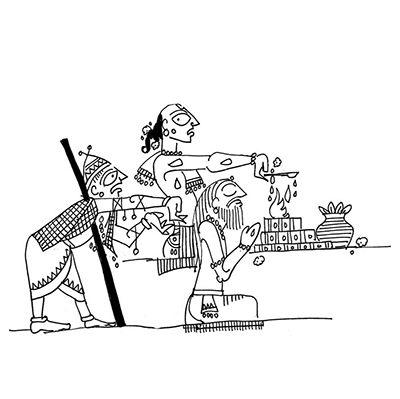
Yagna or Puja
Vedic yagna is conventionally translated as ‘sacrifice’ and Puranic puja is translated as ‘worship’. This translation is the basic problem…
-
Articles

Global misogyny
One finds misogyny in some form or the other in every religion, if one is looking for it. One will find respect for women too, in every religion, if one is looking for it…
-
Articles

How technology has turned the State into an all-powerful God
The only difference between Abrahamic religions and nation-state structure is that God is a supernatural entity established by faith in the former, while the state is an artificial structure established through reason in the latter…
-
Articles

How Call me By Your Name reclaims Eden for gay people everywhere
Luca Guadagnino’s Oscar-nominated Call Me By Your Name, with brilliant use of narrative, visuals and music…
-
Articles

Demon Poets
It is fascinating to learn that until the Mughals painted Hindu mythology on orders of Akbar in the 16th century, demons of Puranas were never shown as having dark complexion…
-
Articles

Who is a Hindu? Diversity unites, homogeneity divides
Unlike Westerners, Hindus have been comfortable seeing unity in diversity for thousands of years…
-
Articles

Is Hinduism feminist or patriarchal?
In Hinduism, God is not a judge and so feminism is not about judging men…
-
Articles
Evolution of the Devil
From the 16th century onwards, the Devil appeared as a goat-like creature. Those who opposed God were called Devil-worshippers… The Hindu idea of hell also evolved over time…
-
Articles

Hinduism thrives on diversity, Hindutva on monotheism of Abrahamic faiths
In nature, there is diversity. There is also equality in the sense that no creature is nature’s favourite. Every living organism has to fight for its survival using its strengths and overcoming its weaknesses to find opportunities and fend off threats. The cultural idea of equality is very different: it is the myth that shapes…
-
Articles

Who is a Hindu? No false gods in Hinduism
Secular media would like to reduce Hindutva attacks on missionaries into a simple villain-victim narrative, but those interested in going deeper will realise it has much to do with the incompatibility of their respective mythologies…
-
Articles
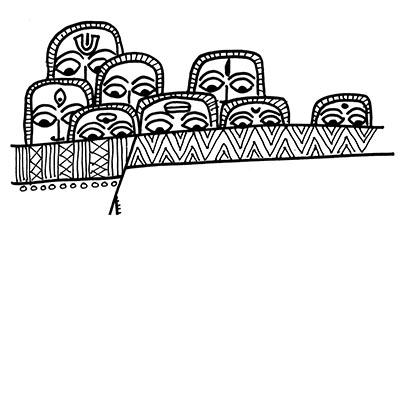
Don’t Blame The God Particle
Nature was self-sufficient. It contained both platitude and violence. Humans begat God as a symbol, to derive meaning, to forge identity. Not God’s fault…
-
Articles

Why do Hindus worship idols?
Why not? Who said how a Hindu or any human is supposed to worship the divine? Who made these rules?…
-
Articles
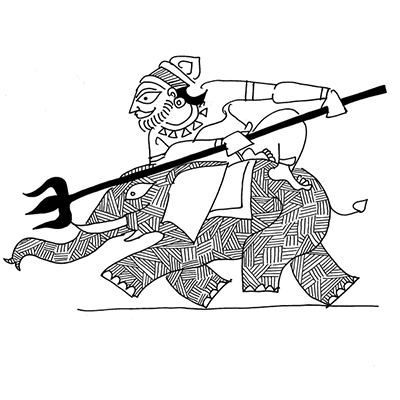
A Hinduism before Bhakti
A thousand years ago, India was very different from what it is today. North India had yet to face significant conquest by Muslim warlords from Central Asia…
-
Articles

The Peacock Angel of the Yazidis
To the north of Iraq live the people known as Yazidis, roughly half a million in number, who have been mercilessly hunted down by the rabid hordes of the Islamic State (ISIS) on grounds that they are Devil-worshippers…