Published in Devlok, Sunday Midday on Sept 09, 2012.
All female models on television commercials are widows ! This was a remark made by a friend. Her argument was that none of them wore a bindi, which is the indicator of marital status in most communities of India.
I ,then observed the two worlds on TV: the bindi-less world of advertising and the bindi-full world of television serials. Everything from direct-to-home cable services to cosmetics to electronics to food items to paint is being sold by (allegedly) modern young women, who look the same, in pastel colored western outfits that has become the uniform of the young cool generation who do not like bindis. Then there is the world of TV soaps where every woman is (allegedly) traditional because she wears colorful clothes full of bling with jewelry and bright cosmetics and creative bindis and red color that spreads less in the parting of the hair and tends to spill more on the forehead. Both are catering to Indian consumers. Are they talking to different worlds: advertising for modern India 1 and serials for traditional India 2 (Bharat)? Who is getting the communication right? I am confused.
Is bindi a cultural symbol or a secular or a religious symbol? Does expectation to wear it mean one is a Right-wing fundamentalist? Does market research reveal that most Indian women, at home, do not wear bindi? Where is this decision of cultural erasure coming from?
No one really knows the origin of the bindi. One can only speculate. Even this is difficult as the marks on the forehead have many regional variations. Painting sacred marks on the forehead was perhaps an ancient ritual way to draw attention to that the one thing that separates humans from animals — the faculty of imagination that springs from the human brain located behind the forehead. Some say this marks the third eye, the uniquely human ability to discriminate and analyze and understand the world.
Red color of vermillion represented potential of the mind. It represented the earth, blood of the hunted animal or the fallen enemy, as well as menstrual fluid. In case of women, a dot (bindu) was put in the center of the forehead. In case of men, the dot was stretched upwards to create the tilak. In case of women especially in North and East India, the red color was sometimes put in the parting of the hair to indicate post-marital status. When stretched horizontally, it was used to indicate sacrifice.
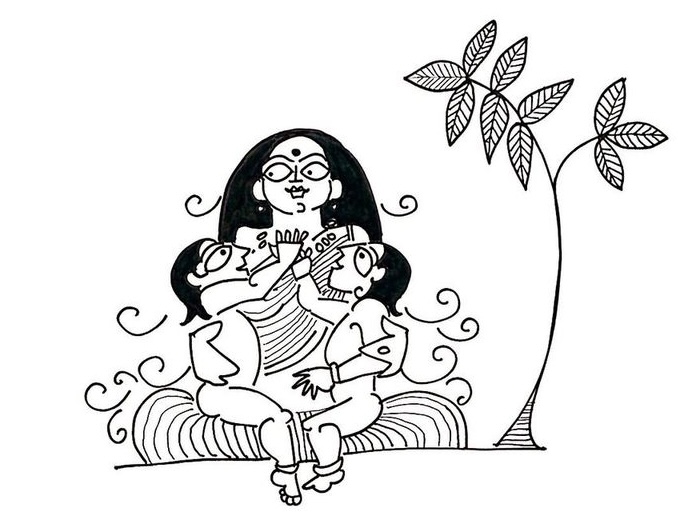
At some point, bindi came to be associated with femininity in many communities of India, to be worn by women after marriage and to be wiped away following widowhood. Since there was no such symbol in men to indicate their marital status, bindi naturally came to be viewed as a patriarchal imposition. Some women used large bindis to reaffirm their ethnicity and Indianness; I remember one fashion designer calling these ‘bullet-hole’ bindis. In USA, there was a hate group called ‘dot-busters’ in the mid-8Os that targeted South Asians. Now that the dots are disappearing, thanks to modernity, I guess we have nothing to fear any more.