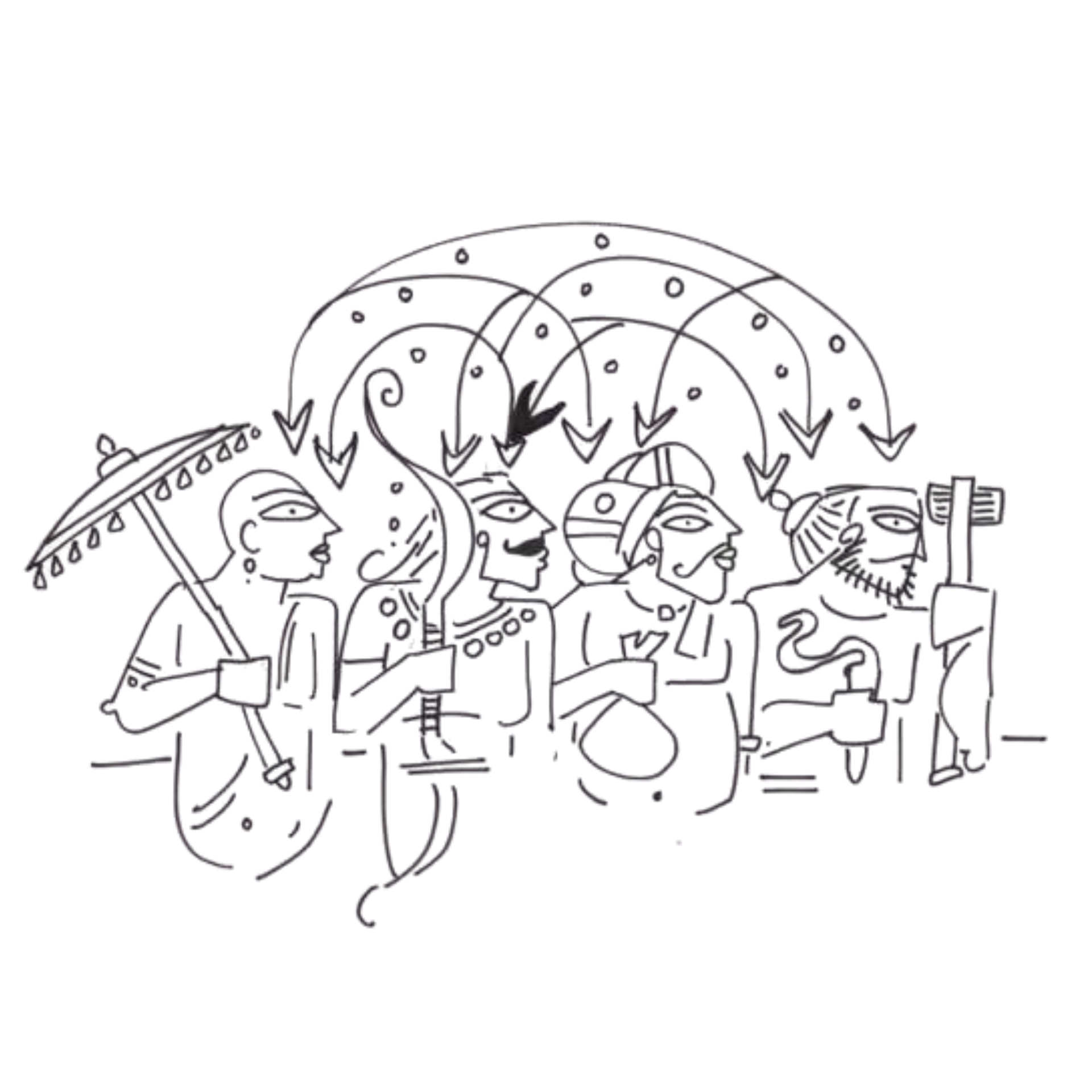
As Chandrayaan-3 lands on the moon, it just so happens that the name of the current Chief Justice of India, D Y Chandrachud, means “on whose brow the moon takes refuge” – a title for Shiva.
The story goes that a long time ago, the moon was cursed with a wasting disease because he favoured only one of his many wives, the 27 lunar mansions (nakshatra). As per another tale, this happened because he dared elope with Tara (star), wife of Brihaspati (Jupiter). In either case, he began to wane. Fearing he would disappear forever he ran to the gods for help. They told him to worship Shiva. Why Shiva? Because from Shiva springs the Ganga which has the power to help the dead be reborn. If Shiva can give the dead another chance at life, he surely can resurrect the waning moon.
Shiva appeared before Chandra at the site we now call Somnath, on the shores of Gujarat, and placed the moon-god on his hair-knot, helping him wax again. Soma is the Vedic herb of regeneration. Shiva is identified with it. In time, the moon itself came to be known as Soma, for it regenerates, and reminds all of us that what wanes eventually waxes, what crumbles eventually resurrects, what collapses eventually rises. Be it temples. Be it democracy. Be it civil society.
As per legend, Chhatrapati Shivaji Maharaj who established the Maratha empire, defying Mughal might in the 17th century, wore the mark of the moon on his forehead. It is called “chandra-kor”, or the lunar crescent. It was meant to inspire people never to give up on the idea of freedom (swarajya), to remind all that after the dark night of the new moon, the waxing begins, and we make our way towards the full moon. The brave warrior men and women of Maharashtra have since chosen the dynamic chandra-kor of their king over the traditional dormant bindi.
For many, the crescent moon is the symbol of Islam because it appears on the flags of Pakistan and Turkey. It is actually the symbol of the Ottoman Empire that controlled much of Eastern Europe and West Asia. It started being used only in the 15th century, after the conquest of Byzantium, when the founder Osman had a dream of a crescent moon stretching from one horizon to another, marking the extent of the empire he would rule. Since the Ottoman Sultan was deemed Caliph for nearly four centuries, his symbol became the symbol of the Islamic world.
The connection of the moon with royalty is an ancient one. Chandragupta, the founder of the Mauryan empire, was so named because as per Jain lore, his mother yearned to drink moon water. Chanakya gave it to her by pouring water such that it was illuminated by moonlight.
As per Hindu lore, India always had two lines of kings, those who descended from the sun, Surya-vamsa, and those who descended from the moon, Soma-vamsa. Ramayan is the story of kings of the solar dynasty while Mahabharat is the story of kings of the lunar dynasty. Most kings of India trace their lineage to one or the other. Yadava kings of Deccan traced their descent to the moon-god.
Many wonder why Ram, who belongs to the solar dynasty, is called Ram-chandra. Why does he have a moon in his name? The popular story is that he loved the moon so much that he would not sleep until his mother showed him the reflection of the moon in a pot of water, placed next to his bed. He saw the moon as his mother’s brother, which is why like Ram, even today, we refer to the moon as Chanda-mama, the beloved maternal uncle, who comes to his sister’s house regularly but always leaves. A taxi driver in Jaipur once offered me a different explanation. He said since Ram abandoned his wife, Sita, his royal reputation was eclipsed by the moon, and so his name always has the moon in it.
Etymologists say that the word we use for moon today, maas, comes not from Indo-Aryans but from local Munda tribes. The Aryan men married local tribal women and so Vedic vocabulary was a mixture of sounds, words and grammar, some coming from the father and some from the mother. The Munda mothers referred to the moon as maa. A cycle of the moon gives rise to a month (maas). Full moon then became poorna-maa. New moon became a-maa.
In art, the moon-god is imagined riding a chariot pulled by either deer, or geese. He holds a rabbit (shasha) in his hands, which is why he is called Shashank. This is no ordinary rabbit. It is the Buddha, in one of his former lives. As per the Jataka, this rabbit threw himself in a fire to provide food for a starving man, impressing the gods in the sky, who gave him a permanent residence on the moon.
All these stories constitute the cultural truth of India. But now India has embarked on a scientific truth with a satellite, aptly named Chandrayaan (moon-vehicle) that has landed on the surface of the moon. Both these truths will mould our Indianness, make us proud, and hopefully wise.