First Published in First City, Delhi, May issue.
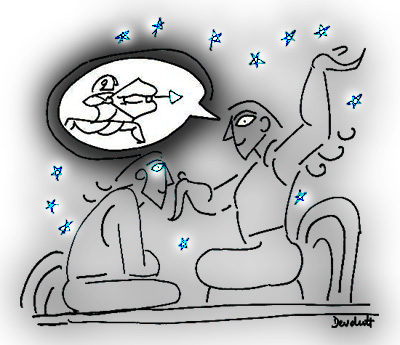
Storytelling is something that is very natural to human beings; we are constantly telling stories. Imagine a child coming home from school and telling his mother what happened in school. What is he actually doing? He is telling a story of what happened in school, of how the teacher behaved, of how the students behaved and as he narrates the story, villains appear, heroes appears, there is a plot and sometimes,even,a grand finale, where the good win and the bad are punished. The same happens when we pick up the phone for a chat. We want to tell a story or hear a story. We are all storytellers. We just don’t realize it.
What is gossip, if not storytelling? — some fact, some fiction, a lot of imagination. Newspapers are full of stories — events as seen by the reporter. Books are full of stories of plants and animals and planets. Shops are full of stories of products and brands and customers and advertising.
Usually, the word story is used for fiction. We assume that when we narrate events of our life it is fact, not fiction. When we read about events in newspapers, we assume they are fact, hence not stories. Story in common parlance then is the opposite of reality.
At a philosophical level, however, all that is narrated is story. What we call reality is actually memory of an event seen filtered through our senses and our biases. At best, it is just a perception of what happened, one version of the truth; at worst, it is entirely the product of imagination. Once we understand this and accept this, we realize the power of storytelling. We realize everything around us is a story — everything that we hear, see or remember stems either from perception or imagination.
Those who actually write a story are perhaps better storytellers than the rest of us because their stories appeal to a larger number of people, not one or two as in a private conversation. They can enchant an audience, maybe an entire society, or a culture, or an entire generation, or maybe even several cultures over several generations.
It is very difficult to understand what makes any story special. Stories are like sweets that have an outer layer of toffee and a soft inner core of chocolate. As we eat this sweet, we first encounter the outer toffee. We chew on it, impatient to get to the chocolate within. The outer chewy part is the ‘form’ of the narrative and the inner chocolate core is the ‘idea’ of the narrative; the outer visible part is the flesh of the story (the plot, the characters, the tone, the pace) while the inner hidden part is the soul (the meaning).
The soul of a story is the reason why the story is being told. The soul can be just entertainment. All the storyteller wants to do is stir an adrenaline rush in you. In Sanskrit, adrenaline is known as rasa or mood-juice. The storyteller is actually evoking the release of various kind of juices in his audience — there is shingar-rasa, to elicit flow of romantic juices in the audience and there is veer-rasa, where again through a series of stories, an event or actors the storyteller is able to construct a heroic flavor in the mind of the audience. This is pure entertainment and there is no deeper level beyond that.
Sometimes, a story is just a report, with no desire to entertain. The storyteller here tries to be very dispassionate so as not to influence the judgment of the audience. Reportage is not easy because as humans we are quick to judge. The moment a storyteller talks about a fat woman, the audience instantly creates an image of a fat person in their head and if the audience does not like a fat person, then, even without a storyteller’s intention, the fat woman becomes a negative character. If a storyteller describes a child as cute and cuddly then by the simple choice of words the image created in the audience’s mind is something that delights. So it is very difficult to report without being judgmental. Journalists struggle to be unbiased but invariably succumb to judgment; even if they don’t, the audience does, seeing meaning even where none exists.
Then there are stories with a clear strategic intent. It tells people what is good and what is bad. If the storyteller has a yardstick for deciding what is good and what is bad, then heroes and villains are accordingly structured. When this is repeatedly done, then it starts to influence the value system of those around. For example, if a storyteller believes that women are inferior to men then their stories will be full of female characters who are cunning, and manipulative and the male characters have to constantly survive their cunningness. Likewise if a storyteller believes that women are victims then their stories will be full of female characters who are subjected to all forms of injustice. Storytellers then become creators of values and judgments, a feat that is rarely acknowledged.
Stories thus construct our truths — they tell us how to see the world. They construct villains and heroes. They tell us what romance is and how it feels when one is in love. It tells us how to behave when one is happy or unhappy. It tells us what good behavior is and what bad behavior is. Stories thus are and have always been a potent tool for political and cultural propaganda.
Parables are stories which very explicitly have a point of view. They sermonize. Parables all over the world are based on what a culture believes to be appropriate social conduct. On that count, a parable must be distinguished from a mythological narrative. Mythological narratives do not sermonize — but they create the platform or framework that allows for sermonizing. While a parable can stand on its own, every mythological story is part of a larger whole. And so to understand a mythological story, we have to know all the other stories that make up pieces of the jigsaw puzzle. Unlike parables, mythological stories are not focused on social issues — they seek to construct a bigger picture about the world. It attempts to explain why the world is the way it is, why did the world come into being, what happens after we die. Typically mythological narratives offer no solution but create a framework for other stories, parables included, which is why they play a rather profound role in any literature.
Traditional western stories typically have a clear start and a clear finish. So the story typically begins with “Once upon a time” and ends with “Happily ever after”. But traditional Indian stories are rather different in structure. Take “Vetal-Pachisi” for example. Vetal-Pachisi is a story of a king who repeatedly goes to a tree and pulls down a vampire with the intent to give him to a sorcerer. On the way, the vampire tells the king a story which ends with a question and he forces the king to answer the question. As soon as the answer is blurted out the vampire runs away from the king and returns to the tree. The king returns to the tree and has to pull the vampire down again. This happens 25 times. Thus, the story always starts at the same point, with pulling down the vampire and ends at the same point by return of the vampire. The plot lies in between. The difference in structure of stories reflect the differences in cultural beliefs. The Western story celebrates a linear construct of life — with one beginning, one ending and one life in between. The Indian story celebrates a cyclical construct of life — with many beginnings, many endings and many lives in between. Thus stories reflect the culture they emerge from, while reinforcing the culture at the same time.
Finally, stories have to be distinguished from narration. A story is basically a plot but narration is the process by which a story is told. The same story sounds different when the storyteller is different. And every storyteller changes his narration depending on the audience. All this makes storytelling rather complex, which is why our view of the world and our truths are also complex.