
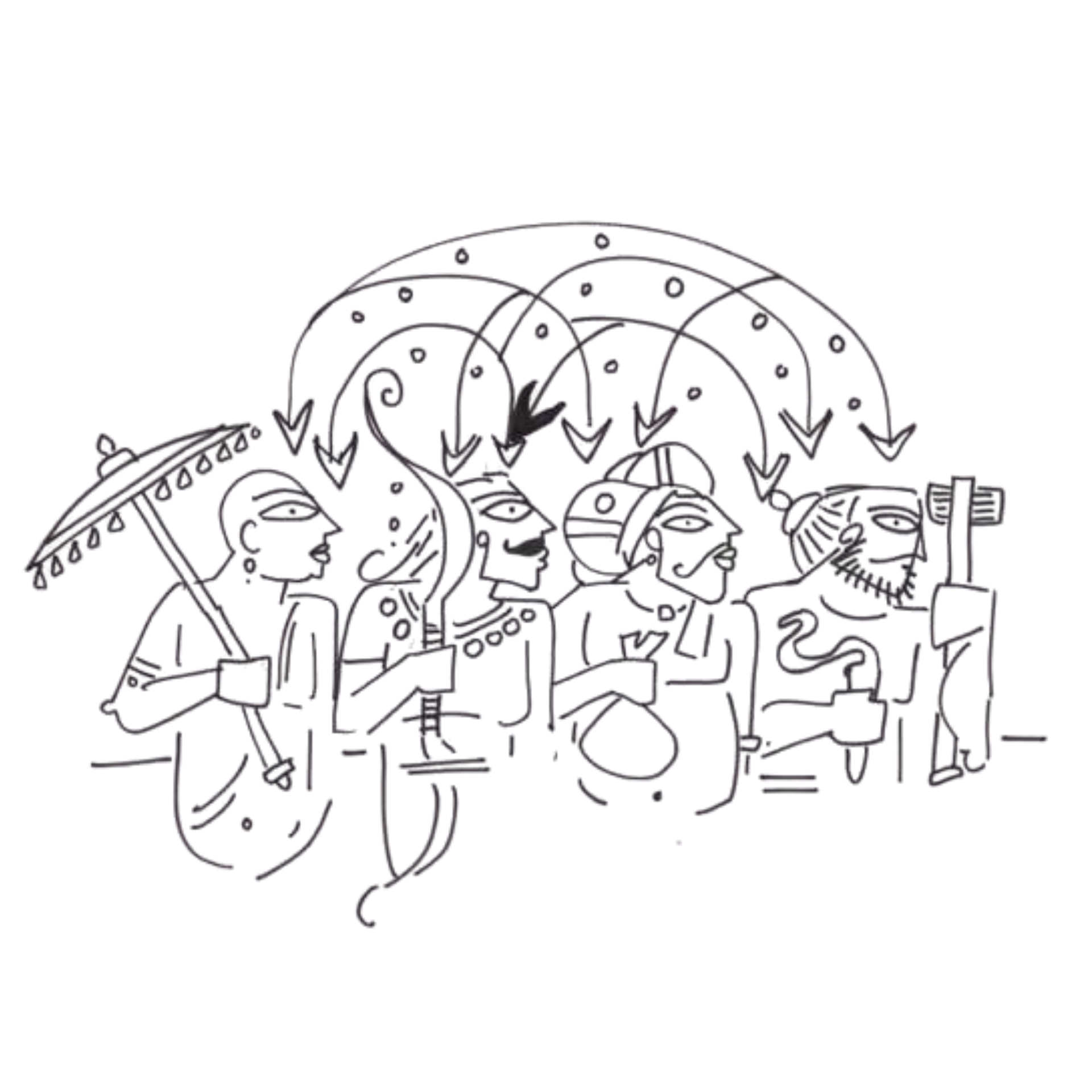
For over 2,000 years, the Brahmin was assured of his profession as a bureaucrat in the king’s court. The entire system was based on his framework, his rules, his language. His son and nephews inherited his role, no matter who was king. The jati-varna system ensured it. When the Muslim kings came 800 years ago, only the court language changed to Persian. On the ground, everything remained the same. The Brahmin was in charge of administrative affairs. But then came Macaulay, and everything collapsed.
Education changed. Language changed. Systems changed. And most importantly the hegemony was gone. Meritocracy was introduced—provided you studied English and were rich enough to travel to London for the civil services exam. It’s a wound that still has not healed. It was made worse when reservations returned post Independence favouring those the Brahmin once considered ‘untouchable’. Modern India is repeatedly told that Macaulay destroyed a glorious Indian education system.
But the older system that existed before the 19th century was not a universal structure meant for all Indians or even Hindus. It was a patchwork of local institutions aligned to elite groups. They were controlled by hereditary scribes, priests, and court scholars who monopolised state paperwork, temple accounts, land records, and legal interpretation. It was a caste-linked and lineage-linked system that gave predictable employment to specific communities.
Into this world entered Macaulay. He despised all things Hindu or Indian. His ideas were shaped by the needs of the British Empire. But his reforms disrupted a very old monopoly. By insisting on English as the administrative language and pushing for recruitment based on written exams, he attacked the privilege of hereditary scribes. It favoured a new mindset shaped by English literature and classical studies. Not Kalidasa, but Keats. Naturally this favoured a new kind of elite. But it broke the older caste guarantee that knowledge, power, and employment would pass from father to son. The resentment of Brahmin groups toward Macaulay is rooted in this loss. The modern call for decolonisation often hides this tension.
According to Christian missionaries, in the 19th century, there were 1,00,000 schools in Bengal, one school for about 500 boys. The Presidency of Madras had indigenous schools where there were more students from lower castes or ‘shudra’ groups. These are facts. And this information is being widely shared across social media today to show the pre-modern education system was not as horrific as Macaulay portrayed. In fact, it was far superior to the clerical education imposed by the British. It had a deeper sense of Indian civilisation. But this cleverly hides a major fact—that ‘shudra’ has different meanings in North and South India.
The traditional four-fold chatur-varna system is a theoretical construct more applicable to North than to South. In the North, the Rajputs occupied the Kshatriya position. The Vaishyas were clearly identified as Baniyas. Then came Shudras. In the South, there was no equivalent of Kshatriyas. Nayaka kings of Tamil lands were traders but often referred to as Shudras. Kakatiya kings of Telugu lands proudly claimed to be Shudras. In most parts of peninsular India there were only two castes: Brahmins and Shudras. Shudras were split into the ‘elite’ right-hand group and the ‘peasant’ left-hand group. Elite Shudras included land-owning and mercantile families. They went to school. Not the rest.
The idea that pre-Macaulay India had a uniformly open education system to all castes is a lie. What remains even more unspoken is the fate of the ‘impure, polluted, untouchable’ castes and tribal communities, each constituting 10 per cent of India. This bottom fifth is rarely spoken even when academicians speak of India’s ‘fluid’ caste system that was made rigid by British documentation.
After Macaulay, English education gradually opened to many castes and communities. It did not erase inequality. But it offered new routes of mobility. A child from a non-elite family could now enter administration by mastering a new language rather than inheriting social capital. This shift is what angers sections of the old elite. Scrapping civil service exams today would not create equality. It risks bringing back recommendation, family ties, and caste influence, much like the collegium system in the judiciary, where networks and kinship dominate selection, where a non-Brahmin judge is something to be proclaimed and showcased as a case study.
Decolonisation must therefore be understood with care. If it means revaluing regional languages and restoring neglected knowledge, it is meaningful. But if it means reinstating old hierarchies in the name of heritage, then it becomes a political tool to regain lost privilege.
Today, anyone who questions traditional medicine or ritual practice is accused of being anti-national. A society that silences doubt collapses into dogma. The debate around Macaulay, English, and education is not just about colonialism. It is about whether India wants a future shaped by open inquiry or a past shaped by inherited authority.