Published on 22nd September, 2019, in Mid-day
If you look to the sky, towards the north and want to identify the Pole Star, you have to first seek the Big Dipper constellation. Dipper means a ladle, the kind used to put ghee in the yagna fire. This ladle-shaped constellation has seven stars. In Hindu scriptures, it is known as Sapta Rishi Mandal, or the constellation of the seven seers. The outer rim of the ladle, directly, has two stars. When we stretch an imaginary line across these two stars, it reaches the Pole star.
The interesting thing to note about the Big Dipper is that it is seen in the sky all through the day and all through the year. All through the day, it rotates around the Pole Star. And all through the year, we notice that the starting position changes, so it is up in winter and down in summer, to the left in spring and to the right in autumn. The Big Dipper, thus mapped around the Pole Star through the year, makes the Swastika sign.
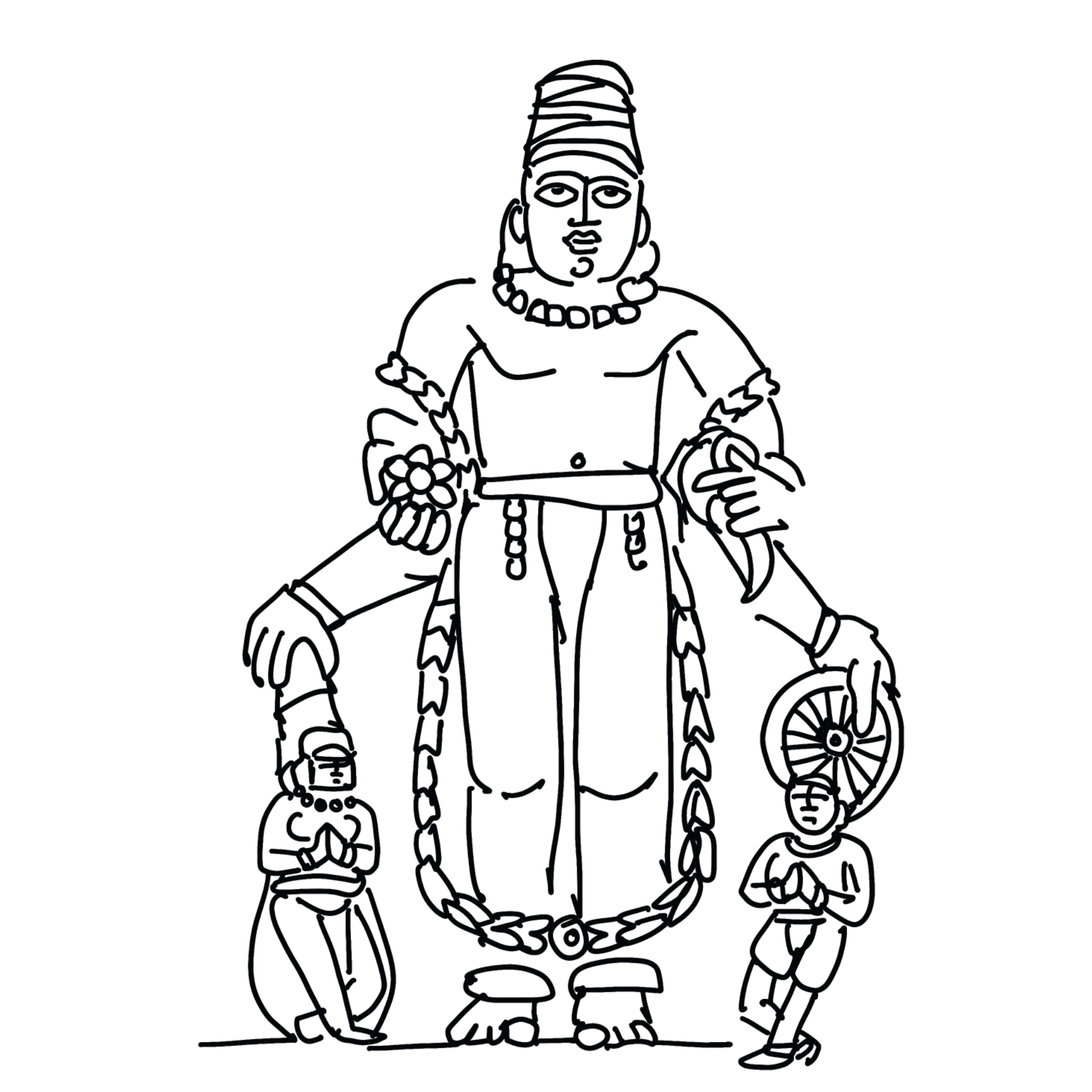
Dhruva Tara represents immortality. The child who sits on the lap of god. The Pole star also represents the soul, the home of Shiva, the wisest one. The four ladles, in the four directions, represent the seven sages making offerings to the Yagya Purusha, who also embodies the Pole Star all through the year to ensure good (su) happens (asti) in all seasons: spring, summer, autumn, winter.
This is of course art, poetry and philosophy being projected to the stars. This is not unique to Hinduism, it is found in all cultures.
In the Bible, for example, we find a story of a man called Job. Job suffered a lot in his life and wondered why God did not help him. He decided once to ask God for an explanation for the cause of this suffering. God gave him a series of unanswerable questions, to show there is a purpose to everything in the larger scheme of things. Therefore, Job had to surrender to his fate, rather than demanding an explanation from God.
One of these questions relates to the stars. God asked if Job could bind the chains of the Pleiades (Krittika Nakshatra) or lose the cords of Orion (Mrigashira Nakshatra). The Pleiades is known to be a gravitationally bound star cluster, that is, the individual stars do not separate over time (they are ‘bound’). The Orion stars, on the other hand, are non-gravitationally bound, that means they eventually will move away from each other (they ‘loosen’ over time). Many orthodox Christians believe that ancient man could not have known this astronomical fact. Hence, this line spoken by God is indeed the Word of God. It proves Creation and Intelligent Design.