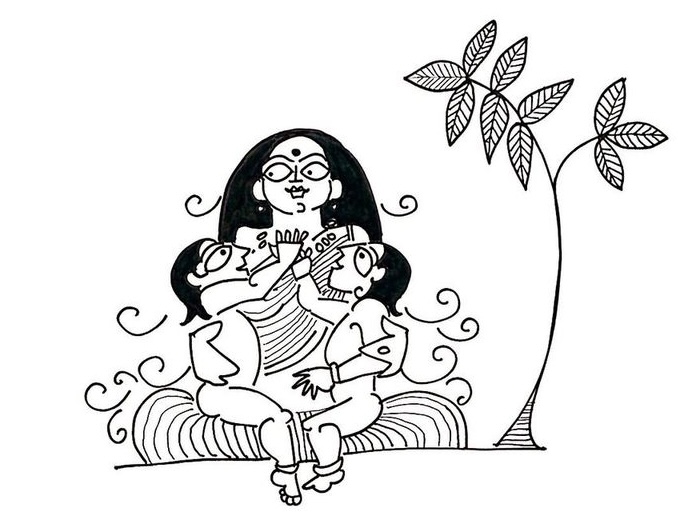
Ram of the Ramayana is a great archer but he is never depicted in art or story as hunting lions or tigers. That is strange, considering his royal status. Ram is never shown seated on lion-throne (simha-asans).
It was after 1500 BC that composite bow and horse-drawn chariots were introduced to the world by Steppe nomads. They marked a military innovation that kings were eager to display. Hunting lions with arrows while riding a horse-drawn spoked wheel chariot became the symbol of kings after the Egyptian pharaohs carved this image on temple walls around 1300 BC. The Persian Shahenshah adopted this symbol around 500 BC. India’s Ashoka adopted only the lion as a royal symbol in 250 BC, not the lion-hunting ritual.
Ram is never shown riding a chariot with a charioteer, images that are common in the Mahabharata, indicating Ramayana story is older. His story comes from the eastern part of India where dense jungles block the path of chariots. Ram’s bow Saranga was probably made using horns (shringa, in sanskrit). and sinew and entrails of the deer, the mighty composite bow, created by Eurasian Steppe nomads as per archaeologists. Hence, Ram’s ability to shoot an arrow through seven Sala trees in Kishkinda.
The oldest manuscripts of Ramayana and Mahabharata were composed by generations of poets who knew about Yavanas, Sakas, Pahalavas, who came to India around 100 BC. But the story is older, as there is reference to honey-based drinks but never sugar-based drinks. Sugar-based drinks were known by the time of the grammarian Panini, 500 BC. Ram’s family name Ikshavaku, referred to bottle gourd initially, and later sugarcane. So we can guesstimate a date of 1000 BC.
Also—contrary to modern belief—as per Surgriva’s Atlas, Ram’s exile was restricted to the North of the Vindhyas and the Narmada, to lands where Sala tree grows (Chattisgarh, Jharkhand, Odisha). Ram’s father performs Ashwamedha yagna to get favours from gods. Ram, however, performs the Ashwamedha yagna to expand territory. In Ram’s ritual, there is no queen—for she has been abandoned. Queens were integral to Ashwamedha rituals, as we learn from Shatapatha Brahmana. The march of Ram’s horse is stopped by his sons, who stand by the abandoned queen. Ram’s story thus comes from the earliest layer of the Vedic period, at a time, when the enemy was not rival Aryan kingdoms (as in Mahabharata), but non-Aryan forest tribes, who worshipped monkeys or bears.
As per Jain Ramayanas, composed around 300 AD, vanars are people whose flags displayed images of monkeys. They also describe Ravana as belonging to the Meghavahan family. This surname is used by Kharavela, the Jain king of Odisha, who lived around 100 BC, whose Hathigumpha inscription refers to Bharat as a northern Gangetic kingdom, probably Haryana, as does Sugriva in his Atlas.
Was Ramayana a war between Vedic people and early Shramanas (proto-Jains, proto-Buddhists), who lived east of Gandak river? Was Janak a Shramana upasaka (worshipper) like Ravana, whose father was a Vedic priest? Is that why some say Sita was Ravana’s daughter, a metaphor for her links with “southern” kings?
Ram tells Vali that Kishkinda is ruled by Iskhavakus—thus declaring the monkey kingdom to be Dakshina Koshala, the southern half of his kingdom, located north of Ganga. This Dakshina Koshala is also called Paschim Lanka by Gond tribes as late as 16th century. It is the forests near Sirpur, in Chattisgarh, famous for its Buddhist sites. Kings of this land equated themselves with lions and tigers (Sharabha). These aspects need considering if we want to see mythology as history.