Published on 3rd March, 2020 in The Hindu
I find it hard to believe that Wendell is gone. The news was a shock. But then, Wendell has always surprised me. From his habit of waking up very early in the morning, to living his life confidently and openly with his husband, Jerome, giving courage and direction to young gay men like me, to having a business without compromising on his art, to being a generous host to my sister and my nephew, when we visited Goa, to being a curious student of mythology, taking down notes meticulously in long hand. That is how we met, ten years ago. He had seen my work and wanted to know more about Goan mythology. He was convinced it contained ideas that would help us understand the evolution of Goa.
Geography and fractals
As we explored things together, I realised something magical – how geography in India is like a fractal. Every area in India tells the same story, but uniquely. We know that Goa was ruled by Portuguese for 450 years. Before that it was part of the Bijapur and Bahamani Sultanate. Before that were the Vijaynagar and Kadamba kings. Before that, the Shatavahanas and Mauryans.
Before that we have rock engravings indicating the earliest human settlements. The Goan tryst with Christianity, Islam, Hinduism Buddhism, and hunter-gathering prehistoric communities is known. But what about mythology, asked Wendell? We walked around his village, and saw the art that he had collected, and at maps of temples of Goa and what emerged was amazing – the mythology of Goa reflected the mythology of India. Goa was a Hindu fractal, a mini-India, showing all influences seen elsewhere in almost the same sequence.
The earliest layer of gods belong to hunter-gatherers and has nothing to do with land-holding and agriculture. These included the worship of anthills, which indicated a connection with a subterranean world. Today, this anthill is worshipped as a goddess, a form of mother-earth, even Durga. There are gods who protect from tiger attacks like Vaghoba, and others who protect from diseases. In the Dev-rais, or orchards of the mother-goddesses, known as ‘ai’ or mother, we noticed the shift to agricultural societies. Farmers and herdsmen were not allowed to enter or cultivate the sacred woods where the gods played. This was an ancient way to protect biodiversity, we now realised.
Documenting myths
I told Wendell how Sama Veda distinguishes between songs for the settlement and songs for the forest, perhaps reflecting this period of human history. The villages had farms that were owned by a community represented by a grama-deva or grama-devi. These were male and female deities, linked to fertility and power. Across Goa one finds images of goddesses with exaggerated genitals, and fierce expressions. Wendell captured many of these deities in his book Moda Goa.
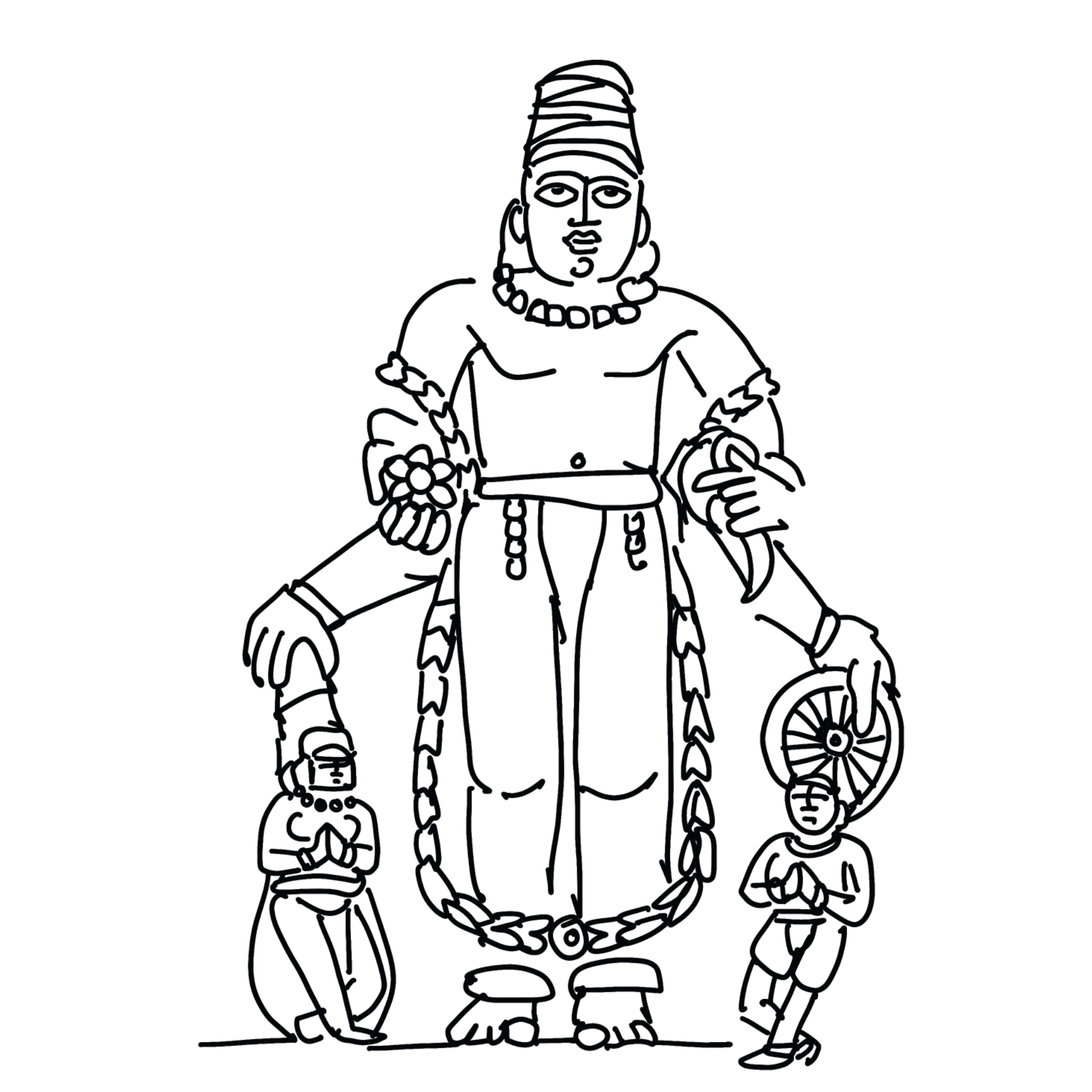
The Brahmin influence does follow. The wild gods become the more gentle Mangeshi. Peculiar to Goa are the metal face masks, where the formless Shiva-linga is given a face. The wild goddess becomes Shanta Durga, the mild one, who does not have the rage of the battle-ready Chandi. The Konkan coast, including Goa, is linked to Bhrigu, hence to Vamana, and to Parashurama. Vamana claimed the earth from the Asura-king Bali, who was shoved back to Patala. Parashurama threw his axe strained with the blood of unrighteous kings into the sea. The sea recoiled in horror and revealed the coast.
There are spots associated with Ram’s journey south. And with Krishna too who is liked to the West coast of India. Goa has the unique Devaki Krishna temple where Devaki (or is it Yashoda) holds Krishna much like Mother Mary holds Jesus. And during Diwali people burn effigies of Narakasura, much as people burn images of Ravana in Gangetic plains during Dassera.
Wendell felt this practice of burning Narakasura may have travelled to Portugal and may have come back to India as the practice of burning the old man on New Year’s Night.
Partners until the end
It was conversations like these connecting mythology to history to anthropology to sociology to fashion and art, that made Wendell the most wonderful of friends. He opened new avenues of thought for me. I miss him. And am glad that while he was on earth, with us, he had Jerome by his side.