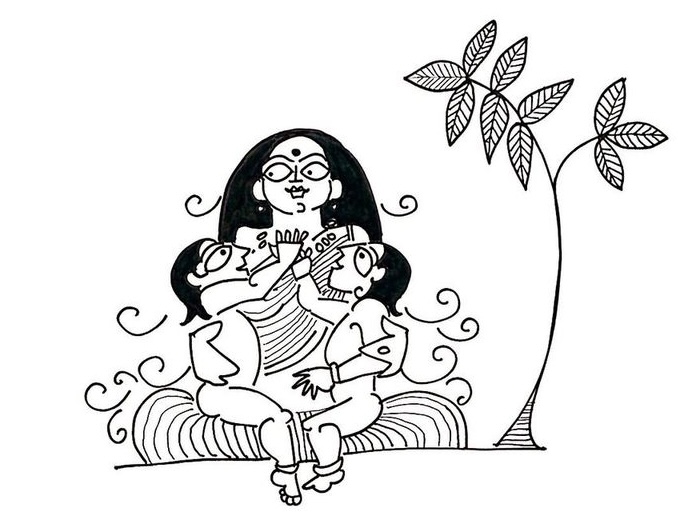
Yagna is the foundational ritual of the Veda. The word yagna is translated even today by eminent scholars as sacrifice, or fire-sacrifice, or fire-ritual. Sacrifice evokes an Orientalist vision of pagans making offerings to appease a powerful deity. The Sanskrit word for such an action is bali. In Arabic, it would be qurbani. To give something that you hold dear to demonstrate submission and piety. But that is not what a yagna is. It is an exchange. A social contract?
In the most recent books on Vedic rituals and culture, scholars are clear that the ritual has roots in the phrase from Taittiriya Brahmana of the Yajur Veda: ‘dehi me dadami teʼ, which means “give me what I give you”. This is a clear-cut transaction. The gods are invoked and given praise in exchange for favours. The more you please the gods, the more likely you are to get what you want. The act of yagna, says the later Kalpasutra, involves dravya (food), devta (deity) and tyaga (renunciation). The act generates divine currency (apurva) that benefits one in future lives. This is no sacrifice. This is investment.
Our understanding of Vedic rituals is very limited as in the 19th century, as colonial powers were demanding explanations about Hinduism, the Brahmin scholar was at his witʼs end. He realised that the new masters, like the old Muslim masters, frowned on polytheism, and idolatry, which was the mainstay of popular opinion. The White coloniser was additionally a man of science and reason and spoke of new ideas like liberty, equality and brotherhood, and had a dim view of Indiaʼs caste system and treatment of women.
The clever answer was equating Veda with Vedanta. Upanishad was to the Vedic rituals what logos was to mythos, what European philosophy was to Greek mythology and Church rituals. So even today, for most people, all things Vedic is talk about jiva, atma and brahman, about liberation, the Hindu equivalent of the Christian salvation.
Swami Vivekananda, like Raja Ram Mohan Roy, and Aurobindo, valued the Upanishad and its mysticism. It seemed egalitarian enough. Swami Dayananda Saraswati preferred the Vedic mantra to Hindu temple worship, but his creative translations evoke the Upanishadic ethos of mysticism. No one talks about the idea of exchange, or the idea of food. “I am food. I am the one who eats the food. I am one who existed before the gods,” is what the Yajur Vedic prose clearly states. What does that mean? Is it to be taken to be material or spiritual, literal or metaphorical?
When we speak of Manusmriti, everyone is well-versed about its prescriptions favouring upper caste heterosexual men. But few note that it is also about feeding. The ‘pancha-maha-yagnaʼ, is about five feedings: feeding oneself, feeding fellow humans, feeding the gods, feeding the ancestors, and feeding the livestock. The yajaman, the householder, is told he exists to nourish everyone around him. The world is all about satisfying each otherʼs hunger. Hunger is what differentiates organisms from objects.
In the 19th century, Buddhist texts were finally translated. And so everyone knows that the Buddha said “desire is the cause of suffering”. But Buddha never said ‘desireʼ. Thatʼs a European translation. He said ‘thirstʼ (tanna, in Pali; trishna, in Sanskrit). While the Vedic idea was to respond to hunger not by eating as animals do, but by feeding as humans can, the Buddhist idea was to outgrow hunger itself. It was so in all the monastic traditions, including Jainism, that valorised fasting, and were called nastika by the Vedic Brahmins.
In modern times, we still refer to a hunger index, as a measure of development. No one can measure hunger, but we can measure the consequences of involuntary fasting, due to lack of food — malnutrition, stunted growth, poor developmental milestones in children, disease, and death. In a world with multi-trillion-dollar economies, people are still dying of hunger. Governments are giving free rations to stay in power. Feeding remains the foundation of culture, and of civilisation.
Business schools do not use the word ‘hungerʼ. They use the word ‘ambitionʼ, a clever synonym for ‘greedʼ. The entrepreneur is asked to “think big” — not for society, but for the shareholder, the stock market, the technocrat. He is not feeding the hungry. He is using various marketing tricks to amplify hunger in the market — create dopamine addicts, who will stay loyal to his goods and service.
The politicians do not give governance to get votes. They evoke insecurity and provide grand visions to get votes. Those who claim to be guardians of Vedic philosophy want people to sacrifice for the nation so they stay in power. This is not the Vedic yagna. This is more like a biblical god demanding submission, threatening fire and flood to those who disobey.