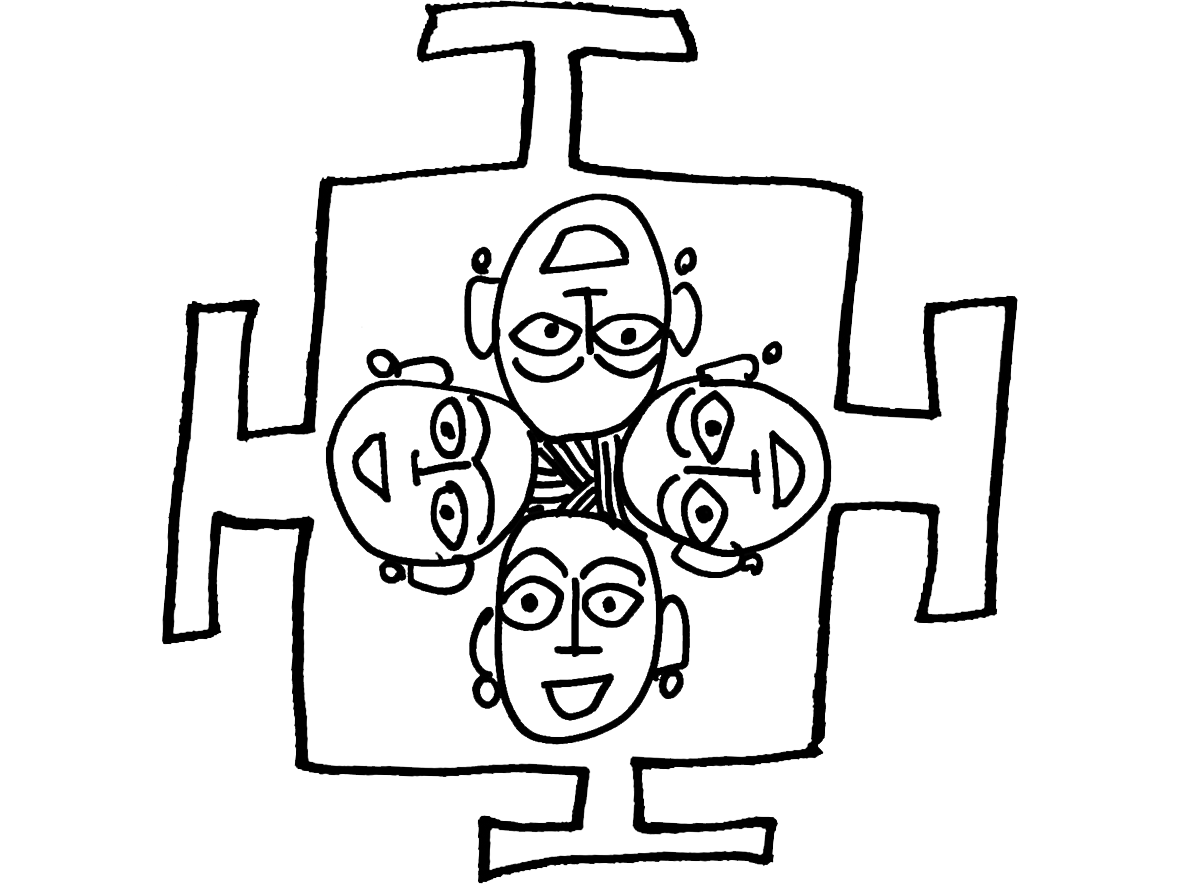
Hindu mythology distinguishes between the world and life. The world is all about physics and chemistry. Life is about biology. Life is about hunger and fear. Without hunger and fear, there is no life. When Biblical God creates the world, it includes the inanimate (sun, stars, land, sea) as well as animate (plants, animals, humans, angels). But in Hindu texts, creation and destruction is all about hunger and fear, the seed of life.
Brahma is the generator of hunger. Hunger is what establishes life, turns an object into an organism. It is what makes the predator seek out food and the prey fight for life. Shiva is the destroyer of hunger, and so the ascetic, the one who liberates everyone from suffering and insecurity. Between the two is Vishnu, the organiser of hunger and fear, who strives to establish contentment by drawing attention to other people’s hunger and the cost of eating.
Mythological characters are the ancient equivalents of modern jargons, a shorthand, to communicate complex ideas. They are metaphors that need to be understood, not translated. They can adorn walls as posters and impress visitors. But like jargon, they are as useful as their usage. So, focus on the content rather than the form. Do not get distracted by religious connotations that politicians, activists and gurus indulge in. Mythology then becomes a toolkit, a medium, to explore contentment.
The rishi who told stories of the creator, organiser and destroyer, and designed characters like Brahma, Vishnu and Shiva, was an ancient Indian ‘seer’ who could see what others could not. He turned sight into insight and insight into reflection and created tools to enable others to do the same.
Sight shows us the ‘food’ that people chase, that they cling to, and that they give away. Sight reveals that all ‘food’ takes the form of resources (Lakshmi), power (Durga) and knowledge (Saraswati). Insight reveals the underlying hunger, insecurity and curiosity shaping all decisions and actions. We can witness the attached Brahma, the detached Shiva and the content Vishnu outside us. Reflection reveals our own hunger, insecurity and curiosity. We can witness the Brahma, Shiva and Vishnu inside us, who can generate, organise and destroy hunger and fear around us.
A Brahma is consumed by his own hunger. And his imagined hunger. He hunts for opportunities. He extracts value and labour. He creates enterprises. The world exists for his pleasure and benefit. He does not think of others. He creates borders for his pleasure. He creates hierarchies to make others inferior. He wants to be the big shark in the shark tank, the big dog in the dog-eat-dog world, the big rodent in the rat race. He does not realise that he creates the world around him. He assumes this world is real, not generated by his fears and insecurities. He does not realise how much anxiety he creates around him. He thinks he is the victim.
Shiva simply withdraws from the world. He destroys the world by shutting his eyes to it. He withdraws into his caves, high above in the mountains. Contrary to popular belief, Shiva does not destroy the world like a ‘terminator’ by breaking things. He simply rejects social structures. The borders and the hierarchy. He does not validate other people’s identity. Hence he is shown in art in a crematorium, covered with ash, dancing with Brahma’s skull. He knows value is subjective. Measurements do not exist in nature. Animals dominate not by choice. Humans dominate out of choice to cope with insecurity and anxiety, in their quest for meaning.
The organiser is content. Vishnu, and his avatars, see the hunger and fear of others and sees how no one thinks of the ecosystem. In fear, everyone is self-absorbed. Everyone is eating, no one is feeding. In nature, all trees exist in an ecosystem. All plants exist in an ecosystem. There is no species that is special. No individual that exists without consuming others.
All that consumes must be consumed to maintain balance. Surplus is unhealthy. In anxiety humans hoard, create artificial scarcity, hence wars, the imagined war zone of corporations. Governments today are running like corporations trying to be ‘great’ rather than trying to take care of citizens. Like Ravana, whose personal ambition results in Lanka getting burnt.
Like Duryodhana, whose personal jealousy and hatred causes the people of Hastinapur to fight a war that has nothing to do with them. The organiser does not compete. Competition unravels the fabric of culture. He is content. Only the content can bother other people’s hunger. Those fighting wars will never bother with diversity or inclusion. Brahma is too busy feeding himself to feed others.