
The Stories We Tell
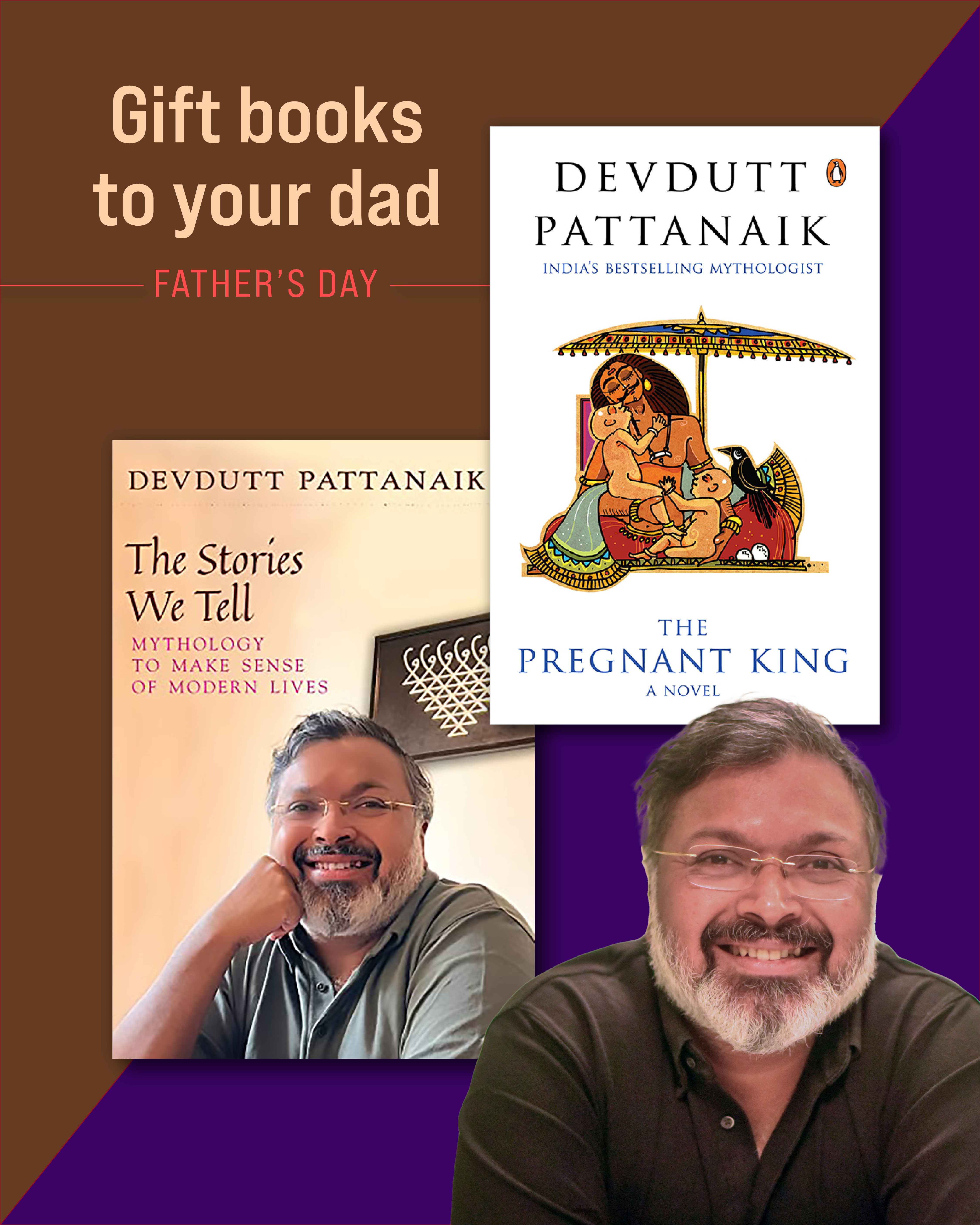
In The Stories We Tell: Mythology to Make Sense of Modern Lives, renowned mythologist Devdutt Pattanaik presents seventy-two tales from India’s rich treasure of myths and legends to explain life in the twenty-first century.
The stories are arranged into a variety of themes, including ‘Apsara’, a reflection on the portrayal of women in ancient texts; ‘Karma’, ‘Justice’, and ‘Appropriation or Exchange’, which show how our modern ideals of justice have been shaped by ancient scriptures; ‘Unconditional Love’, which is an exploration of the parity that must exist between loving partners; and ‘Devas and Asuras’, which illustrates how the binary of right and wrong is anything but black and white.
Originating from the author’s webcast Teatime Tales, this collection of stories is narrated in his inimitable style and offers a fresh and insightful take on how our mythology affects our lives today.

The Pregnant King
‘I am not sure that I am a man,’ said Yuvanashva. ‘I have created life outside me as men do. But I have also created life inside me, as women do. What does that make me? Will a body such as mine fetter or free me?’
Among the many hundreds of characters who inhabit the Mahabharata, perhaps the world’s greatest epic and certainly one of the oldest, is Yuvanashva, a childless king, who accidentally drinks a magic potion meant to make his queens pregnant and gives birth to a son. This extraordinary novel is his story.
It is also the story of his mother Shilavati, who cannot be king because she is a woman; of young Somvat, who surrenders his genitals to become a wife; of Shikhandi, a daughter brought up as a son, who fathers a child with a borrowed penis; of Arjuna, the great warrior with many wives, who is forced to masquerade as a woman after being castrated by a nymph; of Ileshwara, a god on full-moon days and a goddess on new-moon nights; and of Adi-natha, the teacher of teachers, worshipped as a hermit by some and as an enchantress by others.