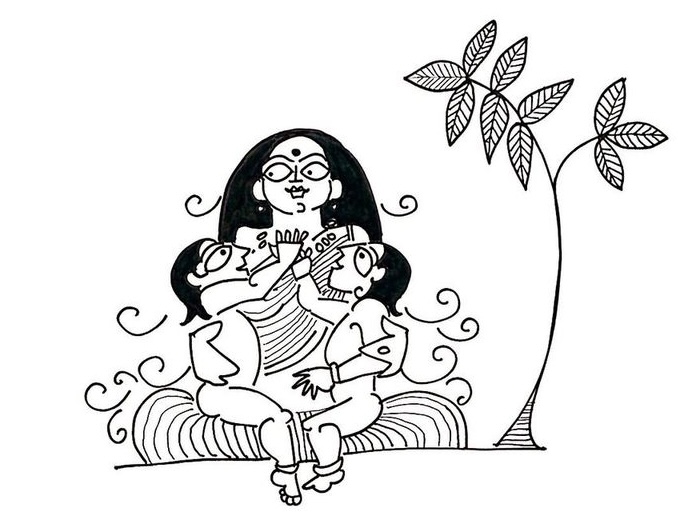
Once upon a time, there was a princess called Indu (the moon) or Indumati (the full moon). Her brother was Bhoja, king of Vidarbha. She chose Aja, king of Ayodhya, as her husband. They had a child called Dasharatha. But then, one day, she died, startled by a flower that fell from heaven. Aja could not bear to live without her, and so died soon after, passing on the mantle of the throne to their young son. Dasharatha’s eldest son was Ram, born of the senior queen Kaushalya. His second son was Bharat born of his favourite queen Kaikeyi.
Kaikeyi tried to secure Dasharatha’s throne for Bharat using her cunning, but Bharat had too much integrity to accept it. He insisted Ram inherit the crown, as per the law. Ram established the legendary Ram-rajya, and ruled the land we now call India, named after his grandmother Indumati, and Bhaarat, named after his brother Bharat. These names remind us that Ram’s kingdom was full of women who were much loved by their husbands, and brothers who did not fight brothers over property.
This could be a WhatsApp forward. Maybe it is. Just like the many fanciful etymologies of Bhaarat promoted by English-speaking, Hindutva-propagating gurus. One such etymology claims that Bhaarat is derived from Bhaa (light) and rata (seeking). Another claims it comes from Bhaava (emotions), raga (tune) and tala (rhythm)
The name Bhaarat probably has Jain roots. It is derived from Bharat, the name of the first Chakravarti, son of the first Tirthankara, Rishabha-deva, who conquered the whole world, and felt he was the first to do so until he found the slopes of Mount Meru carved with the names of hundreds of kings like him, all forgotten over time.
As is often the case, the Jain story has been eclipsed by Hindu stories that insist that Bhaarat comes from Bharata clan, mentioned in the Rig Veda, who won the battle of 10 kings in the land watered by seven rivers (sapta sindhu) — today’s Kurukshetra. This is the earliest battle to be recorded in Indian scriptures dated to 1000 BCE.
Centuries later, it inspired an epic called the Mahabharata of Vyasa, chronicling the tales of that great clan. But here, Bharata is the name of Shakuntala’s son, born in the forest, as his father, Dushyanta, is unable to remember his mother and accept her as a queen. Dushyanta belongs to the lunar line of kings. Shakuntala’s father, Kaushika, belongs to the solar line of kings. Bharat thus marks the confluence of the lunar and solar lines of kings through his father and maternal grandfather. That is why the clan is called Bharat-vamsa and their land is called Bhaarat-varsha, the expanse of Bharat.
Bharat also happens to be the name of the sage who wrote the Natyashastra, the treatise on theatre and drama. But kings usually take precedence when naming a country.
Hindu texts refer to Bhaarat-khand, the portion of the subcontinent occupied by Bharata kings. But for Megasthenes who visited the court of Chandragupta Maurya, 2,300 years ago, the land he was visiting was India, watered by the Indus, which is how the Greeks pronounced the land Sindh watered by the river Sindhu. The name Bhaarat-varsha was only carved 200 years after Megasthenes wrote his Indica, in 100 BCE, in Odisha, in the Hathigumpha caves, by the Jain king Kharavela. For him, Bhaarat-varsha is simply the Gangetic plains, west of Magadha (today’s Bihar). For Persians, the land watered by the river Sindhu and beyond, was known as Hind. This when written in Chinese became Tiānzhú. Both Bhaarat and India referred to Arya-desha, which as per earliest dharma-shastra was located between the Himalayas and the Vindhyas and was the land of the blackbuck. Neither India nor Bhaarat referred to south India (Dravida-desha), south of the Narmada river, or east India (Prachi-desha), east of Gandaka river.
Unless we accept the story of Indumati, India is effectively a name by which the outsider saw India: the land of cotton, iron and spices. Bhaarat then is the name given by Sanskrit-speaking Brahmin elites of the Gangetic plains, who value the Manusmriti.
How should we identify ourselves in the 21st century? By a name given to us by north Indian elites, who defend patriarchy and untouchability? Or by a name given to us by foreigners such as Persians and Europeans who admired us, traded with us and eventually colonised us?
No one decides their own name. We are given names by parents, by elders, by teachers. People change their names when they change their religion or wish to break ties with an imagined past. But the land of Ram can surely make room for his brother, Bharat, who never fought over property, and his grandmother, Indumati, radiant as the moon, who was much loved by his grandfather.