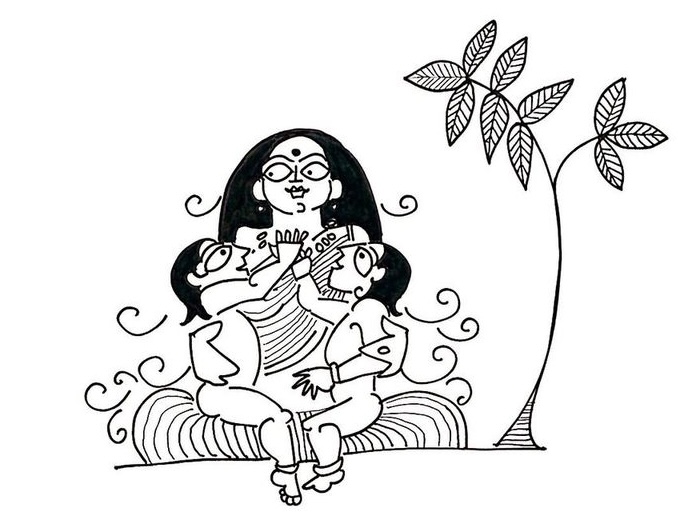
Ram’s father had promised his stepmother Kaikeyi two boons. On the eve of Ram’s coronation she asked for these boons. Kaikeyi wanted Ram to be exiled to the forest for 14 years and her son Bharat to be crowned king instead. Ram agreed without resentment to uphold royal reputation. Kaikeyi’s son, Bharat, refused to accept a kingdom obtained through deceit, also to uphold royal reputation.
In this story, neither Ram nor Bharat see kingship as ambition. For them kingship is a duty, a role they have to play.
Ram is king because he is the eldest son of the royal family. By convention, the eldest son has to be king. Ram is not king because he is the favourite, or he is the best. His selection is not based on merit or popularity. Ravana becomes king by merit, like an alpha claiming a territory by overpowering his rival Kubera. Bharat can also do the same. But he refuses. He upholds the royal law, and knows the value of royal integrity and royal reputation.
In the Buddhist Dasharatha Jataka, this theme of royal integrity is reinforced.
Dasharatha feared that his ambitious second queen planned to kill Ram, his eldest son, his firstborn by his first queen. So, he ordered Ram to go to the forest and not return to the palace for 12 years. Astrologers had foretold the king’s death 12 years later. So Ram would be back in time to claim his birthright. Ram left for the forest. Unfortunately, the king died nine years later.
The second queen declared her son king in the absence of the eldest son. But the younger prince refused to be an opportunist like his mother. He went to the forest and asked Ram to return. But Ram said he would return only three years later, after spending 12 years in the forest, as he had promised his father. It was a question of royal integrity and reputation. So, for three years, the younger prince ruled as regent, placing Ram’s footwear on the throne, awaiting his return to claim his rights as the eldest son.
In the Jain Ramayana, Ram’s forest exile is linked not to royal integrity but to his generosity.
Bharat wanted to become a monk. Kaikeyi tried her best to stop him. Finally, she asked Ram to help. So Ram decided to go into the forest, forcing Bharat to stay back in the palace, and carry out responsibilities as a son, and as prince.
In modern readings of Ramayana, people are too eager to judge Ram and justify Ravana. They see Ram as indulging in an act of injustice against his wife, who is loyal and faithful. In such judgements, focus is on the social realities, on power, law, and justice, not on the psychological realities, the dilemmas a king faces when he has to choose between kingdom and family.
Ram’s wife, Sita, decided to accompany Ram to the forest to take care of his needs. In the forest, she was abducted by the Rakshasa-king Ravana and was rescued after a fierce battle. Ram finally returned to the palace and was crowned king. But his wife could not be queen as tales of her abduction became fodder for public gossip. To protect royal reputation, Ram abandons Sita and has her sent to the forest.
Ram is obliged to his people’s needs. That is the dharma of a king (raja). Ram is also obliged to his wife’s needs. That is the dharma of a husband. Which obligation takes priority? Here dharma is accompanied with a dilemma, i.e. dharma-sankat. By submitting to public opinion, Ram follows raja-dharma. But this comes at a cost. Ayodhya now is in his debt, and he is in Sita’s debt.
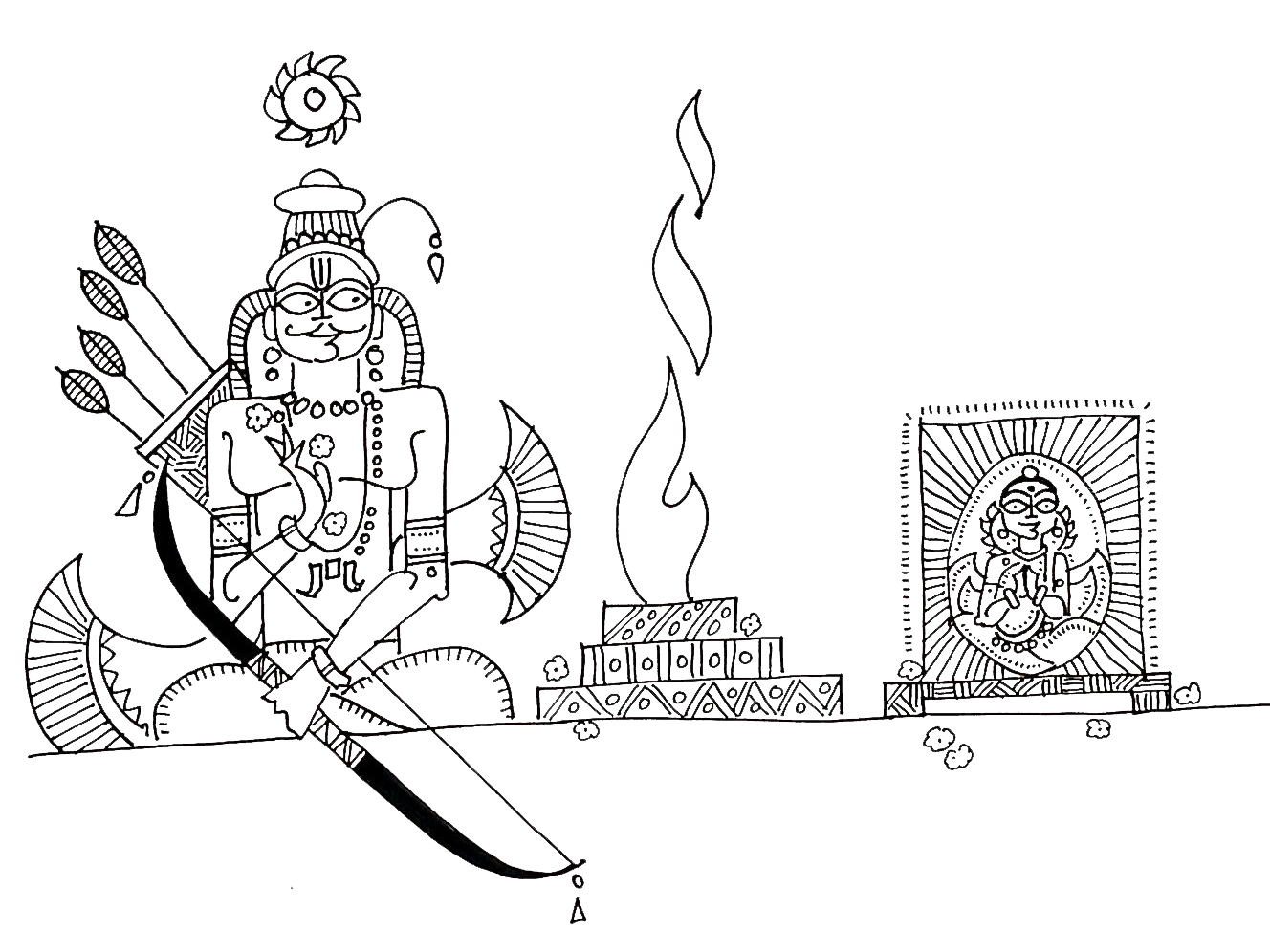
Ram can write off what Ayodhya owes him, which is why he is called the hermit-king, or tapasvi-raja. But how does Ram repay what he owes his wife? He remains true to her, refusing to remarry, despite public pressure. Instead he performs all rituals by placing an effigy of his wife made of gold next to him. This was to remind people that his wife, a victim of malicious gossip, was as pure as gold.