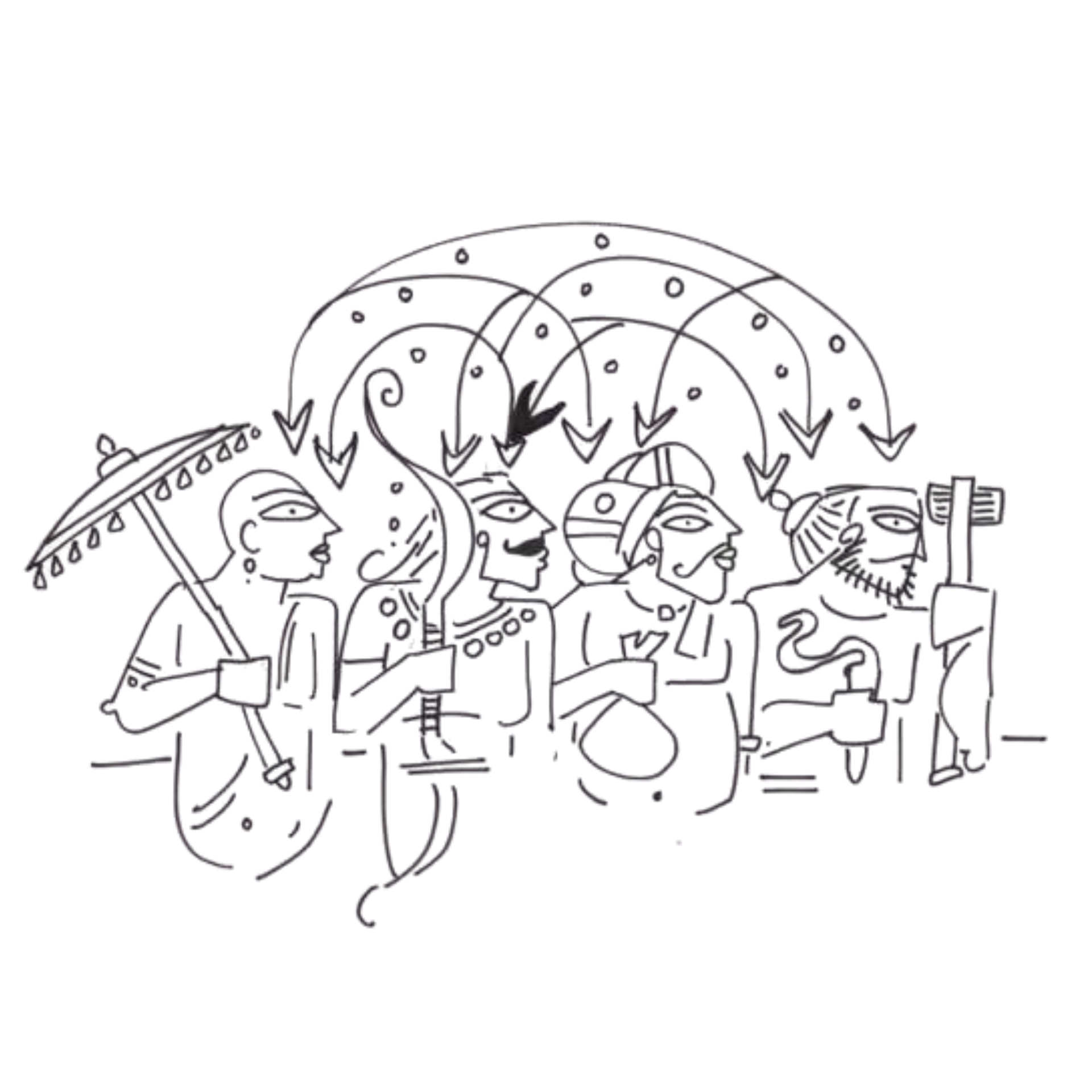
Interviewed by Pooja Singh, for www.livemint.com, on 29th May, 2016.30
We tend to tiptoe around the role of power in management, and fail to openly acknowledge how the animal desire to dominate often destroys the best of organizations. But power is a critical tool that affects the implementation of any idea.
These lines are from author-mythologist Devdutt Pattanaik’s new book, An Indian Approach To Power–The Leadership Sutra, which takes you through Indian mythology and its parallels with corporate life while offering “made in India” sutras (concepts) related to the human quest for significance and the importance of rules. It follows the thread of his earlier book, Business Sutra.
In an email interview, Mumbai-based Pattanaik explains how rules in business spaces are based on ideas similar to those found in mythology, and the lessons that can be drawn from them. Edited excerpts:
Ram’s obsession with rules dehumanized him; it deeply affected Sita’s life. Should there be a limit to following rules in the workplace?
It depends on what price we are willing to pay. That Ram always follows the rule makes him dependable. You know what to expect from him. That’s a good quality too. It also means that around him, there will be Sitas who will suffer. Every benefit has a cost–an idea that is poorly understood by many leaders today who assume “good actions” only have “good reactions”.
The Pandav Bhim and Ravan lived by their own rules, something which today’s millennials do too.
Advantage, you live by your rule and can lead your pack of domesticated submissive followers. Disadvantage, no one sees you as dependable or reliable. And you will have problems trying to delegate–a problem in many family-owned corporations, where the founder cannot let go of his powers, even to his own children.
Recognition has always been seen as a big motivator among employees, managers, even chief executives. Is there any downside to it?
I think we need to understand what recognition means. It means an invisible employee is made “visible”. This matters a lot to humans. There is the rush of power (called Durga). However, it can become an addiction and can lead to depression when one realizes that what people look at is your achievement, not you. You are just as good as your results–a sad reality of the business world today.
One of the premises in the book is that marketing and business are all about ‘maya’ (delusion). In interviews and markets, candidates and products, respectively, are measured through scales. Could there be any other approach to distinguish between what’s good and what’s average?
Maya is a world seen through measurement and comparison. It is a delusion that we cannot escape. It’s water to the value-seeking fish. Hence, the world is maya. We play this game of measurement: Thus you are better or worse than your colleague based on how the management measures you and rewards you. You can measure your worth based on the salary and perks you receive. I don’t say it’s a bad thing. Wisdom is realizing the power of measurement/comparison in our lives and the lives of people around us. And knowing that we can even live in a world where we don’t have to measure and compare, at least privately.
You’ve mentioned that the corporate world is teeming with pretenders and mimics. They think they know how to walk the walk and talk the talk…but are nowhere close to knowing what true leadership actually means. Could you provide an example to explain why there’s a disconnect?
Take the case of why MBA (masters’ in business administration) students wear suits when they come for interviews, even on hot summer days. They are following a code, a uniform. They are mimicking as they are expected to mimic. Yet we ask them to think out of the box, be innovative and subversive. Investment bankers clone each other’s mannerisms as they want to fit in. So do computer nerds.
Leadership is about paying attention to the other, and enabling people not to mimic or pretend, but to be genuine/authentic about their fears. This means creating an ecosystem where people can be vulnerable and thus feel secure and empowered, for example, to express uncomfortable views without fear of censure. Mimicry and pretension means we are hiding. We are not being true. If a leader cannot sense fear in people around him, if a leader feels good when people around him are frightened into pretending, there is a problem. Power flows towards the leader or, rather, boss rather than towards the organization.
In one of the sections of the book, you say innovation is not possible unless rules are broken. Please explain.
Innovation is about rendering the old ways inefficient and ineffective. It is essentially about breaking the way things are. Some imagined a world where phones did not have wires. Someone imagined a world where you did not have to come to office to work. That was achieved through trial and error, often not within corporations, which seek alignment and compliance, but outside corporations, in garage start-ups. Someone essentially “broke” the rule. The hero. Or Vasudeva, of the Jain tradition.
Often, leaders ask employees to leave an organization because they have broken a rule. What’s the ideal way to deal with such a case?
This is classic Abrahamic mythology: The assumption that rule-breaking makes one wrong and evil. It does not take context into consideration. It sees latitude as amoral. It sees allowing as indulgence. Management is then an angry God of Moses, who punishes Moses for taking God’s name in vain, thus breaking the commandment. We have assumed that this is the right way. We are so deeply entrenched in this belief that an alternative sounds like fantasy.
People make mistakes. In fact, only through mistakes do we learn. Mistakes allow us to discover new things. Mistakes help us grow. But for corporations, mistakes are expensive. In a competitive, jungle-based ecosystem, that is not permitted. In fact, forgiveness is seen as weakness, and a sign of favouritism. One reason why we don’t have a leadership pipeline. We are expected to be right all the time, compliant all the time, like domesticated animals who are one day expected to lead a pack of wolves.