Buffaloes are found in ponds, rivers, marshes, and wetlands meant for rice cultivation. Cows, on the other hand, prefer drier jungle areas. India has both dry jungles and wet river basins. Dry areas are meant for wheat and millet cultivation, while wet areas are for rice cultivation. Cows and bulls thus represent two different ecosystems of India. Nomads move around with cows, while farmers are linked to buffaloes, who do not enjoy moving away from their watery habitat.
Bulls are castrated and used as bullocks for pulling carts and for tilling hard soil. Male buffaloes do not need to be castrated. They can be controlled by nose rings. Some buffaloes can also be used as pack animals and used to till flooded rice fields. While most Indians focus on cows, we often overlook how important buffaloes are to India’s economic ecosystem, and how they play a key role in rituals, art and culture.
Buffaloes are depicted on Harappan seals, indicating they were domesticated and were part of the Harappan civilization over 4,500 years ago. This was the river buffalo, whose milk was curdled and churned into butter that was made into ghee. Buffaloes were also used for meat (even today India is a major exporter of buffalo meat), and their bones were used for making tools. The buffalo is found on the famous Pashupati seal facing the hermit who wears buffalo-horns on his head. Buffalo horns are also found on other seals, indicating power and virility.
Buffalo in Jain and Hindu mythology
Around 3,500 years ago, in the Rig Veda (4.18.13), the mighty Indra, energised by the Soma drink, is equated with a wild buffalo. About 2,000 years ago, in Tamil Sangam poetry, Kuruntokai 65, the buffalo in a lotus pond is equated with an uncouth man who doesn’t appreciate the refined girl he is about to marry. This indicates how integral the buffalo was to India’s cultural imagination, from North to South India.
The Mahisha Jataka, illustrated on the walls of Ajanta, speaks of a gentle buffalo who tolerates the mischief of a monkey. He refuses to punish the monkey for his irritating and incorrigible behaviour, even though he is advised to do so by the tree spirit or yaksha. One day, the gentle buffalo is away and his place is taken by another buffalo. The monkey, without realising it is another buffalo, plays the same tricks and is trampled to death.
In Jain mythology, the buffalo is the emblem of the 12th Tirthankara Vasupujya. The Jain Yakshi Jwalamalini is shown riding a buffalo. As per one story, the Yakshi was a devout Jain in her previous life, who fed Jain monks, but her husband treated her badly. So she was reborn as a Yakshi and she rides a buffalo who was her husband reborn.
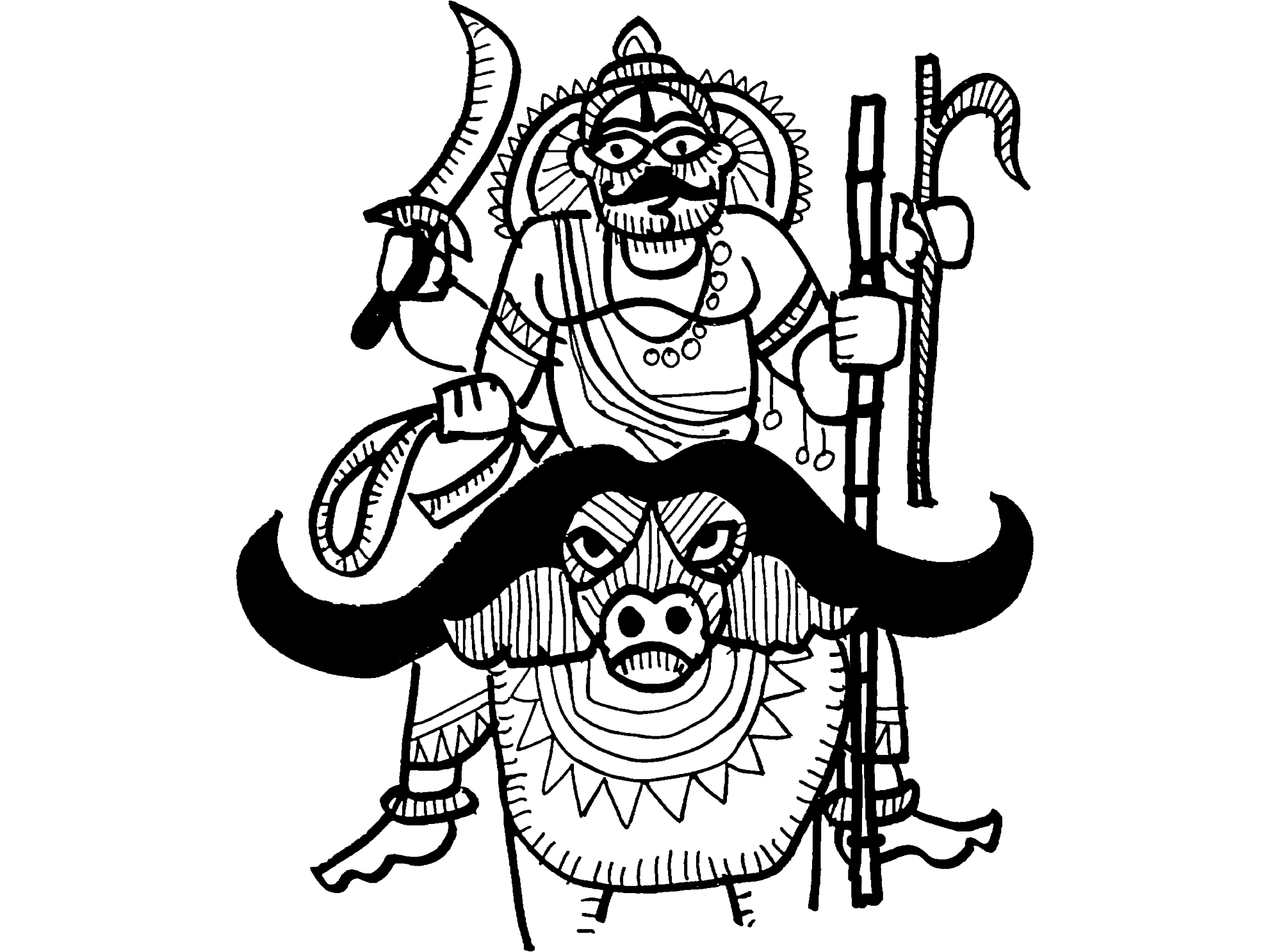
The buffalo plays a very important role in Hindu mythology. It is the vahana (vehicle) of Yamraj, the god of death. The buffalo is also popular as the demon Mahisha who is slain by the many-armed goddess Durga. The oldest image of this goddess killing the demon was found in Rajasthan and dated to 100 BC. Many terracotta images from the Kushan age show the goddess killing the buffalo with her bare hands.
Later, the image gets more elaborate. The goddess is shown riding her lion and killing the buffalo by pinning him down with her feet. Such images are found in the Gupta, Chalukya, and Pallava temples. Now they are part of the Navaratri celebrations held every autumn across India.
Buffalo sacrifice in folk festivals
In folk festivals across Deccan, a young male buffalo (reda) is offered to the goddess as a sacrifice. The offering of buffalo to the goddess is also meant to make her happy so that the children are safe from tiger attacks. When one buffalo is sacrificed, its leg is put in its mouth and presented to the goddess. This practice is found in Nepal, too. At the same time, a new male calf is chosen and fattened up the whole year to be offered to the goddess the following year. Such rituals ensure the fertility of the earth: with new life replacing old life.
In Kerala, the local god Ayyappa, son of Hara (Shiva) and Hari (Vishnu), defeats Mahishi, the sister of Mahisa. In Maharashtra, there is worship of Mhaso-ba the buffalo-god, husband of the village goddess. It seems that while the buffalo suitor of the goddess is killed, she chooses the bull-riding Shiva as her husband.
Many folk goddesses of the Deccan region have young male priests called Potraj or the buffalo king, who lead processions in honour of the goddess. The Potraj is dressed like a fierce man with whips, and found in processions such as Bonalu, celebrated in the Telangana region of Andhra Pradesh. This figure is sometimes identified as the son of Kali, and sometimes as her husband, while he calls himself her servant.