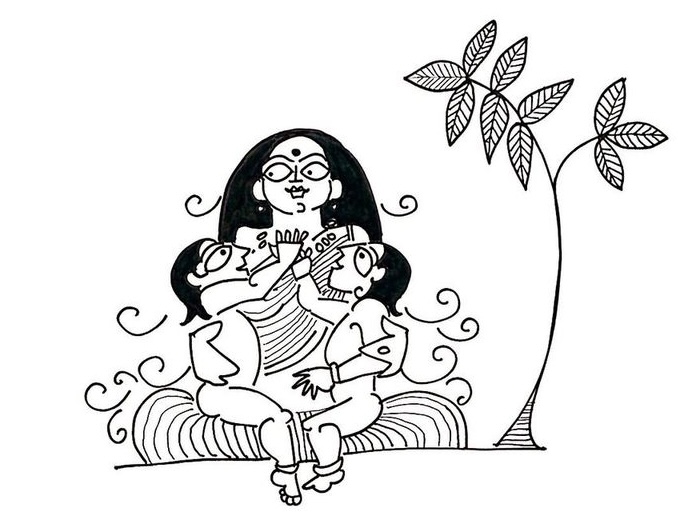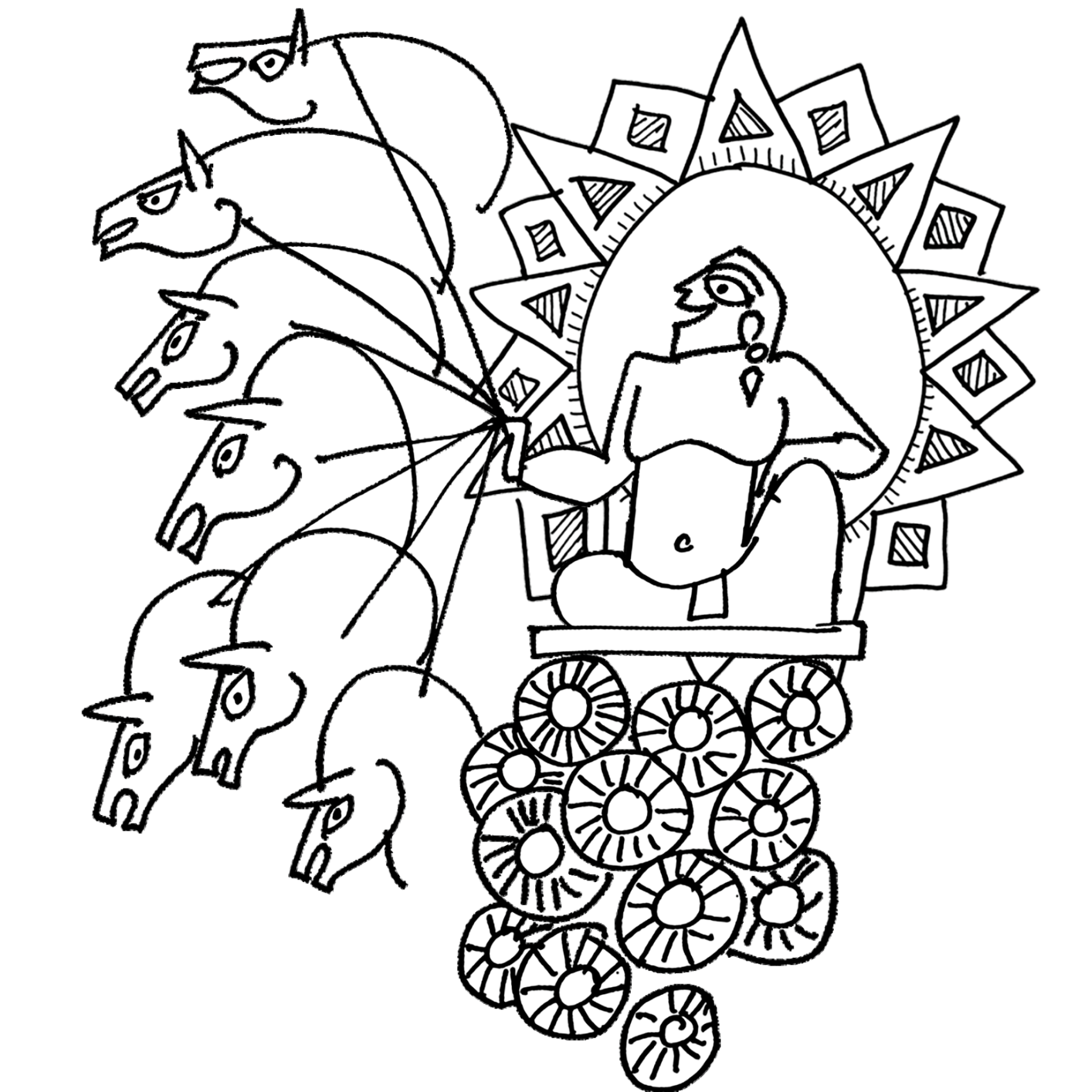
This is an ancient tale first narrated in the Vedic corpus. The sun-god Surya is married to Saranya, who cannot bear his blazing presence. She flees in the form of a mare. Surya pursues her as a stallion, and from this union are born the Ashvin twins, divine horsemen who move swiftly across the worlds in chariots drawn by horses. They rescue those who fall into wells, oceans, and darkness, acting as healers and saviors at the threshold between life and death. Saranya eventually dissolves into the landscape itself, becoming the river Sarayu, turning flight into flow, fear into nourishment.
Surya’s children also become rivers. His daughter Yami, twin sister of Yama, transforms into the river Yamuna. Another daughter, Tapti, born of Chhaya, Surya’s second wife, the shadow of Saranya, becomes the river Tapi. Myth explains geography through kinship: Yamuna flows east, aligned with the primary wife and the rising sun; Tapi flows west, associated with shadow and sunset. Direction is not accidental. It is moral, cosmic, and genealogical.
From early Vedic times, the sun is also tied to humanity and death. Surya has two sons who frame the human condition. Manu is the father of humankind, lawgiver, and culture hero. He sends the eagle to retrieve Soma from distant mountains, offers the sacred drink to Indra, and is guided eastward to fertile pastures. When the great flood arrives, Manu builds a boat and preserves life. He represents continuity, survival, and social order under solar guidance.
His brother Yama embodies the opposite destiny. The first mortal to die childless, he becomes trapped in the realm of the dead and transforms into the king of ancestors. While Manu opens the future, Yama guards the past. In Iranian memory, Yima echoes this figure as the first human, saved from annihilating cold, suggesting a shared Indo-Iranian solar ancestry.
Surya has two sons by his second-wife too. Chaya, the shadow, bears him another Manu, who will be father of humanity in the future. Manu’s brother is Shani, the god linked with Saturday, with delays, with the end of the week. What starts with the sun ends with saturn. What starts with Manu ends with Yama (cosmically) and with Shani (temporally). Surya’s daughter by Saranya is Yamuna. Surya’s daughter by Chaya is Tapti. These are parallels of the world of light and shadow.
The Puranas extend this solar logic into kingship. India is ruled by two great dynasties, solar and lunar, both ultimately traced to Vivasvan, the solar deity. From Brahma’s mind-born son Marichi comes Kashyapa, then Vivasvan, then Ikshvaku, founder of the solar line. This lineage is marked by stability, righteousness, and antiquity. Figures such as Ram, Buddha, and several Jain Tirthankaras are placed within this solar ancestry.
The lunar line emerges through a deliberate crossing. Ila, child of Vivasvan, becomes female in an enchanted forest and marries the son of the moon. Thus the lunar race is born, thriving on the banks of the Yamuna, daughter of the sun. Later myths deepen this interweaving: Chandra, born of Atri, fathers Mercury, who again marries Ila. From this line arise kings such as Krishna and Jain teachers like Nemi.
Sun becomes river. River becomes bloodline. Bloodline becomes history. In Indian myth, light flows not only in the sky but through water, ancestors, and memory.