October 12, 2016

First published October 11, 2016

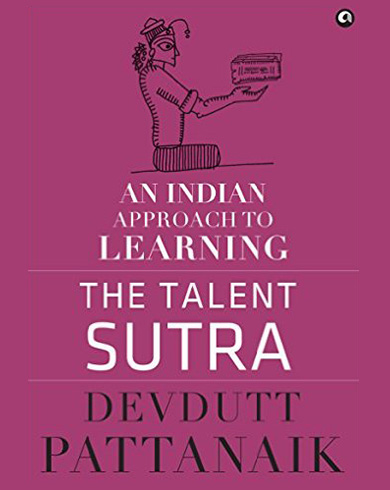
The Talent Sutra: An Indian Approach to Learning

The Talent Sutra: An Indian Approach to Learning.

Saraswati is the goddess of knowledge in Hinduism, as well as in Buddhism and Jainism. Her name is derived from the fluidity (saras) of the imagination. Human imagination enables us to invent and innovate, visualize, plan and de-risk. Yet imagination is a bad word in the world of business and management. It strips us of certainty. We want to control the imagination of those who work for us, prevent their minds from wandering from work. Yet every human being lives in an imagined reality. Recognizing this enables us to work with talent, build strong relationships and nurture people to face any situation with faith and patience. Failure to recognize imagination is why family-owned businesses are unable to manage professionals and how professionally- run companies end up creating ineffective, mechanistic talent management systems. Training, learning and development, are not just about skills and knowledge and competencies, they are about appreciating the human-animal, recognizing that neither we nor those around us are programmable machines that we can plug and play. Managing people, hence relationships, is key to the survival of an organization.

Derived from Devdutt Pattanaik’s influential bestseller Business Sutra, this book explores concepts like creativity in the workplace, nurturing talent, and the importance of teamwork. It will help employers and managers become more inclusive leaders who are able to carry their team along with them.


Recent Books

  • flowers of india book

    Flower of India: Ways of Seeing the Lotus

    In Flower of India, bestselling author and renowned mythologist Devdutt Pattanaik examines the lotus as one of the most pervasive and resonant symbols of the Indian subcontinent. Through its many avatars—as plant, resource, metaphor, design, and sacred form—he traces how the lotus has shaped India’s cultural imagination across history, religion, art, and everyday life. Concise…

  • astra shastra

    Astra Shastra: Weapons of the Hindu Gods

    Well-known mythologist Devdutt Pattanaik introduces young readers to the wonderful weapons of Hindu gods with his unique art and easy-to-read text…

  • Escape the Bakasura Trap : Let Contentment Fuel Your Growth

    This book re-discovers this path, first revealed by Hanuman in the Mahabharata. Insightful and inspiring, Escape the Bakasura Trap is another classic from one of our great mythologists and thinkers…

  • लंकेश: रावण संग एक रोमांचक यात्रा

    यह पुस्तक भारत के सबसे विख्यात महाकाव्य रामायण और इस कारण भारत के सबसे बड़े खलनायक, रावण, को विस्तार से जानने की राह खोलती है।…

Recent Posts

  • Of Jains And Jews

    Of Jains And Jews

    The comparison between Jains in India and Jews in Europe reveals two remarkably similar minority communities with profoundly different historical destinies. Both occupied economically influential positions disproportionate to their demographic size. Both cultivated strong internal discipline, dietary codes, educational traditions and merchant ethics. Yet while Europe repeatedly produced violent anti-Semitism culminating in genocide, India never…

  • India Between Empires: A Reality Check

    India Between Empires: A Reality Check

    India has always been sandwiched between East Asia and West Asia. From the West, came horses. From the East came gold. India itself was the land of cotton – it had neither metal nor horses…

  • Tantra of the Wheel of Time

    Tantra of the Wheel of Time

    Compiled in the early eleventh century as Muslim armies pressed into northwest India, the Kalacakratantra — the Wheel of Time Tantra — is one of the clearest cases in religious history of a sacred text designed as a political response to a contemporary threat. …