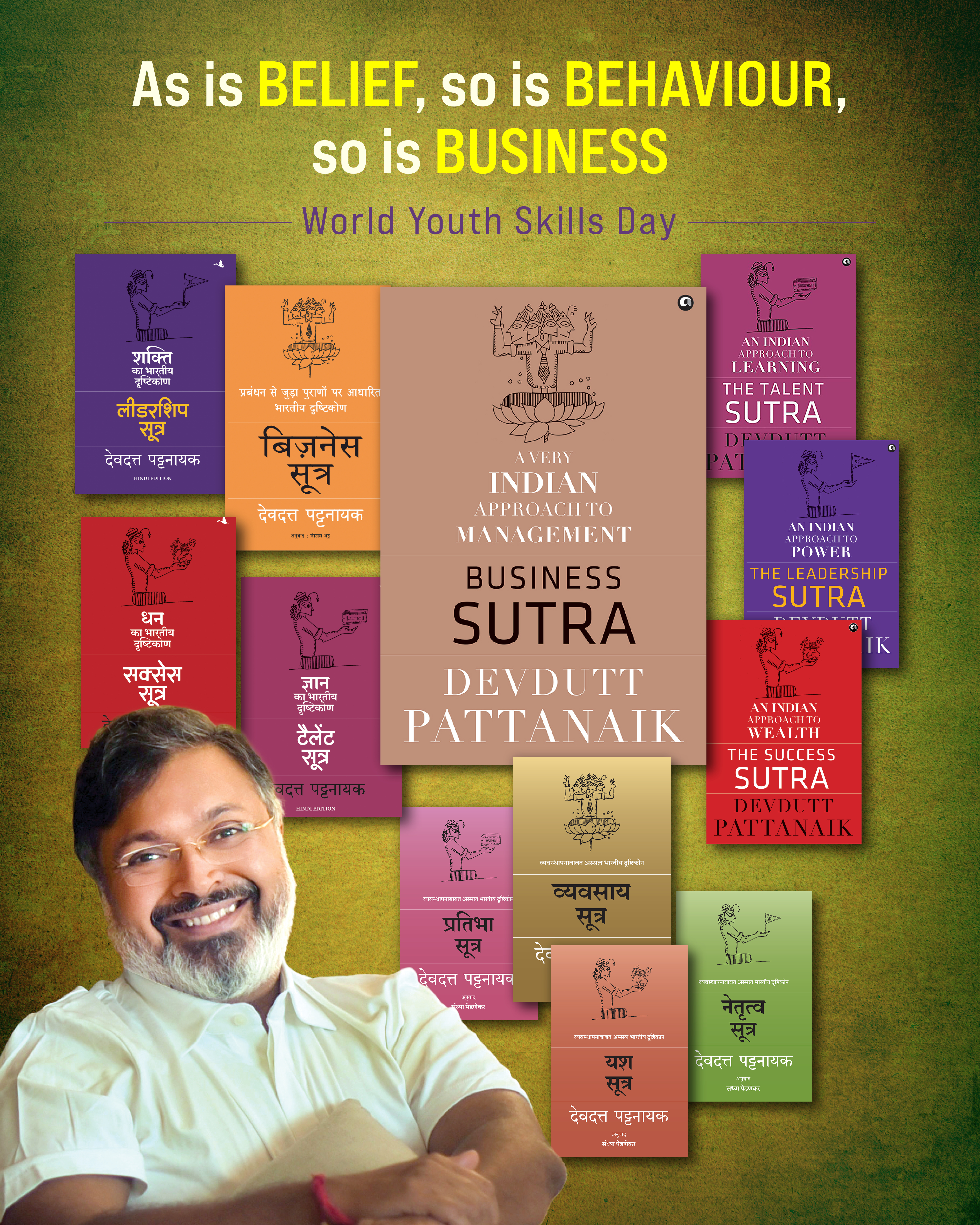
As is BELIEF, so is BEHAVIOUR, so is BUSINESS

BUSINESS SUTRA
Business Sutra uses stories, symbols and rituals drawn from Hindu, Jain and Buddhist mythology to understand a wide variety of business situations that range from running a successful tea stall to nurturing talent in a large multinational corporation. At the heart of the book is a compelling premise: if we believe that wealth needs to be chased, the workplace becomes a rana-bhoomi – a battleground of investors, regulators, employers, employees, vendors, competitors and customers, if we believe that wealth needs to be attracted, the workplace becomes a ranga-bhoomi – a playground where everyone is happy.

The Talent Sutra
Saraswati is the goddess of knowledge in Hinduism, as well as in Buddhism and Jainism. Her name is derived from the fluidity (saras) of the imagination. Human imagination enables us to invent and innovate, visualize, plan and de-risk. Yet imagination is a bad word in the world of business and management. It strips us of certainty. We want to control the imagination of those who work for us, prevent their minds from wandering from work. Yet every human being lives in an imagined reality. Recognizing this enables us to work with talent, build strong relationships and nurture people to face any situation with faith and patience. Failure to recognize imagination is why family-owned businesses are unable to manage professionals and how professionally- run companies end up creating ineffective, mechanistic talent management systems. Training, learning and development, are not just about skills and knowledge and competencies, they are about appreciating the human-animal, recognizing that neither we nor those around us are programmable machines that we can plug and play. Managing people, hence relationships, is key to the survival of an organization. Derived from Devdutt Pattanaik’s influential bestseller Business Sutra, this book explores concepts like creativity in the workplace, nurturing talent and the importance of teamwork. It will help employers and managers become more inclusive leaders who are able to carry their team along with them.

The Leadership Sutra
Durga is the goddess of power in Hinduism, as well as in Buddhism and Jainism. Her name is derived from the word ‘fortress’ (durg). She is the goddess of kings. She rides a lion, the king of the jungle and a symbol of royalty everywhere from China to England. We tend to tiptoe around the role of power in management and fail to openly acknowledge how the animal desire to dominate often destroys the best of organizations. Critics tend to see power as a negative thing. But power is a critical tool that affects the implementation of any idea. Any attempt to restrain it with rules results in domestication and resentment and fails to energize the organization. Leaders often equate themselves with lions and indulge their desire to dominate when, in fact, the point of leadership is to be secure enough to outgrow the lion within us and enable and empower those around us. But this is not easy, as anxiety overpowers the best of leaders. Derived from Devdutt Pattanaik’s influential bestseller Business Sutra, this book offers startling and original insights into the exercise of power and leadership. It explores the human quest for significance, the power of rules to rob people of self-esteem and the need for stability even at the cost of freedom.