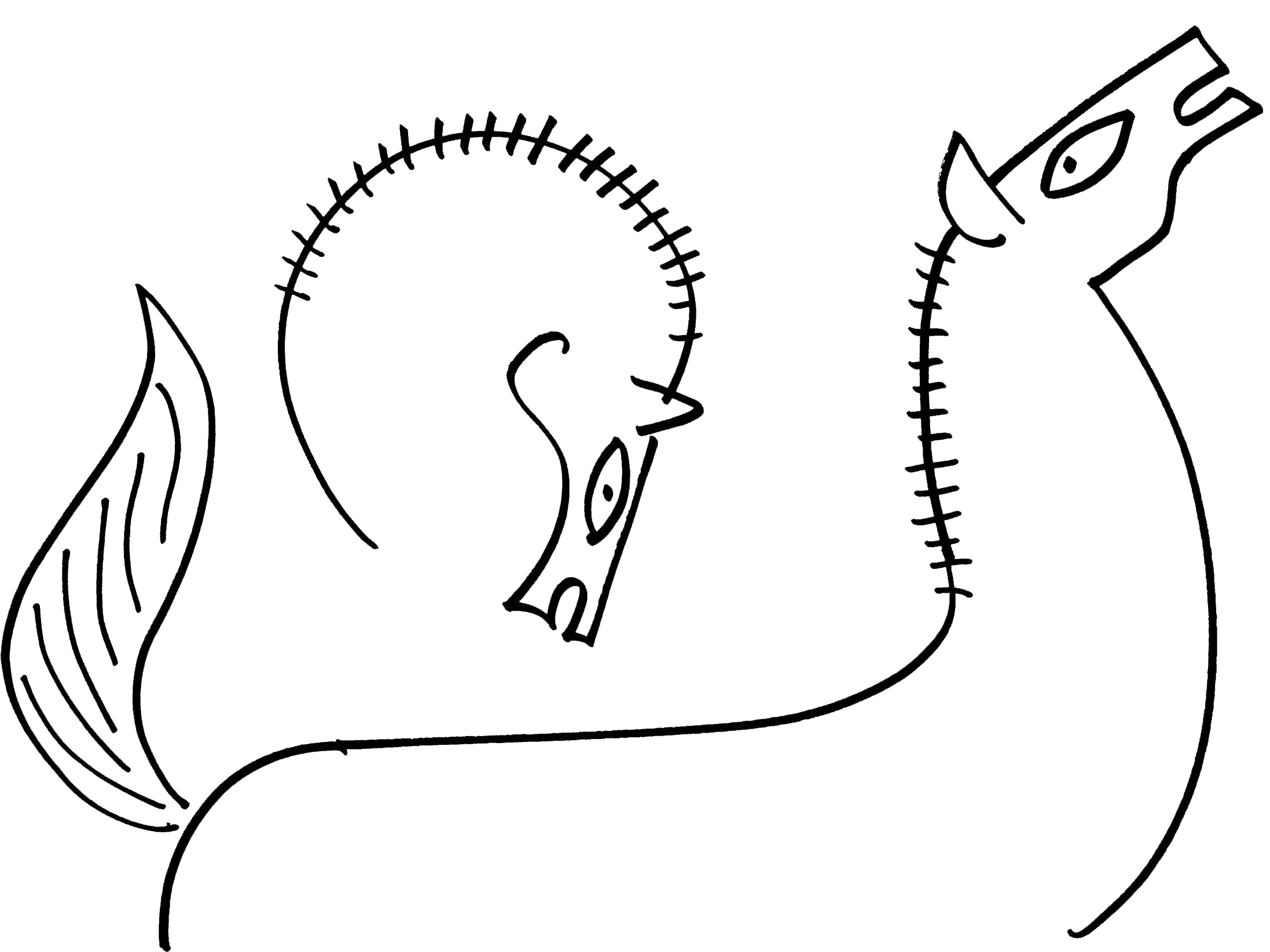
At the Varadharaja Perumal temple in Kanchi (or Kanchipuram), there is an image of a horseman that is rather peculiar. On one side, it appears to be a South Indian Nayaka king, but on the other side it resembles a foreigner wearing trousers and a tunic. A foreign temple guardian, or mercenary, either Portuguese or Turk.
The horsemen were known in Tamil Nadu as Ravuttan (horse riders), a term based on Rajput words such as Rawat and Raut (chieftain). Such guardian images are found in many temples of the Arcot and Mysuru regions. This may have inspired the “horse dance” known as “Poikkaal kuthirai aattam”, as well as terracotta horse image offerings to please folk deities such as Ayyanar.
Carved in the 17th century by Nayaka kings, it reminds us of a time — until the 19th century — when horses were imported in vast numbers to India from Central Asia, Persia and Arabia. The ‘vilayati’ (foreign) Turki horses came by land for northern markets. North Indian kings would not allow horses go south to their rivals below the Vindhya mountains. So the south imported the ‘bahari’ Arabian horses by sea (bah’r means sea in Arabic).
For over 3,000 years, horses were imported into India. They were critical to govern empires and, therefore, were always in demand. But a little known fact is that horses are difficult to breed in our country, which explains the need for annual imports.
Local horse breeding did occur in pockets of Gujarat and Rajasthan about 800 years ago. This was to satisfy the demands of the Delhi sultans, when supply from Central Asia was cut following Mongol invasions. However, the local breeds (such as Tattu) were always considered inferior to the foreign ones (Turki, Tajiki). Kathiawar was one of the few places where foreign breeds could thrive in India.
An import with impact
The Rig Veda contains some of the oldest horse poetry in the world. The horse is mentioned 200 times. It is a reminder that the poets were familiar with this foreign animal that had been imported into the subcontinent from a faraway land. There are no horses in Harappan cities because horses had not been domesticated when these cities thrived.
In the Bronze Age, we do not find horses in Egypt or Mesopotamia or China or the Harappan civilisation of India. However, by the Iron Age, horse-drawn chariots were found everywhere as indicated by artworks in ancient Egypt, ancient Greece and burial sites in China. This is when they entered India and inspired the Vedic hymns.
Genetic evidence now shows that horses were fully domesticated north of the Black Sea in 2000 BC. These were tiny animals that couldn’t be ridden. They could not pull heavy-wheeled wagons either. So, that led to a new invention: a light spoke-wheeled chariot that could carry two men — the charioteer and an archer. This was the greatest military invention of the times, immortalised in the Mahabharata as Krishna and Arjuna (with his Gandiva bow) on the chariot pulled by four horses at Kurukshetra.
Chariot-riding was replaced by horse-riding around 700 BC and became the norm when Alexander, atop a horse, defeated the chariot-riding Persian emperor around 331 BCE. The Indo-Greeks (Yavana), the Saka-Pahalava (Scythian-Parthian), and the Kushan (Yuezhi) controlled the horse-trade from 200 BC to 200 AD. Mauryan kings imported horses and exported elephants. Prince Siddhartha leaves his palace riding a horse, but there is no horse rider in the Mahabharata and the Ramayana indicating that the epics are older stories, though the manuscripts were composed much later.
Story of the stirrup
If one travels to Sanchi and Bharhut, one can see images of men riding horses on Buddhist sites. They do not have saddles or foot stirrups like the ones we find on the Varadaraja Perumal temple horsemen. They have ‘toe-stirrups’. The iron stirrup and wooden saddle were later inventions that came to India with the Turks, after 1000 AD.
Surya, the sun god, was first shown riding a chariot drawn by four horses at Buddhist sites such as Bodh Gaya, inspired by the Greek sun god Helios. While images of Surya with seven horses are based on older Vedic descriptions (1000 BC), that he is shown wearing boots indicates the Kushan influence (200 AD).
Surya’s son, Revanta is always shown as a horse rider, with a dog and hunting boars. His images do not have iron stirrups, indicating they emerged before 1000 AD. Iron stirrups are also seen in the horse riders of Varadharaja Perumal temple. Thus, we find horse art revealing an aspect of foreign influence on Indian history that will rarely make it into textbooks.