Published on 10th July, 2016, in Mid-Day.
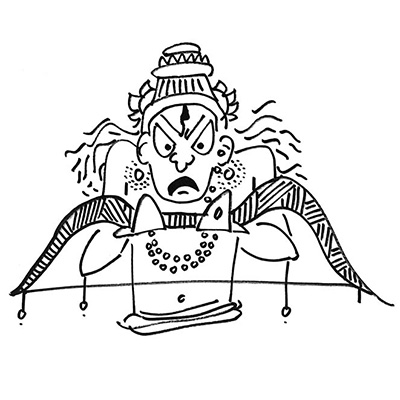
In the Mahabharata, during the war at Kurukshetra, Yudhishtira is forced to withdraw from the battlefield at one point. Arjuna follows his elder brother, to check on his wellbeing, but this annoys Yudhishtira, who would rather have Arjuna on the battlefield than in his tent. Arjuna gets upset when his elder brother mistakes his concern for cowardice. Tempers flare. Words are exchanged. Yudhishtira ends up insulting Gandiva, Arjuna’s bow. Fearing that the brothers may come to blows, Krishna intervenes until sanity returns. Yudhishtira regrets his harsh words. Arjuna regrets his rage. But then, Arjuna remembers a vow. ‘I had sworn to kill anyone who insults Gandiva. Must I kill my elder brother now? And even thinking about killing my brother, I must kill myself too.’ Arjuna moans. That is when Krishna says, ‘You can kill without killing. Insulting your brother is as good as killing him. Praising yourself is as bad as killing yourself.’ Thus, Krishna turns ‘insult’ and ‘praise’ into weapons.
How is this possible? For this we have to understand the architecture of the body as per Hindu mythology. Humans inhabit three bodies: the physical body (sthula sharira), the mental body (sukshma sharira) and the social body (karana sharira). Physical body is our flesh and our breath. Mental body is how we imagine ourselves, our fragile ego, which is nourished by praise and diminished by insults. Social body is also called causal body, as it is responsible for causing circumstances around us: our fortunes and our misfortunes. It is essentially ‘what we have’. Thus, our houses and cars and bank balance and our visiting card, that gives us status in society, are also extensions of our body, as is our self-image.
Violence is hurting the physical body. Violation is hurting the mental and social body. We feel violated when someone abuses us verbally or trolls us on the Internet. They are attacking us through our mental body. We feel violated when someone steals our money, encroaches on our property, scratches our car. They are attacking us through our social body. Krishna equates violence with violation when he says insulting others is as good as murdering them and praising oneself is as good as suicide.
Non-violence is globally glorified as the act of civilisation. But the human desire to hurt others has not abated even in the most civilised of societies. So, we substitute violence with violation. Instead of hitting you, I insult and demean you. I give you water in a separate cup. I make you wait outside my office for long durations. I pay your salary late. I overwork you and exploit you and humiliate you at work. I don’t let you use my toilet or sit on my sofa.
These are violating acts that hurt despite being non-violent. In fact, the wound is deeper. We see this desire to hurt people non-violently in the action of critics and trolls. We see this everywhere around us, in the speeches of politicians and in the gossipy and bitchy huddles with friends. It is in our sarcasm. It is in our vitriol. It is in the idea of untouchability.
As in cases of violence, ‘non-violent violation’ produces deep scars. But these scars are not visible or measurable. They play a key role in shaping our personalities, and our attitudes towards the world. It eventually impacts our lives and those of people around us.