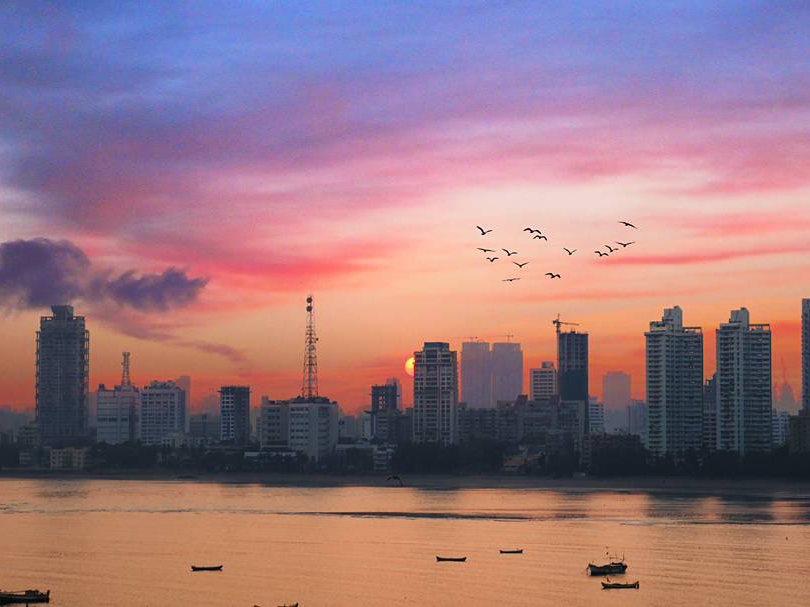
The first skyline is the contemporary 21st-century glass and concrete skyscrapers of cities like Mumbai and Delhi. These skyscrapers show that India is part of an international community of corporations and conglomerates found in Singapore, London and Manhattan. It cares more about efficiency, effectiveness and financial productivity, and less about culturally-anchored designs.
The second skyline was the modest buildings of the Soviet-style housing societies in post-independence India. The architectural style shaped government colonies of independent India where the aim was to create an egalitarian society. For many, like the Delhi Development Authority which came into existence in 1957 and has since built around a third of the housing in Delhi, the arrival of these houses was seen as the arrival of the city. Urbanism was being consciously constructed.
Before that, the third skyline is the Indo-Saracenic architecture of the British prominently seen in the 19th century structures. The buildings constructed in the architectural style included clock towers, watchtowers, courthouses and railway stations, indicating a new era of industrialisation and British imperial control. The style merged Mughal architectural features — like onion domes, overhanging eaves (chajjas), and arches — with Gothic styles. It is visible in Delhi’s Rashtrapati Bhavan and Mumbai’s Chhatrapati Shivaji Maharaj Terminus (formerly Victoria Terminus).
Also, in the 1930s, a modern international movement known as Art Deco appeared along the coast of Mumbai. The style was used prominently in office buildings, residences, and movie theatres in the city. These buildings are easy to identify with their rounded corners, nautical features like porthole windows, ship deck-style railings, and the “frozen fountain” silhouette, like a scene from books like Fountainhead. We can call this skyline 3.5 as it is part of the European influence on India.
Moreover, the fourth skyline is from the Maratha period. The period is noted for forts and temples, embodying the influence of Persian architecture in the form of arches, domes, and minarets. Massive fortifications were yet another feature of the period that became popular around 1700-1800 when Marathas dominated much of India and expanded their empire northwards even beyond Delhi.
Prior to that, the Islamic architecture of the Turko-Persianate age represents the fifth skyline. The era that began around 1200 AD is known for mosques, dargahs, tombs, and palaces bearing Persian influence visible in the true dome, the minarets, and the true arch. The architectural style avoided anthropomorphic images and used Arabic script as calligraphy.
Around this time, the Rajput architectural style also evolved. The unique cupola or pavilions (chattris), with special windows (jharoka) jutting out of the wall are some of the features of Rajput architecture. After 1500, Rajput architectural style underwent changes when Mughals adopted it.
From 500 AD onwards, the landscape was dominated by temples representing the sixth skyline. Temples in the South (Dravida style) can be distinguished by monumental entrance towers (gopuram) and the pyramidal towers. Temples in North India (Nagara style), on the other hand, can be distinguished by their bell-shaped and hill-shaped curvilinear roofs (shikhara). Though Hindu temples were grand, we must not forget the Jain temples that crown the peaks of Mount Abu and Palitana.
The seventh skyline between 300 BC and 300 AD was dominated by pillars, dome-shaped stupas, rock-cut caves, and temples (chaitya) and monasteries (vihara) of Buddhists and Jains. It was strongly Buddhist. Hindus at this time did not express themselves architecturally.
Before that, there would be a thousand-year period when there was no skyline to speak of in North India. Houses were built of organic materials (mud and straw) hence, nothing survived, although epics provide descriptions of grand cities like Hastinapur and Indraprastha.
In the Deccan region, however, since 1000 BC, there were dolmens — the eighth skyline. The dolmens were large burial sites where great people either died or were cremated or buried. Dolmens were formed from a large horizontal slab resting on two or more upright slabs. The structure was sometimes surrounded by a circle of stones.
Lastly, 4,500 years ago, in 2500 BC, there were the brick-walled cities of the Harappa in the North-Western part of India — the ninth skyline. What is notable here is that unlike the Pyramids of Egypt or the Ziggurats of Mesopotamia, there are no large, imposing structures, perhaps because this was a relatively equal society. The elite felt no need to use the architecture of palaces and tombs to intimidate the population.