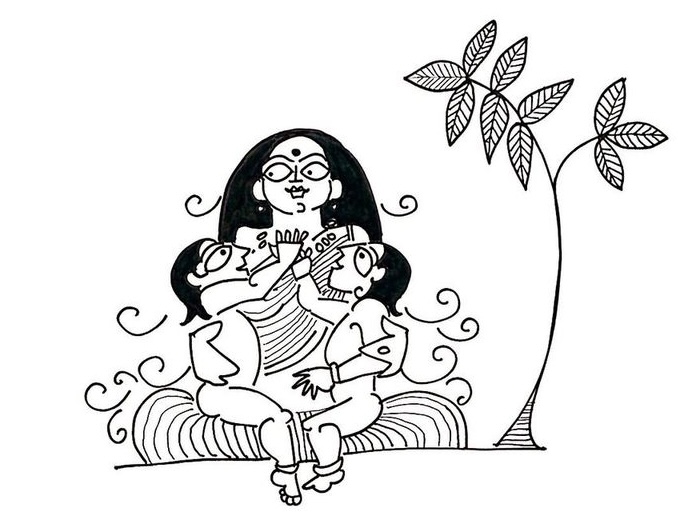
In Hindu Puranic lore, gods are usually presented as one half of a couple and are always located in landscapes. When we say Shiva, we think of him with Shakti, in the middle of snow-clad mountains or in a deodar forest. Vishnu and Lakshmi are visualised in the middle of the ocean. Krishna and Radha are always in the middle of a forest, at night. Rama and Sita are either wandering in the forest, or seated on a throne in the palace. Landscapes play an important role in stories as they symbolise emotions.
We never think of landscapes as emotions, but this is what is established in some of the oldest Tamil poetries, which are nearly 2,000 years old. Here, various emotions of lovers are connected to different geographies.
The passionate lover who elopes with her beloved from home is linked to the mountains. Here stands the ancient Tamil god Seyon, with a spear in his hand. The lover patiently waiting for her beloved is linked to the forests and pastures. This is the realm of the handsome god Mayon, much loved by cowherds. The lover who cheats on his beloved and is untrustworthy is linked to the fields. This is the realm of the rich god equated with the elephant-riding Indra. The lover who anxiously waits for the beloved is linked to the seashores. Tamils were seafarers. The god of this realm is Varuna. The lover who is on a terrible adventure far, far away on a risky mission is linked to the dry desert-like wilderness. This landscape of anxiety is linked with the goddess Kotravai, later called Kali.
In Vedic poetry, division is made between the wild forest and the cultivated fields. In the wild, there is anxiety and insecurity. In the fields, there is order and control and security. Some travellers prefer nature, where humans share space with plants and animals. Others seek culture, sightseeing monuments, and partying in hotels and clubs, where humans are in charge. In Ramayana, Rama is a creature of cultivated spaces, while Sita is the wild one of the forests. Marriage is about two landscapes meeting and working with each other. We visit each other’s landscape and maybe create a new landscape, one that is our own. In Tantrik lore, Shiva sits in the mountains, Chamunda sits in the crematorium. When they make a home, they find joy in Kashi, on the banks of the Ganga.
All relationships go through different kinds of emotions. There is the joy of finding private time away from family. There is the impatience of waiting at a restaurant. There is the anxious waiting, when there is no reply to a WhatsApp message or a missed call. There is jealousy, when one’s beloved talks about other school and college friends, the buddies who seem more interesting than you. There is the adventure of new jobs, which separates lovers, forces them to settle into long- distance relationships, and enjoy love through Zoom calls. In marriage, all these emotions are experienced and through these emotions the ancient Tamil, Tantric, and Puranic lore spoke about travelling to different landscapes. Geography was linked to psychology. Travel is as much about changing geography as it is about exploring emotions. You truly recognise your spouse after you travel together