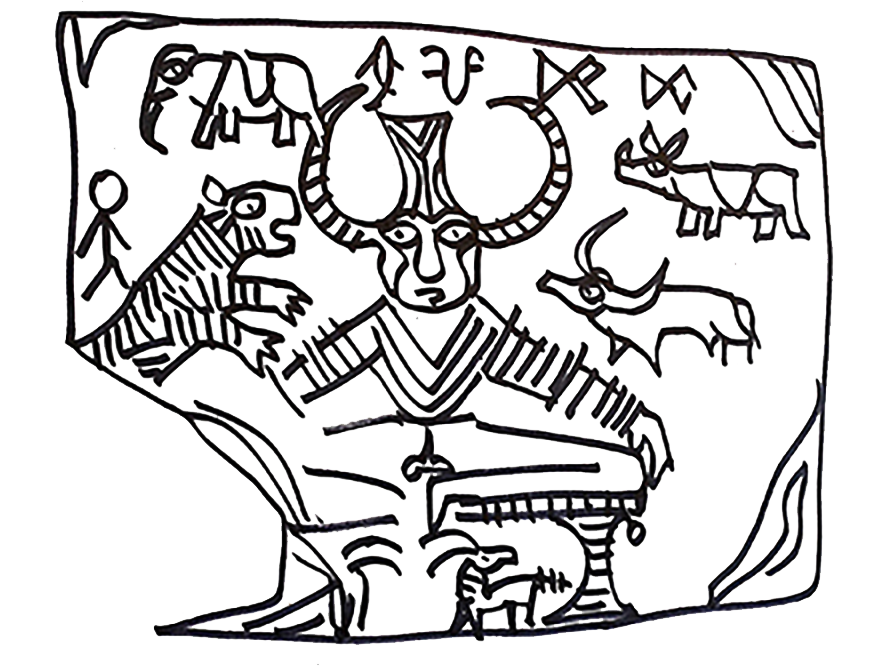
A hundred years ago, on September 20, 1924, the world learned about the Indus (Harappan) civilisation for the first time when John Marshall, then director general of the Archaeological Society of India, wrote about it in The Illustrated London News. It was based on two similar seals found first in Harappa and then in Mohenjo-daro, cities separated by over 500 km. The dating was actually done through a ‘Letter to the Editor’ by Professor A.H. Sayce on September 27, 1924. He recognised the seals as identical to those he had found in Sumer, dated to 2300 BC.
Originally described as Indus-Sumerian, it was soon clear that this civilisation had developed independently, and so was renamed Indus. But with sites found beyond Indus, in the mountains of Afghanistan in the west, the dry river bed of the Ghaggar-Hakra in the east, and the coast of Gujarat in the south, the civilisation is now named after the first city discovered — Harappa.
Now, we know that these cities played a key role in the supply of the much-in-demand lapis lazuli — the deep blue semiprecious stone used in sacred ornaments — and tin, which was needed to make the alloy bronze. Both raw materials were obtained from Central Asia and from present-day Afghanistan. It was processed in sites located on the banks of the river Indus, and were transported by boats from the Gujarat coast up the Makran and Persian coasts to Oman, from where it made its way to markets in Mesopotamia, Egypt and even the island of Crete.
Proof of mythic thinking
Harappans used seal-based administrative technology like the Mesopotamians. The most common seal — almost 80% of the 2,000-odd ones found till date in the wide area — has the image of a one-horned bull-like creature, the unicorn. Clay figurines of this creature prove that this is not simply a bull in profile. The Harappans imagined this fantastic creature, and fantastic imagery is proof of mythic thinking.
People have been wondering what these unicorns are, and the clue may lie in architecture. Harappan cities are stark and utilitarian, lack any display of wealth and power, and seem rather egalitarian, despite the use of words such as ‘citadel’ to describe the gated community with common facilities. Could it be a monastery, or the temporary residence of wandering monks who regulated trade and resolved disputes between competitive trading communities, each with its own seal? The famous ‘horned-sage’ seal was probably a representation of these monks, and may have been a unicorn — a beast not found in nature, not aligned to any clan, embodying the transcendent nature of those who shunned wealth and power. This merchant-hermit connection could explain why the elite of the Harappan civilisation shunned every cultural tool of intimidation from monumental art to elaborate tombs, which were hallmarks of contemporary Egyptian and Mesopotamian civilisations.
Mercantilism and monasticism
This model is not as fantastic as it sounds. It is found even today in many South Indian Hindu temples, and can be traced to earlier Jain temples. Mercantilism has always thrived with monasticism in India. Buddhist monasteries across Asia were established along trade routes. Of course, all the examples that we have are less than 2,500 years old. But it is not impossible that someone had similar ideas 4,500 years earlier.
Buddhist and Jain lore insist there were Buddhas and Tirthankaras who lived before the historical Buddha and the historical Tirthankara. The unicorn is shown in at least one seal sprouting out of a pipal tree, an ancient Indian symbol of monasticism, revered by later day Buddhists, Jains and Hindus.
What follows is a paraphrased version of Khaggavisana Sutta, an early Buddhist work. Khaggavisana means a sword-like horn, which is commonly translated as the one-horned rhinoceros. But it could also refer to the mythical unicorn. For the unicorn is not a natural beast, just as celibacy is not a natural state.
Wander alone like a ‘unicorn’.
Renouncing violence, children and companions, wander alone like a unicorn.
Reject longing, shun adornment, speak the truth, wander alone like a unicorn.
Abandon family, riches, grain and pleasure, wander alone like a unicorn.
Like a fish in the water tearing a net, like a fire not coming back to what’s burnt, wander alone like a unicorn.
Eyes downcast, not footloose, senses guarded, with protected mind, not oozing or burning with lust, wander alone like a ‘unicorn’.