Published on 2nd August, 2017, on Gaylaxy Mag.
When I was a small boy, I remember visiting Guhyeshwori Temple every time we visited Pashupati Temple with my parents. In fact it’s the other way around, my mother and grandmother usually visited Guhyeshwori Temple first then walked to the Pashupati Temple afterwards. Located around one kilometer east of the main Pashupatinath Temple, I was told that Guhyeshwari Temple was one of the revered holy temples in Kathmandu, Nepal. This temple is dedicated to Adi Shakti. This refers to the popular legend where Shiva, distressed, was carrying the corpse of Devi Sati and Vishnu annihilated it with his Sudarshan Chakra. Shiva later declared the 51 such places where Devi Sati’s body parts fell to be worshiped as the Shakti Peethas and meditated at all these places as various forms of Bhairavas. The place where Devi Sati’s knees fell is Guheswari in Kathmandu.
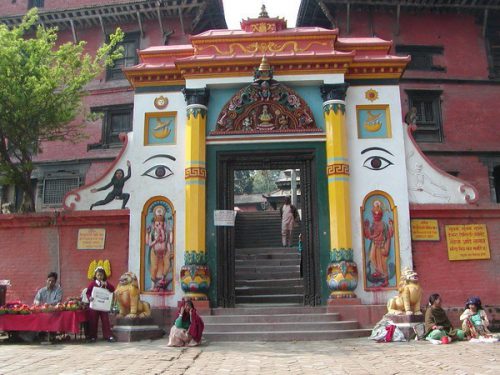
In Nepal, the form of Shakti is Mahashira and the form of Bhairava is Kapali. King Pratap Malla built this temple in the 17th century. More than the temple Pashupatinath and Guhyeshwari, and the main idols of these temples representing the Shiva and Shakti unity, I was struck by the vivid image of a life size Kinnara or Third gender and a Kankala or Skeleton, right at the entrance of the Guhyeshwari temple (you can find these images all across the Tantrik temples in Nepal, either at the entrance or on the temple wall-outside). I asked several people, “Who are they and why these images are here?” Not only did I not get any answer, but my questions made people really uncomfortable.
The Kinnar or Third gender is portrayed as having long unbound hair, has very dark skinned body except the face which is white, has fully grown-up female breasts and fully grown-up male genital which is erect, and the only thing she wears is a Bindi on her forehead. The Kinnar image is on the rights side of the entrance as you walk out of the temple, along with lord Ganesha. The life (or should I say the death) size Kankal or Skeleton is portrayed on the left side of the entrance along with lord Kartikaya. Interesting thing is that both of these images are next to big-wide open eyes on either sides of the entrance.

For many years I didn’t get any answers but during my recent conversation with Devdutt Pattanaik, I asked him the same decade old question: “Who are they actually and why these images are here? What are they trying to convey?” And I hear the most fascinating reply from him.
Devdutt Pattanaik’s Reply:
The Tantrik images are very fascinating. Perfectly aligns with Tantrik thought.
Tantrik texts and imagery starts appearing in South Asia in Buddhism and Hinduism roughly around 600 AD. During this time, society shifted in two different directions.
Gyana, which was highly intellectual and favoured celibacy and monasticism-essentially rejection of Nature (Shiva in Puranas)
Karma, which was focused on rituals and marriage and household duties-essentially control/domestication of Nature (Vishnu in Puranas)
Tantra embodied all that was being left out, rejected and denied. The raw power of nature. Its dark side. This attracted a whole school of thinkers, who were often identified as sorcerers and magicians. Lots of stories of war between celibate monks (often of upper caste) and sexual yoginis (often of lower castes).
Padmasambhava of Himalayan Buddhism comes from this tradition; he was born probably in Odisha. The Goddess plays a central role here. Here we find the ‘hidden’ aspect of life being brought to the forefront:
Death and Decay (Kankala)
Alternate Sexual beings (Kinnar/Kimpurusha)
Terror (Bhairava)
Dalits (Chandala)
Essentially all the Bhuta-ganas …… essential part of nature that no one likes: cockroaches, fleas, maggots, locusts, rodents.
These are typically associated with Goddess. She is offered food that the ‘mainstream’ gods avoid: lemon, chillies, blood.
Thus the world is acknowledged between those who deny nature, those who control nature and those who appreciate nature’s hidden (guhya) side that culture denies.
In the temple gate, we are forced to see (see the value placed on eyes) what we don’t want to see.
Her children (lord Ganesha and Kartikiya) reveal her power. She managed to get the super-celibate Shiva to give her children. Neither are born normally via sexual intercourse. This is triumph of nature/Goddess over three dominant aspects of culture/God (priestly Brahmin, royal Vishnu, ascetic Shiva).
Modern Western society wants to bring the “dark” aspects of nature in public space. This frightens many ordinary folk who react with violence.
Traditional society in South Asia acknowledged the queer but avoided bringing it to mainstream. They had their place in the margins, but were never completely rejected or denied.
Hope this answers your questions.
Thank you Devdutt for this insight!