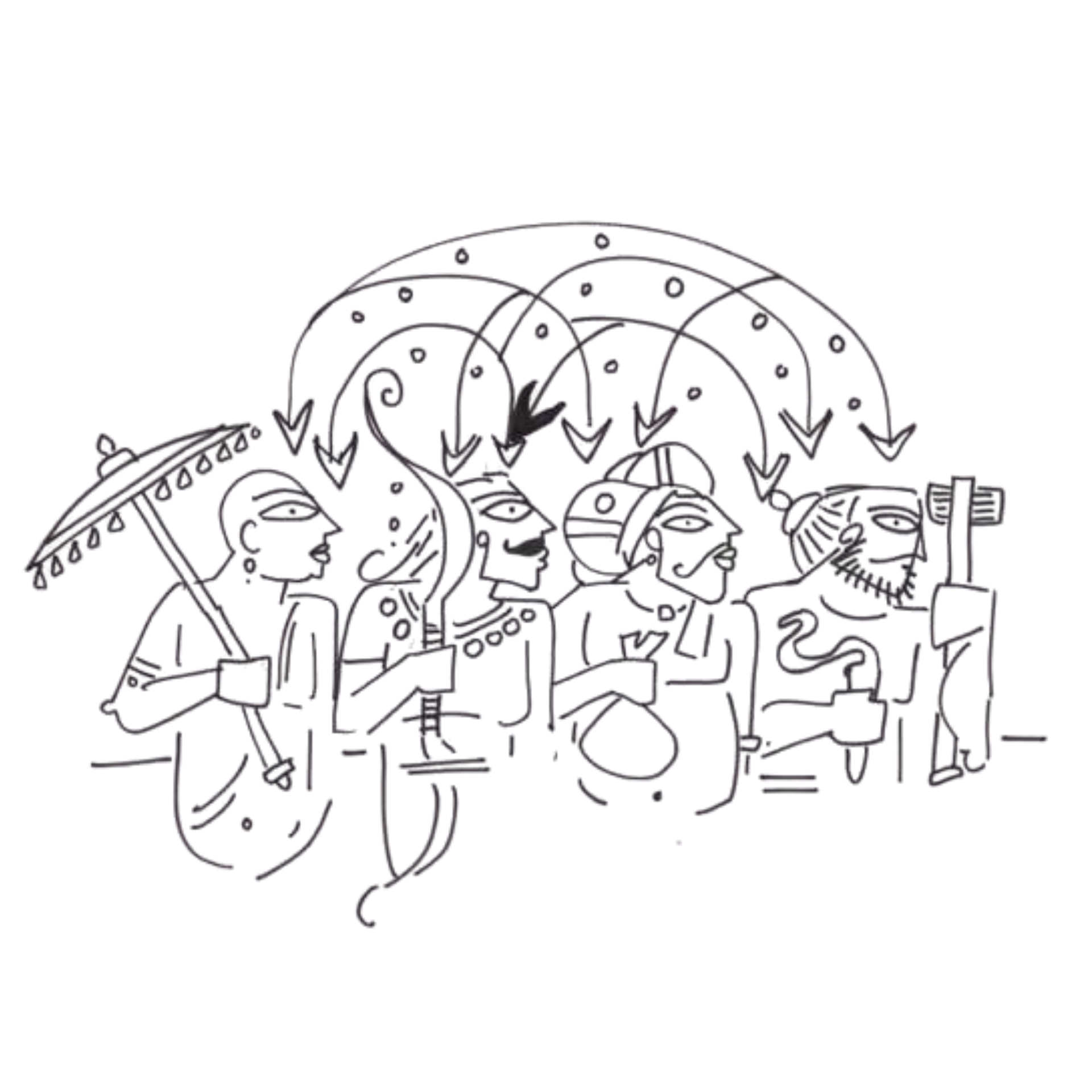
One finds the agiary on the western coast of India, in Mumbai and towns such as Sanjan and Diu in Gujarat. These fire temples of the Zoroastrians, frequented by those who call themselves Parsis or the people of Persia, are distinguished by their unique artwork that evokes memories of ancient Mesopotamia: giant winged bulls with human heads, and birds with human torso and head.
These creatures can be traced to 8th century BC Assyrian architecture in the lands we now call Iraq. They eventually made their way to Persia, by the 5th century BC. The fantastic beasts combined the strength of bulls and eagles, and were seen as servants of the ‘one true God’. This was a revolutionary idea in the otherwise polytheistic and pagan ancient world.
Gods were represented by images back then, and housed in temples. But the Persians chose fire, preferably that which came from the sky as lightning, to represent the formless Ahura Mazda — the benevolent power, one who is not a jealous god, one who does not demand obedience. Persian monotheism influenced the Jewish community, which was exiled in Babylon at the time. The Jews were seeking a narrative to unite the displaced tribes, and they were inspired by Persian ideas such as Paradise, the Devil, and the Day of Judgement. Though the Jewish God would be a jealous one, seeking absolute fidelity and submission. Thus was born the Jewish Bible, which would later become the Old Testament of the Christians, and would influence stories referred to in the Quran. The world forgot the origin of these stories, but they still survive in India, a land that gave refuge to all religions. Albeit conditionally.
Embracing caste to survive
As per legend, and documented in the 16th century AD in works such as Qissa-e-Sanjan (Legend of Sanjan), the Parsis arrived on the Gujarat coast over a thousand years ago, seeking refuge from Arabic invaders. The local Indian kings — the Pratiharas and the Solankis — were reluctant to accept them as refugees. They were apprehensive of foreigners because they were aware of the rising tide of Islam. The refugees, however, assured the king that they would not proselytise their faith or convert locals. They would, instead, mingle ‘like sugar in milk’ — adopting the Indian way, speaking the local language, and dressing up as the natives did. Caste rules were implied.
Even today, the Parsi community has strict rules of endogamy, and non-Parsis are not allowed to enter the agiary (just as many temples forbid entry to non-Hindus). Ironically, the community owes its rise during colonial times to the fact that the British found them easier to deal with (they ate meat and eggs) than the Muslims (who they never trusted) and the Brahmins (whose caste rules they found annoying).
The 19th century saw more Parsis coming to India, particularly to Mumbai. A century later, Persia had been renamed Iran by Reza Shah, a Nazi sympathiser, who wanted to remind the world that the word ‘Arya’ was first inscribed by the Achaemenid emperor Darius the Great over 2,500 years ago, at Behistun, a large rock relief in the mountains of western Iran. The new wave of immigrants to India were called Iranis, and became famous for their cafe culture. Though they follow the same monotheistic faith and come from the same homeland, Iranis are seen as a separate community by the Parsis. Caste manifests in various ways, one could argue.
Indo-European connection
The Parsi community forms the transition zone between the monotheistic mythologies of West Asia and the polytheistic mythologies of South Asia. Genetic, linguistic and archaeological evidence now informs us that the eastern arm of the Indo-European speaking people, who domesticated the horse and invented the chariot around 2000 BC, settled in the Oxus basin around 1700 BC, where they were exposed to a thermogenic herb. They split into two groups — one went west towards Iran, and referred to the herb as ‘homa’, while the other crossed the Hindu Kush, and came east to India and called the herb ‘soma’.
The former mingled with the Mesopotamians and became monotheists under influence of a prophet called Zarathustra. He referred to the Devil as Angra Manyu, and to demons as ‘div’. The latter referred to their gods as ‘deva’. For the west-moving Ariya people, Yima was the first human; for the east-moving Aryas, Yama was the first human who died. The two groups would meet as strangers, nearly 2,000 years after the separation, and they would discover their common roots, rather alarmingly, because of enquiries by European racists on the origins of civilisation.
And despite the Aryan connection, neither can the Hindus enter the Parsi agiary, nor can the Parsis enter orthodox Hindu temples, in the 21st century.