Published on 7th June, 2015, in Mid-day.
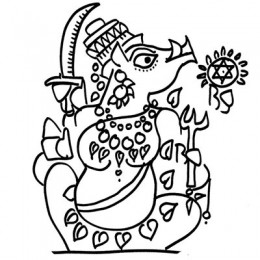
We have heard the story of how Vishnu takes the form of a wild boar, plunges into the waters, defeats an asura and raises the earth-Goddess on his snout and brings her back to the surface of the sea. This is Varaha, whose images adorn many Vishnu temples, though temples dedicated to Varaha are not very popular, except in certain parts of Andhra Pradesh. But what about a goddess who is a sow, or a female pig? Varahi? When was the last time we heard about her?
Varahi is a goddess described as having the head of a sow and pendulous breasts and pot belly and anywhere from two to six arms bearing many weapons, which includes a trident, a noose, a mace, a discus, who sometimes holds a child in her arms, and is often shown riding a buffalo. Varahi is worshipped usually at night, and offered fish and the blood sacrifice of male animals. She has no male consort. And this makes her a Tantrik goddess, associated with fertility (hence the baby) as well as death (hence the buffalo). Her temples are few and far between. Some of the more popular ones are in Odisha, Varanasi, Chennai and Nepal. The temple in Chaurasi, Odisha, receives offering from the Jagannatha temple in Puri, a Vaishnava shrine that has always acknowledged a close relationship with Tantrik Shakta goddesses.
Varahi is most popularly known as one of the many Matrika goddesses, a female collective, often identified as the shaktis of male gods, who emerge to support Durga in her battle with Raktabeeja. These goddesses, Varahi included, drink the blood of the demon so that he cannot reproduce himself. Among the Matrikas, of which there are typically seven, Varahi appears fifth, and is therefore called Panchami. And there is an interesting reason for this. The Matrikas are commonly linked to the Devanagari alphabet and seven Matrikas embody the seven rows of consonants, with Varahi embodying the fifth, hence the sounds: pa, pha, ba, bha, ma.
Pigs are known for their intelligence, fertility, fierceness, and independence. In India, neither Muslims nor meat-eating upper caste Hindus eat pork. Pigs have traditionally been seen as dirty, and ‘untouchable’ and associated with communities also considered ‘untouchables’ who lived in the fringes of villages. This forms the basis of the critically acclaimed Marathi film: Fandry. Varahi’s worship thus does contain an element of defiance, and subversion.
In Vaishnava texts, Varahi is the shakti of Varaha. In Shakta texts, Varahi is the mother of Varaha. Varaha is always associated with the demure earth-goddess while Varahi is fiercely independent. Varaha is worshipped with fruits and milk while Varahi is offered blood and meat and even alcohol. Varaha is part of the Vishnu pantheon and worshipped at daytime while Varahi and her Matrikas are typically worshipped in the night. This tendency of having a Varaha-like force and a Varahi-like counterforce to create a churn is what has enabled Hinduism to survive and thrive despite many historical challenges.
We live in times when Hinduism is being increasingly defined in puritanical terms: where celibacy is glorified, where non-vegetarian food and alcohol is viewed as bad, where female freedom is feared. These are times to remember goddesses such as Varahi, who emerged as part of the Tantra challenge to puritanical Vedanta, and ensured humans have a more realistic rather than romantic view about sex, violence, life and death.