Published in Devlok, Sunday Midday, December 23, 2012.
Young people constantly approach me saying they wish to read the original Ramayan, original Mahabharat, and the original Purans. It makes me feel so happy that Generation Y is not what pundits claim them to be. They are seeking what is known in academic circles as the Ur-text, a word of German origin that refers to an original document. But there are none when it comes to India.
There are two reasons for this: structural and philosophical.
Structurally, Hinduism or Jainism, even Buddhism, is not based on a book. This is unlike the other major religions of the world: Judaism, Christianity and Islam. Judaism has the Tanakh, Christianity has the Bible and Islam has the Koran.
In Islamic times, so much value was given to the Koran that when Sikhism formalized itself a holy book was created over 200 years compiling all the holy songs of wise men of the time describing the idea of the divine. This was the Guru Granth Sahib, known as Adi Granth or Ur-text of the Sikh faith, declared as the embodiment of the guru.
In colonial times, Christianity dominated the world, and so religions that did not have a book were dismissed as false religions leading to a scramble amongst Hindus to find one single holy book. Bhagavad Gita’s popularity over the last century is indicative of this need. Rig Veda, the earlier favorite, was more esoteric and it seemed to shy away from ideas like God, even rebirth, making it agnostic, not in line with ideas of devotion.
Philosophically, ideas from India — be it Hinduism, Jainism or Buddhism, seek to be sanatan, or timeless. Timeless ideas do not belong to any period of time or geography, hence cannot be locked in a book or a particular script. So the desire to find the original Ramayan is seen as foolhardy as Ramayan has always existed. But still there is pressure to go back to the original Ramayan to separate it from the ‘corrupting’ and ‘polluting’ impact of future generations.
In Hinduism, every holy book has several editions and several variations, in several languages, and so it is often difficult to know what is the original. And each book makes sense only when it is read with other texts that complement it. Often oral traditions have to be considered too, but that is a whole new issue.
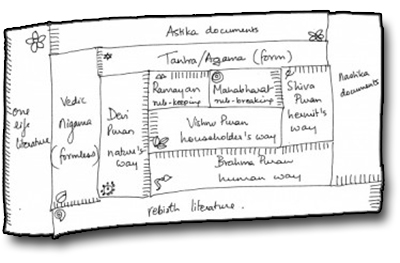
Ramayan of the rule-following Ram complements the Mahabharat of the rule-breaking Krishna, both of which are subsets of the Vishnu Puran, that tells the story of Vishnu. Vishnu Puran speaks of the householder’s way of life, and complements Shiva Puran, which speaks of the hermit’s way of life. Both make sense under the larger umbrella of Brahma Puran, which complements Devi Puran, which speaks of the Goddess. All these fall in the category of Agama or Tantra where thoughts are personified as characters and made ‘sa-guna’. These complement Nigama or Veda where thoughts remain abstract, hence stay ‘nir-guna’.
Vedic texts came to be known as astika because they expressed themselves using theistic vocabulary. But many chose to explain similar ideas without using theistic vocabulary. These were the nastikas (Jains and Buddhists), also known as shramanas, the strivers, who believed more in austerity, meditation, contemplation and experience rather than transmitted ritual and prayers favored by priests known as Brahmins. Their texts have to be read to appreciate Vedic texts better.
Each book thus that explains India is, like the land itself, one piece of a grand jigsaw puzzle.