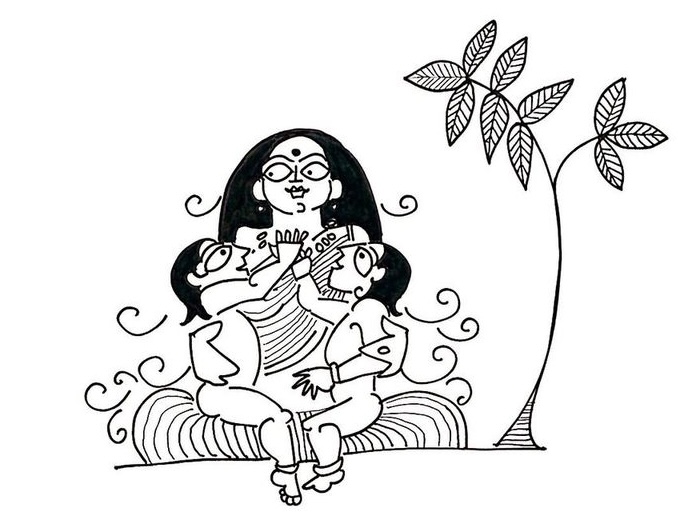
As per the Jataka tales, before he became the Buddha, Siddhartha Gautama experienced 550 rebirths. The stories of these rebirths are recounted in the Jataka tales. He was reborn as plants, animals, and humans. He was always reborn with a male body, never a female one.
And yet, in the 20th century, when Buddhism was reimagined in India and in the West, many people rejected the idea that Buddhism endorses the concept of rebirth. Scholars argued that rebirth was a Brahminical concept, intended to justify the caste system, as it was claimed that good deeds lead to rebirth in upper-caste families and bad deeds result in rebirth in lower-caste families. Reformers argued Buddhism was anti-caste, anti-fatalism and had nothing to do with rebirth doctrine.
This is rather ironic, as the early Vedas have only a crude notion of rebirth, where ancestors of those who perform rituals can be reborn on earth. The more elaborate karma theory was popularised by monastic orders like Buddhism, Jainism and Ajivika, around 2,500 years ago. These were the “gnostic” faiths that saw life on earth as a materialistic polluting trap, and offered liberation from the wheel of endless rebirths.
In the early days of Buddhism, it was said that a Buddhist monk could transfer positive karma at will to those who supported him with food and donations. Thus, merchants who sponsored Buddhist activities could earn good luck by funding Buddhist monasteries. This “prosperity spirituality” facilitated the widespread growth of Buddhism along trade routes of India. Buddhist doctrine allowed people to break free from the shackles of social hierarchy, and get rich, by investing the positive karma of monks in their businesses.
As merchants took Mahayana Buddhism to China and Southeast Asia, about 1500 years ago, many merchant-kings began seeing themselves as Bodhisattva, or Buddha-to-be, like Maitreya, who is Buddha of the future, who delays his Buddha-hood for the good of humanity.
Rebirth took on a new dimension in Tibetan Buddhism around 1,000 years ago. In this tradition, the Lamas of Tibet introduced the concept of conscious reincarnation, where the heads of monasteries would declare where they would be reborn after their death. This concept was employed effectively in political contexts.
The Tibetans popularised the image of Kalachakra, or the wheel of time. In the 13th century, Kublai Khan of China met the Lamas of Tibet and embraced Buddhism. Two hundred years later, Mongol warlords claimed to be reincarnations of Kublai Khan, with support from the Lamas of Tibet, who themselves were said to be reincarnations of Phagpa Lama, the religious leader who had converted Kublai Khan. Soon, individuals aspiring to kingship in Mongolia, Tibet, or China began asserting that they were reincarnations of former kings or Lamas.
This idea even reached the Islamic world, where the Mongol destruction of Baghdad was explained through the concept of reincarnation. It was suggested that before Muhammad, the earth had been visited by many prophets, who were born in various parts of the world, and their reincarnations had manifested as the Mongols who defeated the Muslims and destroyed the city of Baghdad.
Thus, the modern tendency to view Buddhism without the doctrine of rebirth is to disregard a central tenet of this ancient faith.