Published on 9th May, 2021, in Mid-day.
Humans found food in the plant and animal kingdoms. They were first foragers of fruits and roots, and hunters of animals. Then, they became cultivators of the land and herders of goats, pigs, sheep and cattle. Many tribes in India tell the story of how Thakurdev taught them to domesticate cows and cultivate rice, thus giving them an alternative to hunting and gathering. But this caused friction between those who wanted to wander and those who wanted to settle, the hunter/herders and the forager/farmers. The settlers valued land, and so boundaries, while the wanderers believed in no such thing, taking cattle across farms and pastures, defying boundaries.
This dichotomy is seen even in the 4,000-year-old images of pharaohs of Egypt, with criss-crossed hands. In one hand there is a flail, and in another a shepherd’s crook. The crook was a herdsman’s tool, used to domesticate animals, while the flail was the farmer’s tool, used to de-husk grain. Metaphorically, it indicated the use of power to control people, turn them into obedient sheep, and remove the disobedient from the obedient, like chaff from grain.
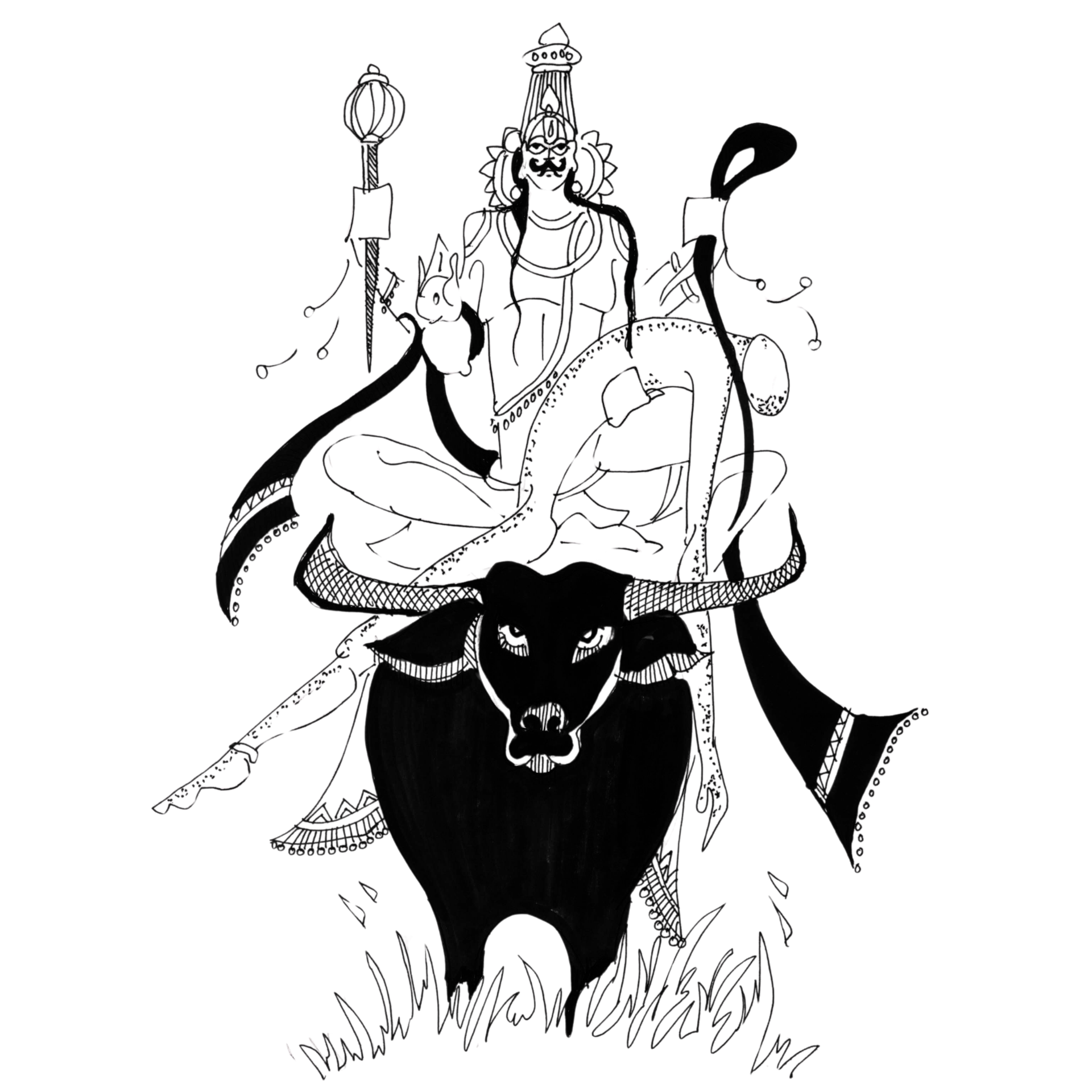
Harivamsa, the appendix of the Mahabharata, gives us stories of Krishna’s childhood for the first time. Associated with the cow, he always has a crook on him (this image is mostly found in South Indian temples), and Balarama, his brother, associated with farming, always has a plough. In Indo-Greek coins, Krishna is shown with the wheel of the cart pulled by oxen, and horse, and Balarama holds a pestle to pound grain. Krishna is the primal herdsman and Balarama, the primal farmer. But they work with each other. They collaborate; they do not compete.
In the Bible, there is a story of Cain and Abel, sons of Adam and Eve. Cain, a farmer, kills Abel, an animal herder, because he feels God prefers the offering of animals over the offering of grain. What he does not notice is that his brother’s offering is generous, while his is stingy. Be that as it may, it reveals the primal tension between the farmer who has settled next to cultivated land, and the herder who has animals that wander in search of pastures, often threatening crops of settled communities.
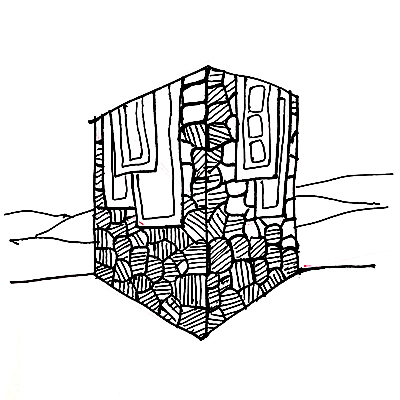
A similar story is found in the Islamic traditions, where Cain is Kabil, and Abel is Habil. Kabil lives in a house of stone, indicating settled life, while Habil lives in a house of cloth, a tent, indicating he is nomadic. Kabil is taught by the devil to murder his brother with a stone. Later, Kabil, the killer of Habil, dies when his stone house collapses over his head.
Tension existed in the Arab world between the city-dwellers who lived along the coast of Arabia, and experienced rain and so were involved in farming, and the desert-dwellers, the Bedouins. The latter moved on camels from oasis to oasis. The Prophet Muhammad’s parents belong to the coastal cities, while his foster mother was a Bedouin. The Kaabah, the metaphorical House of God, a room of stone in Mecca, built by Prophet Ibrahim, centre of Islamic pilgrimage, is always covered with a black cloth. This perhaps reminds the Muslim world, as they go around the cuboid structure, of the eventual peaceful union of the fighting brothers—the nomadic (the cloth) and the settled (the stone), the two states of human existence: the restless and the restful.