Published on 12th February, 2023, in Mid-day.
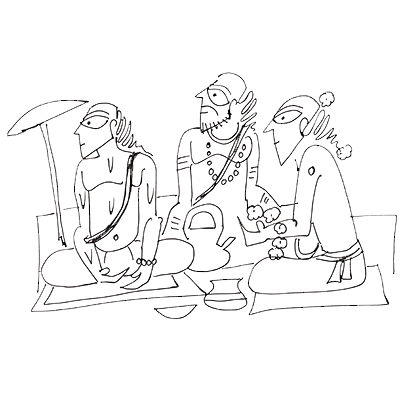
Our textbooks teach us that Hindu society is divided into four groups: Brahmin, Kshatriyas, Vaishya, Shudras, consisting of priests, landed aristocrats, merchants and servants. This is the Vedic varna system. However, this is a highly simplistic division, which doesn’t take into account that there are over 5,000 communities (jati) in India, which can be classified in various ways across these four categories. This is best understood by studying the subdivisions of the Brahmin division.
In Vedic times, Brahmins were classified as Hotrs who chanted Rig Vedic hymns, Udgatrs who sang Sama Vedic hymns, Adhvaryus who performed Yajur Vedic rituals and mumbled Yajur Vedic hymns. Then there were the Atharva Vedic Brahmins linked to spells outside the yagna ritual world. These different groups became the many shakhas or branches of Vedic Brahmanism.
These were further divided on the basis of gotra. Gotras are difficult to define, some say it belongs to lineages who shared the same cattle herd housed in the same cattle shed, or the same original teacher or academy. Practically speaking, members of the same gotra (sa-gotra) are not allowed to marry. Then there emerged Brahmins based on vocation: the Shastri (subject matter expert), the Pundit (the temple priest), the Joshis (astrologer), the Upadhyay (teacher), for example.
Later, there came to be Brahmin families linked to multiple vedas. In Uttar Pradesh, we find Chaturvedi (four), Trivedi (three), Dwivedi (two). In Bengal, we find the upadhyaya (teachers) were classified into Bando-padhyay, Chatto-padhyay, Gango-padhyay, Mukho-padhyay.
Another way of classifying the Brahmins is by their geography. So you have the Pancha Dravida Brahmins or the five Southern Bradman’s and the five Northern Brahmins described in Rajatarangini. Thus there are Brahmins who belong to Kashmir, Pahari, Kanyakubja, Sarayu-paar, Kashi, Mithila, Utkala, Vanga, Andhra, Karnataka.
There are further subdivisions, for example, in Kerala, we find rivalry between the landowning Brahmins Nambudiris and the Brahmins who lived and worked in the temple, the Ambalavasi Brahmins. There is also rivalry between the older migrants to Kerala who have the top knot tied in front known as Purvashikha and the later migrants who have their top knots behind.
Brahmins are divided on the basis of the deities they worship and the philosophy they align with. There are the Smartas who worship Shiva, Vishnu and Devi. There are the Shrautas who value the Vedas. There are the Vaishnavas, who value only Vishnu. Amongst Vaishnavas, the Sri Vaishnavas distinguish themselves from the Madhwa Brahmins of Karnataka who value Dwaita philosophy. In Tamil Nadu, the Sri Vaishnavas are divided into the Northern and the Southern groups, based on which scriptures and sub-philosophy they value.
There are hierarchies amongst Brahmins too. Those who performed funeral rituals were seen as lower than those who performed marriage rituals. Those who chanted Vedic hymns were seen as superior to temple priests. Those who worked as weavers and musicians in temples were called Brahmins as they had access to the temple but were placed in lower rank. Thus with heterogeneity, we also find hierarchy within Brahmin groups, who make up barely five to 10 per cent of the Hindu population.