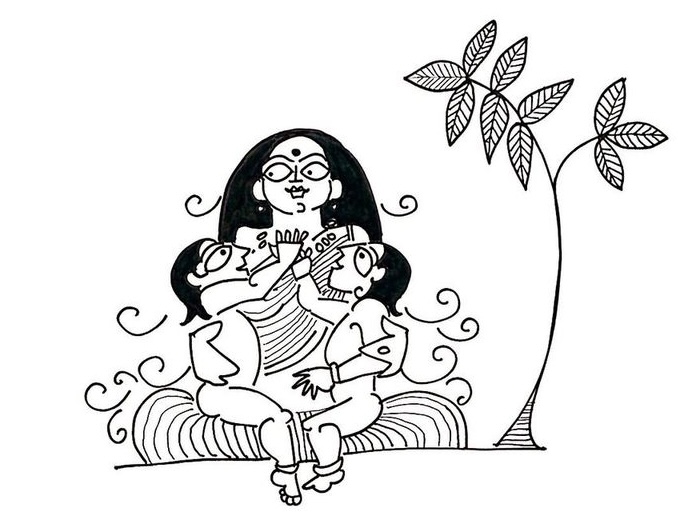
In the Vedas, composed in the Indus and Ganga River basins, before 1000 BCE, Indra is the king of Vedic gods. Indra had to protect his cattle from being stolen by demons like Vritra and Vala. We can take this literally or metaphorically. Indriya is the Vedic word for sense organ, equated with grazing cattle, always at risk of getting lost and stolen. Indra must protect them. There is tension between restraint (yoga) and indulgence (bhoga).
How do we prevent our sense-organs from leading us astray? That was the concern of the spiritualists. For materialists, the spiritualists were people seeking power by controlling others. Those who opposed pleasure were not Indra; they were Vritra and Vala. These pleasure-seeking materialists were called Charvaka, those who love to let their cow-like sense-organs (indriya-go) graze (charu) on the pastures of pleasure.
We get a glimpse into the world of Charvaka when we read poetry of people untouched by the spiritual sensibilities of Jains, Buddhists, and Brahmins, in early Tamil and Prakrit poetry, composed even before 100 BCE. Here is a verse from a Tamil Akam poetry written in the Kaveri delta, that captures the simplicity of people as they go about seeking the sweetness of life: ‘My friend, like nectar hidden in a rock. Living without the joy of union brings only pain.ʼ
Here is a verse from the Prakrit work Gathasaptasati, written in the Deccan region, in the Godavari delta, about the quest for pleasure: ‘This young man refuses to be leashed. See how he rushes to his beloved like a patient to his doctor.ʼ
Those who did not bother with the spiritual world were deemed nastikas (non-believers) while those who saw the spiritual cause and consequence of all things material were deemed astikas (believers). Charvakas were nastikas therefore. Brahmins clubbed them with Buddhists and Jains who were seen as nihilists, rejecting the world itself. However, the Buddhists and Jains also rejected the Charvaka. Opposition to the Charvaka was one thing that brought the Buddhists, Jains, and Brahmins together, as these intellectuals saw the pursuit of pleasure as causing pain, violence, and anarchy. It had to be regulated.
Charvaka was presented as a ‘a school of thoughtʼ. But it was not. It was just default programming, ordinary people (loka) lived their lives, driven by wants and desires, without examination. This is why Charvaka was called Lokayata (way of the people). The text describing this materialistic way of functioning was known as Brihaspati-sutra. Unfortunately, this text is lost, and we have access to a few unreliable fragments. Here is a popular verse: ‘Live life to the fullest. Drink ghee even if obtained by foul men. When you die, your body will be burnt. Nothing awaits thereafter.
Was this Brihaspati the guru of Indra as per Hindu mythology, or was it someone else? Or were these the same Brihaspati in two phases of their life: youth, and old age? In the Mahabharata, we are told two stories about Brihaspati. One in his youth, and one later. We cannot be sure if they are the same Brihaspati.
· In his youth, Brihaspati desired Mamata, the wife of his brother Utathya. He forced himself on her anyway. She was already pregnant. The child already in her womb became blind and was named Dirghatamas. The child conceived by force was abandoned and adopted by Kuru-Bharata.
· In his old age, Brihaspati (Jupiter) was horrified when his wife Tara (star) eloped with Chandra (moon). Brihaspati forced Indra (sky) to fight Chandra and bring Tara back. Tara returned, pregnant. Furious, Brihaspati cursed the child that he would be neither male nor female. Thus, was born Budh (mercury) of ambiguous gender.
Both stories are about kama. If we connect them, it seems that as an unmarried youth, Brihaspati did not respect the marriage of Utathya and Mamata. However, later, he is himself on the receiving end when Tara does not respect their marriage and elopes with Chandra.
Did Brihaspati favour the Charvaka ways in his youth? Did he change his mind later, after marriage? Brihaspati would surely have reflected on the Charvaka behaviour of his wife, and himself, when they are driven by their feelings, unrestrained by rules, responsibilities, and spiritual restraints, feeling neither guilt nor shame. He saw the power of kama, that had provoked Brahma to chase his own creation, his daughter.
In passion, humans do not think of merit (punya) or demerit (paap), or entrapment in the wheel of rebirths (samsara), or code of social conduct (dharma). Did Brihaspati then change his mind, and abandon his old carefree and careless ways? Did he then become the very patriarch he opposed? Did he then become the teacher of Indra, restraining him, forcing him to follow the path of hermits like Brahmins, Buddhists, and Jains of yore?
We can only speculate and reflect on our own lives as our sense-organs crave to graze on the pasture of sensual stimuli around us.