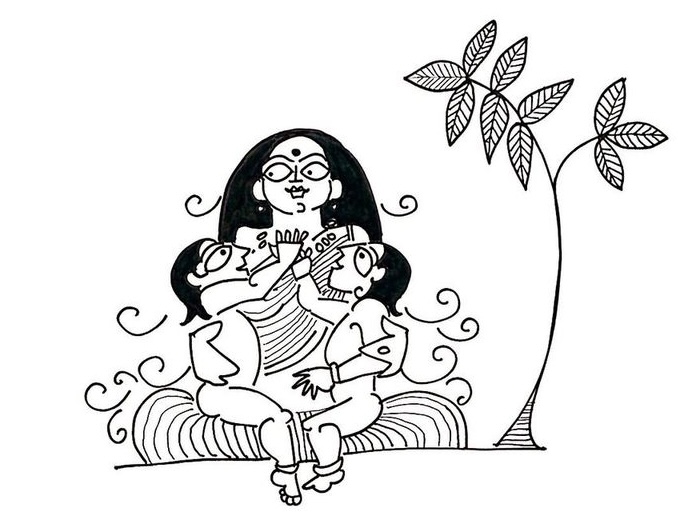
Varuna is one of the most ancient gods of the Vedic pantheon. In the Rig Veda, he is majestic, distant, and terrifying. He sits above the world, ruler of the sky and the ocean, guardian of the cosmic law called rta. He sees everything. Nothing escapes him. His noose catches those who lie or break their word. His power is not physical strength but moral authority. He is a governor and a judge.
He belongs to the world of priests, chants, and night skies. He complements Indra, the warrior. Indra is associated with raids and war. Varuna is associated with peace. Indra accumulates wealth (yoga). Varuna distributes wealth (kshema). Indra is linked to individualistic expansion (svarajya). Varuna is linked with collective consolidation (samrajya).
But in later texts, Varuna is linked to the sea and the western direction, just as Indra is more linked to rain and the eastern direction. When Vishnu and Shiva rise in popularity, Varuna becomes father of Lakshmi, the goddess of fortune, who Indra woos.
But, far away from the texts, along the long Indian coastline, a different Varuna lives. A romantic sea god — Samudra Dev, Jol Devta, Varun Raja. Here, people speak to him, sing to him, fear him, love him. Fisherwomen sing at dawn, traders pray at dusk, and sailors whisper to him before sailing. In these songs and stories, the tides of the sea represent the yearnings and craving of a lonely god.
In Gujarat, they tell of a fisherwoman who sings so sweetly that Varun Raja rises from the sea to woo her. But when she refuses, he does not punish her. He leaves her pearls and fish — gifts of the ocean. In Odisha, the sea god falls in love with a young bride who waits at the shore for her husband’s return. He cannot have her, so he gives her safe passage and treasures instead. And in Bengal’s Sundarbans, the sea god seduces a pearl maiden, takes her beneath the waves, but lets her go when she wants to return to the human world. This is not the cold Varuna of the Veda, but a warm, desiring, passionate god.
So we have two ways of seeing the same god. One is cosmic, where Varuna stands for law, morality, and distant power. The other is folk, where he is a sensual sea-god, who desires but also respects the shore. In the first, the sea is infinite and formless, like the night sky. In the second, it is alive, hungry, breathing, a lover who whispers through the waves.
Both images coexist. Neither cancels the other. The Vedic Varuna reflects the worldview of priests and rituals, where gods are guardians of order. The folk Varuna reflects the worldview of people who live with the sea every day — fisherfolk, traders, sailors — who must treat the ocean as a being with moods, appetites, and emotions.
And that is the magic of Indian mythology. Gods are never frozen in one form. They change as they travel. They carry both dignity and desire. Varuna is not only the god of the sea; he is the sea — sometimes calm, sometimes dangerous, sometimes a judge, sometimes a lover.