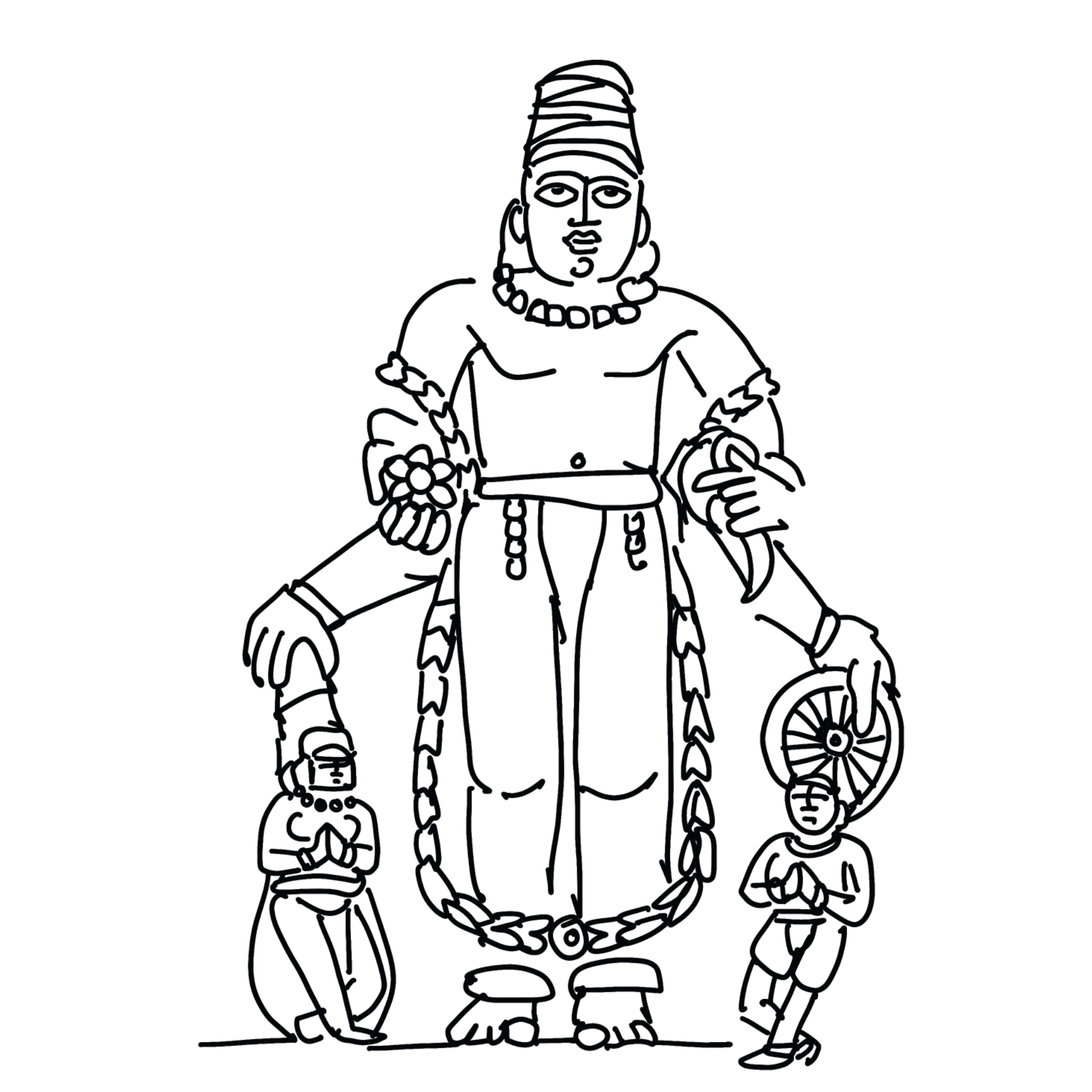
There are many folk versions of the Ramayana, with a Sanskrit Ramayana assumed to be the original. These various versions create a Ramayana tradition with different plots, enriching our understanding of the story. Similarly, there are many versions of the life of the Buddha, with people assuming the Pali version to be original and authentic.
The idea of a historical Buddha gained precedence in the 19th century with the rise of historical thinking. However, as scholars now point out, almost every information we have about the Buddha is probably an invention by his followers. It is very difficult to distinguish fact from fiction, as the life of the Buddha was transmitted orally for a long time before being written down. Those who transmitted the stories did not care for historicity as we do so today.
What is interesting is to see how the life of the Buddha evolved. There is the birth story, of course: how his mother dreams of an elephant, bears him under a Sal tree, and dies a few days later. The Buddha is then raised by his aunt, marries a beautiful princess, and is kept in isolation to see only the pleasures of life. One day, he steps out of the house, sees disease, death, and old age, and decides to renounce the world. After attaining heightened awakening (Buddha-hood) under pipal (Bodhi) tree, he realises the futility of austerity and promotes moderation. The Buddha spreads his messages to kings and common people, and finally dies (pari-nirvana) between two Sal trees. Thus, Sal trees are linked to his birth and his death, while Pipal is linked to his wisdom, and this reveals the value placed on tree cults by the story transmitters.
Kings fight over the Buddha’s bones and are finally placed in stupas. Then Emperor Ashoka redistributed them in 84,000 locations across his vast empire. Similar stories are told in China of a Ming emperor who redistributes relics and statues of India across his realm. There is even a story in Thailand of how Ashoka has to travel to Southeast Asia to fetch an original relic, which is no longer found in India!
As the story of the Buddha travelled across Southeast, East, and Central Asia, it evolved in many ways. To explain karma, a new set of stories was created, of how the life of the Siddhartha Gautama, the prince of Sakya clan, was the culmination of 550 prior lives, documented in the Jatakas, where the Buddha-to-be took many forms, including animals, birds, kings, merchants, and priests before he was born as the Buddha. In these 550 lives, he invariably takes a male form, revealing a gender bias.
There are stories of the Buddha’s previous lives where he decides in the Tusita heaven who should be his worthy mother. In Chinese and Japanese chronicles, there are stories of rivalry between Buddha’s mother, Maya, and her sister, Gautami, who eventually becomes his stepmother. There are also stories of his rivalry with his cousin Devadatta, who becomes a follower and wants to lead the Buddhist Sangha after the Buddha, but is prevented from doing so. Devadatta wants the monastic order to be more austere and vegetarian, which Buddha disallows. Devadatta tries to assassinate the Buddha and is thrown into hell, where he suffers endlessly. There are also stories of Yashodhara, who in some versions, is simply pregnant when the Buddha leaves for the forest and so is accused of infidelity when she delivers her child. She survives various trials to prove her fidelity to the Buddha.
In Chinese chronicles, the Buddha’s wandering is not in a forest but on mountains, which are seen as important places of wisdom in Chinese and Japanese traditions. He encounters many teachers who torture him like Zen masters. In Japanese tradition, the Buddhaʼs death is linked to a Shinto god of epidemics, who tricks the Buddha into dying by taking advantage of his compassion. He threatens to kill a thousand humans for every breath the Buddha takes. So the Buddha chooses pari-nirvana. Thus, we find the story of the Buddha transformed dramatically in different parts of the world.
In Mahayana Buddhism, Shakyamuni is one of many thousands of Buddhas. The most popular Buddhas in China and Japan are Virochana and Amitabha. For Amitabha Buddha, chanting his name all your life can take you to his special Pure Land Heaven (sukhavati) where one is born through lotus flowers, not the womb of a woman. Notice the gender bias, which was common in monastic orders. There is no need for meditation or ritual, just chanting Amitabhaʼs name. In Zen Buddhism, you don’t even have to chant; you just meditate and contemplate becoming the Buddha yourself. This vast diversity in stories and beliefs of Buddhism makes us question the idea that there is only one Buddhism when actually there are many.