Have you seen the rich constantly talk about gratitude on social media? Are they thanking people for making them rich? Are they thanking God for making them rich? If they are thanking people for making them rich, then they see people as donors to their lifestyle, who seek nothing in return. If they are thanking God, then they are seeing themselves as moral and ethical beings who have been rewarded by the divine. Gratitude is a clever trick marketed to avoid taking responsibility and being accountable for one’s actions. Gratitude is a masquerade of humility. Unless it is accompanied by generosity.
The poor are also told to be grateful. They could have starved to death, but they must be grateful to get the leftovers of the rich. The ritual of gratitude comes from a warped reading of Christian and Islamic mythologies, where God is all powerful so no one has any power. Those who are rich and powerful are because God wills it so. The rich must be grateful to God for their fortune. The poor must be grateful to God for at least being alive, and not as miserable as others.
The idea of gratefulness is not found in Hindu, Buddhist and Jain mythologies, which value accounting more than judgment. Neither wealth nor poverty is good or bad. All actions are based on debts. The rich have a lot of credit. The poor have a lot of debt. The rich are expected to invest more. The poor are asked to beware of debt-generating addictions.
But the rich prefer lending to investing. They give in order to take. This is called return on investment. The rich revel in getting high returns on investments. The richer one is, the more influence one has, the more you can bully vendors into giving you more deals and discounts. Hence the rich want to be monopolists. And are grateful when they get that monopoly. Right now, America is moving towards oligarchy, like Russia. Having supported dictators around the world, western nations are realising the hungry Bakasura is now starting to feed on those who fed him. For, when we take more and give less, we eventually describe growth as a state when we only take and do not give. The rich, therefore, seek not just wealth, but also respect and glamour, and then announce gratitude when they burp in satisfaction.
Criticising the rich instantly turns you into a Socialist, who wants the rich to pay more taxes. In the West, only the rich are expected to be charitable and have social responsibility. In Indian stories, every human being is accountable and has to repay debt. Because Indian stories are well aware of humanity’s debt to nature, something missing in western discourse.
Western myths only talk of people-the rich and the poor, the faithful and the faithless. They never talk about nature. Nature is chaos to be controlled in Greek and Norse myths. And in the Bible, humans have dominion over earth to do as they please. So other than being grateful for the right to plunder nature, humans have no other obligation.
Nature demands balance. What eats gets eaten. Humans eat but do not want to be eaten. From nature’s point of view, all human surplus is debt. All prot cornered by the rich is debt. This has to be repaid. Only in Hindu mythology, the earth takes the form of a cow and complains to Brahma that she is being plundered by the rich. So Vishnu takes the form of Parashuram, Ram and Krishna and creates family conflicts where the rich kill the rich. In Hindu stories, the word ‘king’ is used because in agricultural societies only the king was rich.
In Buddhist stories, the word ‘merchant’ is used because in markets only the merchant was rich. Buddhist stories never talk about how nature is upset by human actions because Buddhism, like Christianity and Islam, is about the human condition. It ignores the plunder of nature. Buddhism, contrary to popular belief, is not about ecology. Wherever Buddhism spread, rice farms and rich monasteries led to degradation of nature. Old Hinduism shunned building permanent structures for this reason. Regeneration was a key theme in Vedic Hinduism. Not immortality. The quest for immortality leads humans to invent plastic.
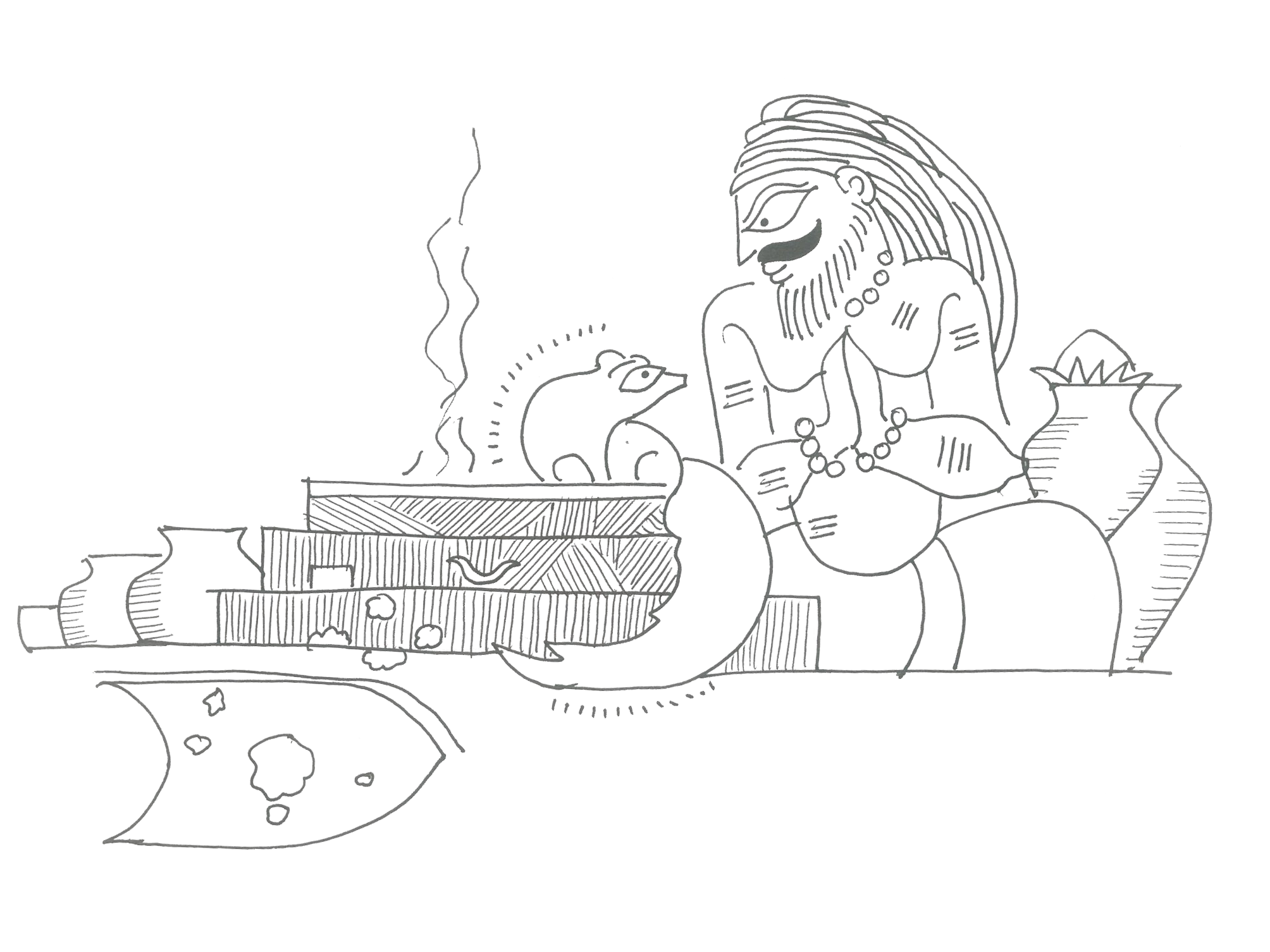
In the Mahabharata, to display gratitude, Pandavas invite hundreds of people to a grand feast and make many donations. But a golden mongoose says this display of donation is nothing compared to the food donated by a beggar who gave a third of what he had to a stranger and a third to a rival beggar. It is not the volume but the proportion that matters. And even more than that, the intent matters. Are you showing gratitude? Or are you repaying the debts you owe to nature to ensure you are not cast in hell?