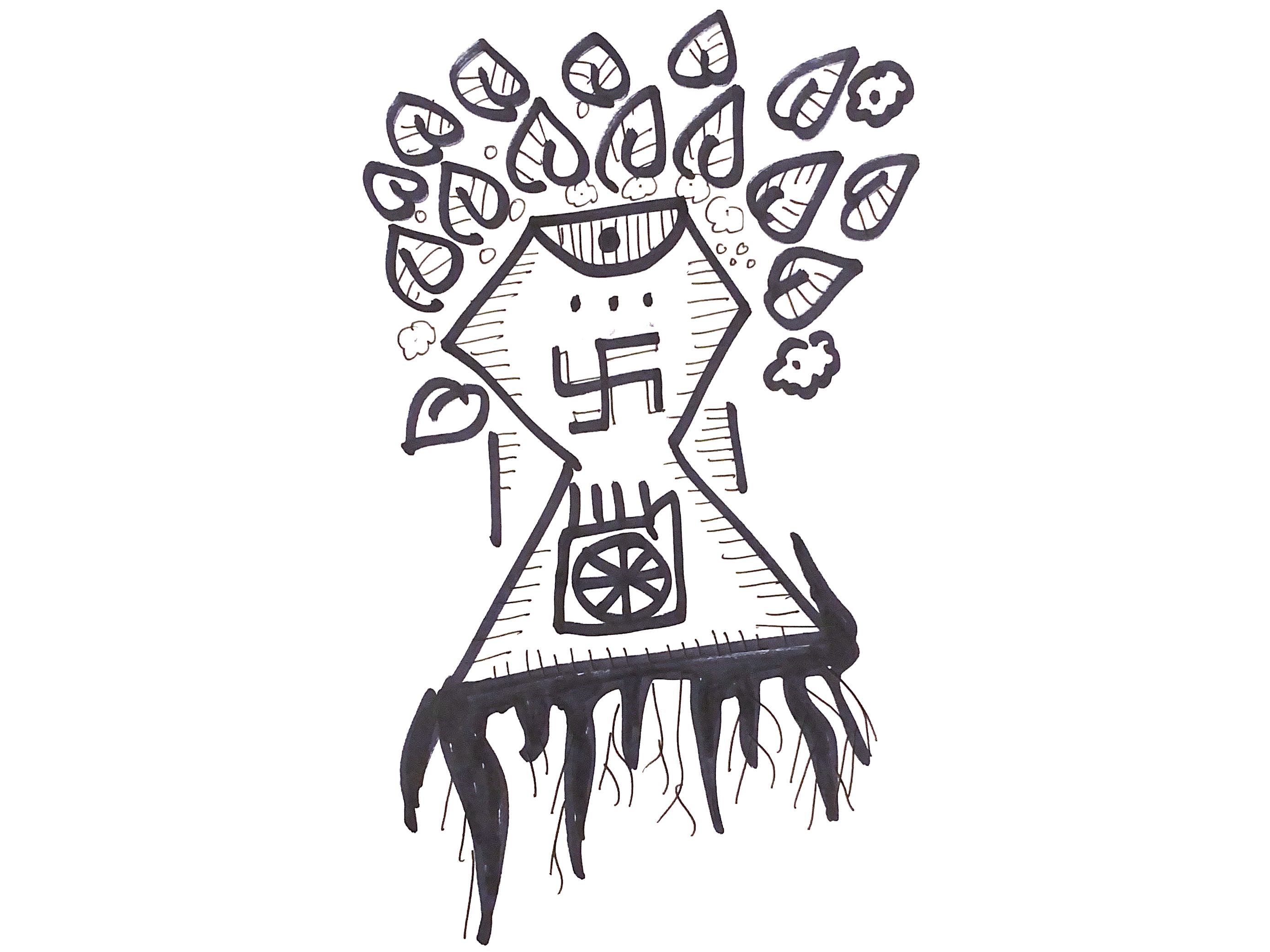
The Left endorses its ideology when it frames Hinduism solely through the lens of caste. Yet, genetic studies have revealed that endogamy, marrying within communities, became widespread only after the 5th century AD, 1,500 years ago, with the shift from a more mercantile to a more agricultural economy, and the rise of temple-based communities. There is no reference to caste in Ashokan edicts which are 2,300 years-old. Words like dvija (twice-born) are invented only in dharma shastras, that were mainstreamed by the Gupta kings 1,800 years ago. So is there another way to frame Hinduism, one without essentialising caste?
Scholars have noted that while Western and Chinese thinkers focussed on social matters and material reality, Indian thinkers focussed on the mind. The West bypassed the mind by focussing on God. “In the beginning there was God”; China bypassed the mind by focussing on nature. “In the beginning there was the Dao, The Way”. Science chooses matter over mind. “In the beginning there was the Big Bang”. All these exist outside humans. They speak of creation in objective rather than subjective terms.
Creation in the Veda happens differently. “In the beginning there was craving”. Depending on which Vedic verse we read, this craving can be hunger for food, hunger for security, hunger for knowledge, hunger for companionship, hunger for success. It can be the hunger of plants, animals, humans and gods. It starts from within the body, not without.
Buddha argued against craving. “Desire is the cause of suffering”. ‘Desireʼ is an English (mis)translation of the word tanna that he used. Tanna means thirst in Prakrit; itʼs trishnain Sanskrit. To end suffering, one needs to end thirst, and that leads, eventually, to the end of the self (nibbana in Prakrit, nirvana in Sanskrit). Realising the extreme nature of his thoughts, and that most humans seek fulfilment of aspiration and ambition, Buddha proposed the ‘Middle Pathʼ, where hunger is moderated by compassion. Buddha was no social justice warrior as is imagined by 21st century activists.
Jain Tirthankaras drew attention to the violence inherent in the act of consumption that follows craving. They spoke of non-violence as the way to break free from the restraints imposed by nature. “Shun food to destroy hunger”. The teachers chose to be celibate, shunning not just food but also other forms of pleasure. They wandered naked, rejecting possessions, even clothes.
Neither Buddhism nor Jainism speak of God. Both saw nature as a never-ending fetter of hunger from which they sought escape. Both were therefore monastic orders, distancing themselves from social demands as well as natural cravings. Both were patronised by merchants, known for their affluence. Buddhist and Jain doctrines helped the ambitious merchant keep his greed in check. He was told that the problems of his life came not from the food he accumulated, but from his hunger that he did not regulate.
Buddhism and Jainism focussed on the individual self. Hinduism expanded the definition of self to include the other. Other peopleʼs hunger became the tool to understand oneʼs own hunger. They spoke of four realms that humans occupy: Naraka, the realm of endless hunger for the self; Swarga, the realm of endless food for the self; Kailasa, the realm of peace for the self; and Vaikunta, the realm of delight for the other.
Everyone seeks Swarga for themselves. Willy-nilly, they create Naraka for others. This results in endless violence. The residents of both realms see themselves as victims. One justifies hoarding; the other justifies raiding. Today, we call it the conflict between Capitalists and Communists, Right and Left, Materialists and Spiritualists. Everyone is asked to pick a side. We are told there is no alternative to war. One side will win, and the other side will lose. But as the history of the world has shown us, no one really wins any war. Eventually, the triumphant die. Their victories, their monuments, even their achievements are forgotten.
In Hindu stories, the divine is the embodiment of contentment, the opposite of craving, conflict, and competition. Divine took two forms: Shiva and Vishnu. Shiva is Hara, one who takes away hunger. Vishnu is Hari, one who gives food. Shiva helps those in Naraka; he wants the hungry to be content. Vishnu helps those in Swarga; he nudges the affluent to be generous. Without contentment, there cannot be generosity. Without generosity, there cannot be contentment. But neither Hara nor Hari are heard; no one sees the other; victimhood persists; the violence continues.
Hara and Hari do not punish those who do not listen to them. They are never angry. They are patient. They persist in doing what they always do. They are not in a hurry. For while humans live mortal lives, the Hindu divine is immortal (Sanatana), embodying ideas that were as true for past generations as they will be for future ones.