Published in Devlok, Sunday Midday July 31, 2011.
Every time I visited the temple of Jagannath in Puri, Orissa, my aunts would tell me of huge treasures buried somewhere deep under the temple, protected by serpents. We believed it, as much as we believe Hogwarts, a fascinating and fantastic tale that did not have to be true. But now, a vast treasure has been discovered in the vaults of the Padmanabha-swami temple in Kerala, and I have started to wonder if there is more to the tales of my aunts.
I visited the grand Padmanabha-swami temple over a decade ago. Like most temples in Kerala it evokes a primal experience very simply by not allowing electricity into the sanctum sanctorum and insisting that men enter the temple wearing unstitched cloth. So you see stone and gold and lotus flowers and murals in the flickering light of lamps, and feel overawed.
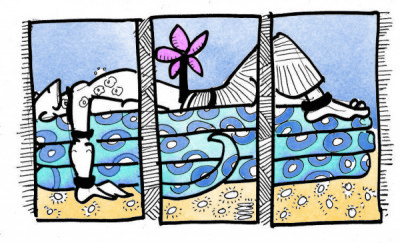
What struck me most was the design of the shrine. The deity is the reclining Vishnu from whose navel (nabhi) rises a lotus (Padma) in which sits Brahma, the creator of the world. The image is massive and cannot be seen in a single glance. It has to be seen through three doors: the first showing his hand, the second his navel and the third his feet. This is to draw attention to the limitations of the finite human mind. At any one moment, we can comprehend only a part of the whole, never the whole, because the whole is God, who is infinite.
Of course, the scientific mind and the economist mind and the historian mind, dominated by the left half of the brain, and consumed by logic, is dismissive of such wisdom and focuses on the ‘reality’ of the wealth locked in the temple vault. Who does it belong to? Will corrupt politicians lay their hands on it? Will people benefit from it? Will it stagnate as a museum of the past or help the future Indian economy by being invested in the market? Nobody is asking the question, why was so much wealth given to God, rather than being invested in the kingdom?
Wealth and property are unnatural concepts, manmade creations, enforced through laws and courts. We own a piece of land only when it is registered and acknowledged by the court of the land. Only humans can write wills and bequeath their property to another human being.
Yet, many humans refuse to pass on their wealth to others — not even to their family, or friends. They prefer passing it on to non-human entities, for example an institution. An institution can be either secular like a charitable institution or an educational institution or the nation state, or it can be a religious institution like a church or a temple. What makes people prefer institutions over humans?
Is it because they have lost faith in humanity? Could it because they have been a victim of the corrupting influence of wealth and do not wish to inflict it on others? Or is devotion to a deity so intense that the plight of fellow humans has become a blind spot?
Wealth has no value when it lies buried in a vault. Yet even today gold is poured into temples: gold thrones for mystics, diamond studded shawls for gods, mobile phones and cars to goddesses. People who do this often are uncomfortable handing over a sliver of their fortune to a person they know. Clearly, this is a manifestation of a lifetime of disappointment with fellow human beings: cruel sons, careless daughters, loveless spouses, greedy siblings, treacherous servants. And so through donation there is a final rejection of humanity and submission to that one entity, who cannot ever fail or talk back — God.