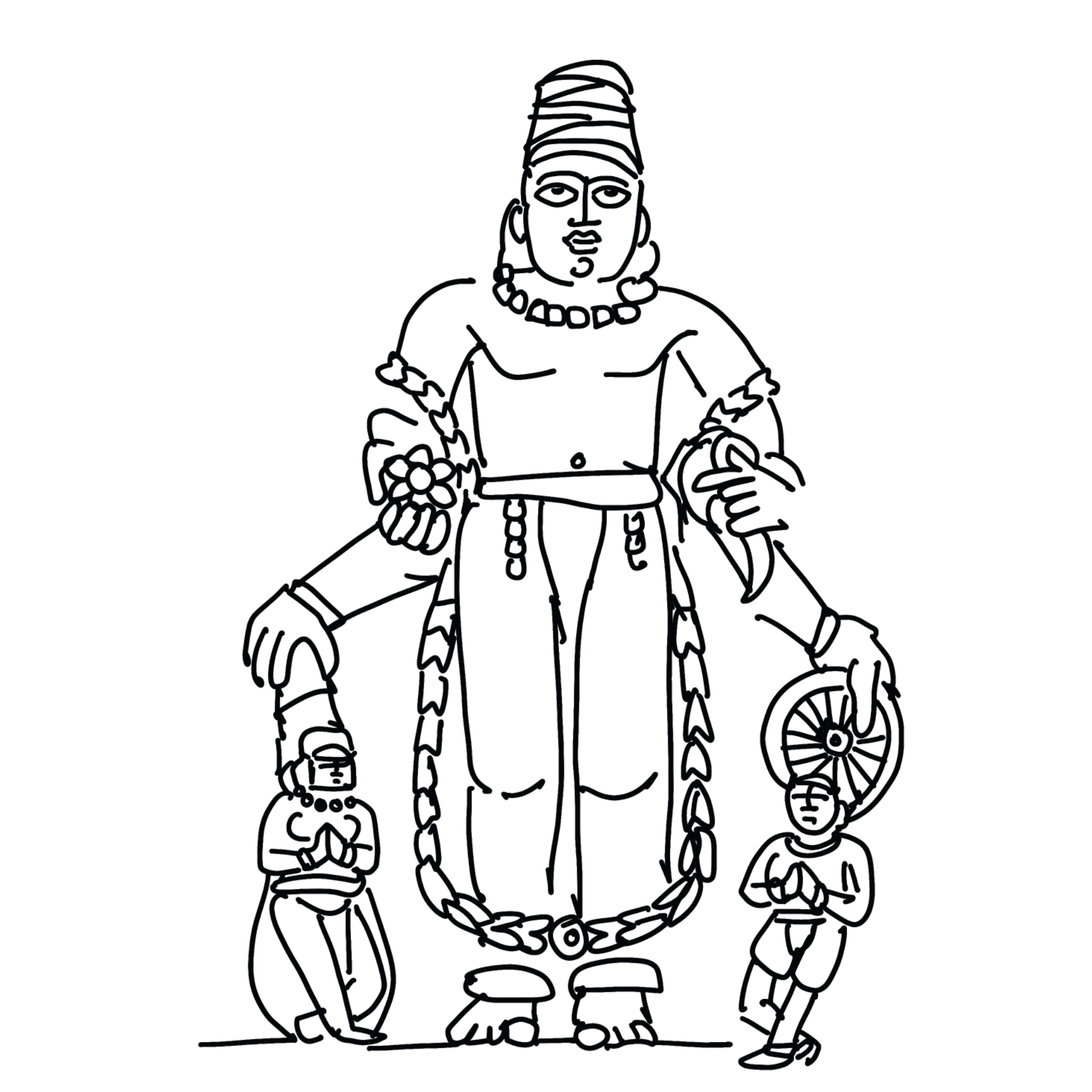
In the business world, people talk about fixed assets and movable assets. In ancient times, merchants referred to the same concept using mythological characters. For example, fixed assets would be called Bhudevi or the earth goddess, and movable assets like coins would be Sridevi.
The landowner’s power came from the land, Bhudevi, while the merchant’s power came from gold coins, Sridevi. These became the two forms of Lakshmi, the goddess of wealth. One can either possess agricultural land or pastureland. The former can even have forests and orchards. The latter is the land over which one’s cattle graze. One could even charge a toll to people travelling through these lands. But the trader, the moneylender, the banker, and the toll collector make a different kind of money. They can carry cash wherever they go.
Mythological characters need not be religious. This equation of mythological characters with religion is a 19th-century colonial view. But if we broaden our horizons, the goddesses talk to us in a very different way. Myths become shorthand for concepts.
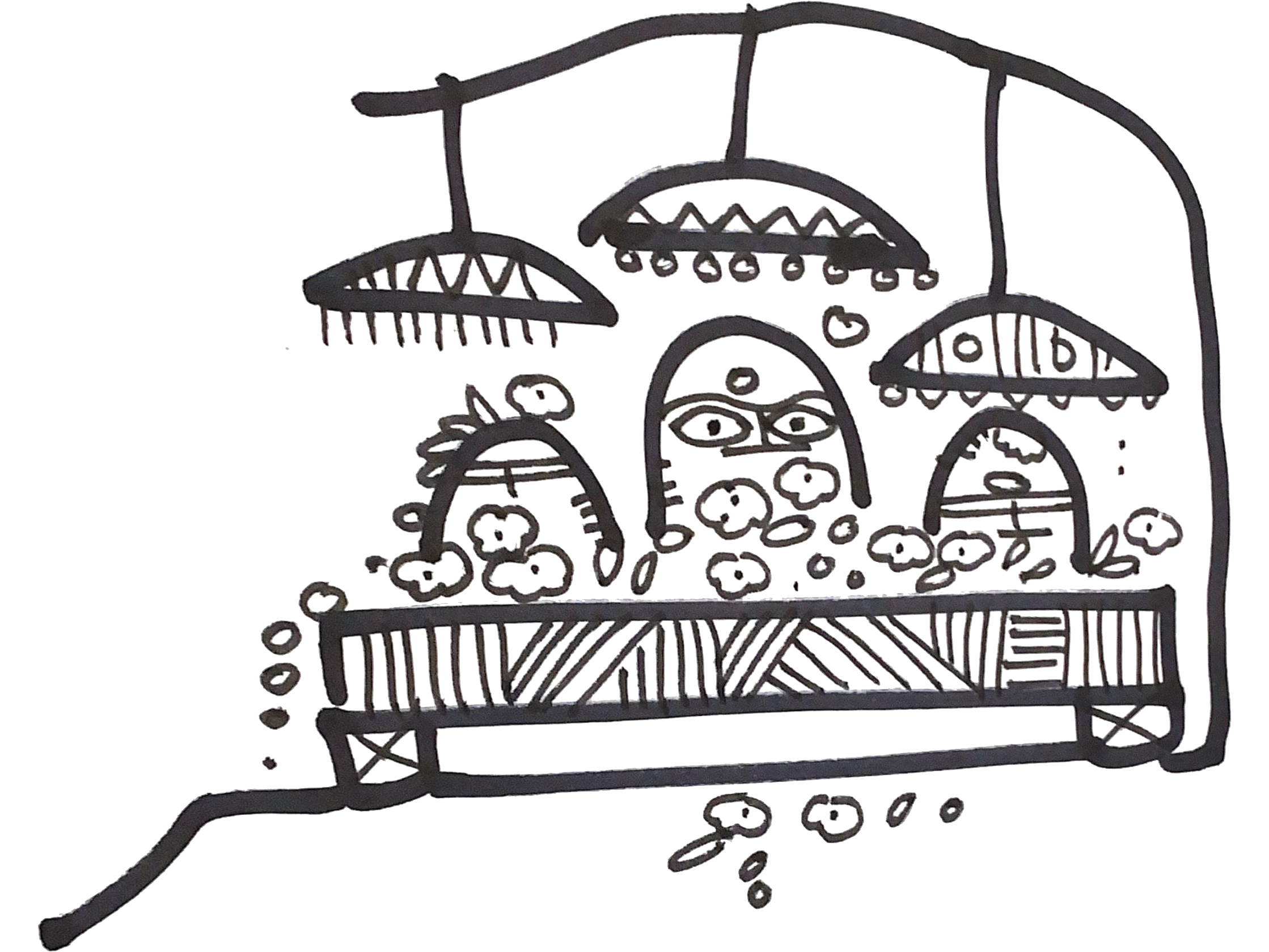
The village goddess, or Gramadevi, stands for an institutional way of thinking. In institutions, no individual has all power, power is distributed through a complex set of rules and mechanisms. Individuals can come and go, but the institution survives. The Gramadevi embodies that institution of the village, where people come and go, but we are all bound to the rules of the goddess. She becomes the institutional goddess of a community, or a clan, a Kuladevi or a geographical space called Gramadevi.
A Gramadevi gives shelter to many Kulas. The same Kula can be distributed over multiple geographies and, therefore, belong to multiple Gramadevis; and in the shrine people would have a Kuladevi as well as a Gramadevi. The Kuladevi defines our loyalty to a particular lineage, while a Gramadevi indicates loyalty to a particular region. As it is today, an IIT engineer will connect with his Kula of IIT. But the same IIT engineer is part of a Grama, the place where he resides.
If one assumes that people in the past were savages and did not think like the modern man, we are quite mistaken. We must start looking at mythological characters as substitutes for modern management jargon. We can see how knowledge is divided. Knowledge of the arts is separated from knowledge of skills. So, the creative arts were linked to dancers, courtesans, musicians — what is called Gandharva Vidya. But a whole set of skills also existed like, the skills of the cobbler, metalsmith, bureaucrat, and accountant. Each one of them had a whole different set of skills. Thus, we hear of how the vidya has multiple forms and all forms of vidyas were worshipped at one time. We can look at each vidya as a separate department of knowledge. Those who studied astronomy had a different vidya, and those who studied metallurgy had a different vidya.
Each vidya was locked in a particular caste group. So, one caste group would not share its vidya with another caste group. That was a knowledge management system that allowed knowledge to remain within a lineage. One of the reasons why caste was promoted is to prevent knowledge from leaking from one caste group to the other. For example, a weaver would not share his knowledge with another weaver family for fear of losing a competitive advantage.
Across India, we find different kinds of goddesses. Goddesses linked to knowledge and skills (vidya), goddesses linked to different forms of wealth (Sri), and different forms of power (Shakti). Vidya could be accounting, dancing, and weaving. Sri could be cows, land, and gold. Shakti could be weapons, and titles. Shakti can come from a Durga who manages the fort, or it can come from a Gaja Vahini who controls elephants. New goddesses emerged with the arrival of gunpowder, which gave kings a competitive advantage.
Around the 10th century, many circular roofless temples were built in Odisha and Madhya Pradesh regions. These were called yogini temples, housing wild goddesses, and various forms of vidya, sri, and shakti. Similar circular formations have been seen in Buddhist and Jain Tantrik art with a central male character like Shiva, Bhairava, Heruka or Tirthankara. These are metaphors for the knowledge, resources and power that dance around us, tempting us. Without her, we cannot be wise, rich, and powerful. However, when we acquire these goddesses we have to also pass them on to others — not lock them up. If we hoard them, and restrict them to our communities, they destroy our intellect by making us arrogant, pompous, stupid, and miserable. The only way to be at peace is to let them flow, across communities, across generations, removing all boundaries and hierarchies. We can see this as a ‘mythʼ of primitive people. Or a poetic way to speak about the distribution of wealth and power to create a fair society.
It is important to widen our horizons, and appreciate how people in the past communicated ideas using gods and goddesses and their relationships. It reveals a lot about society.