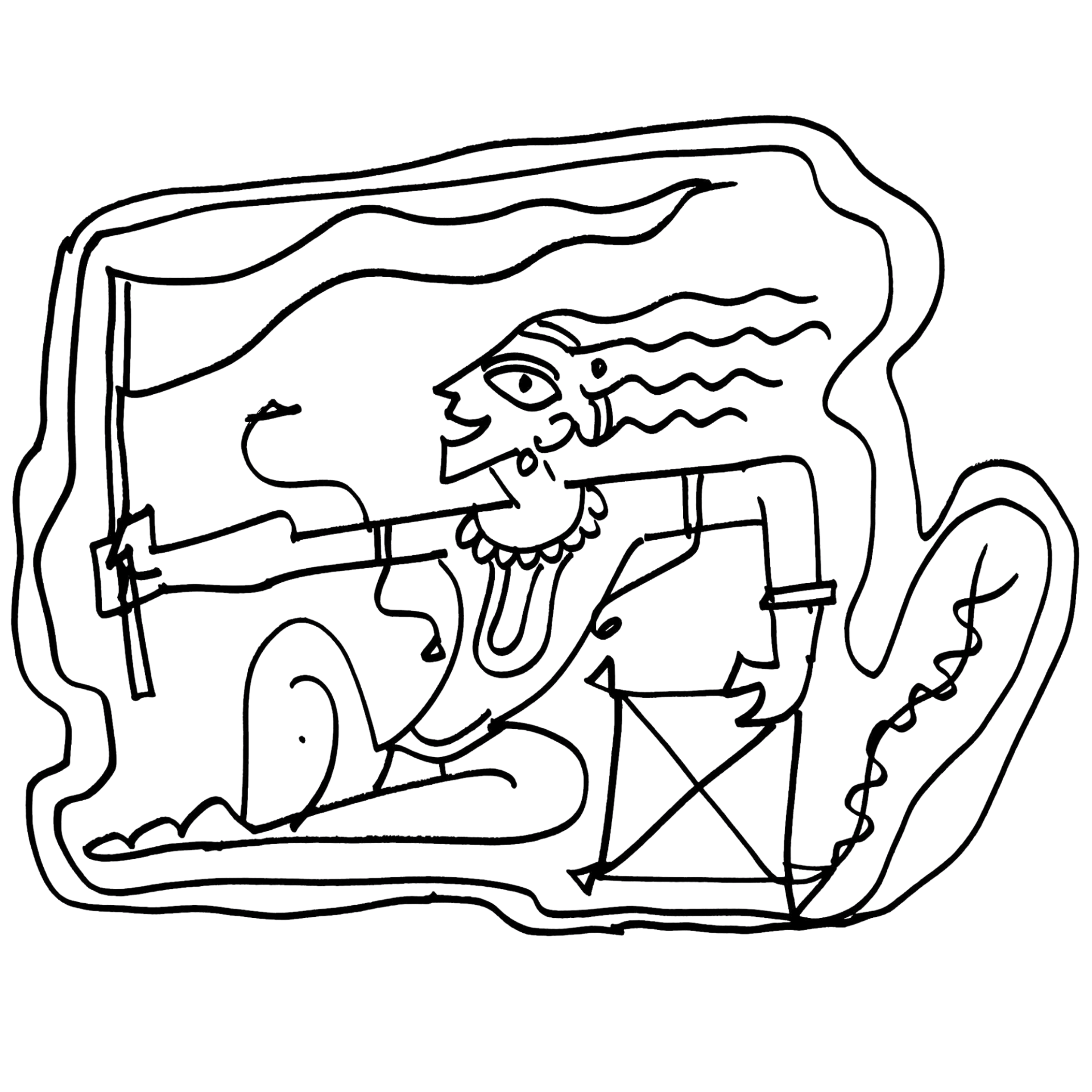
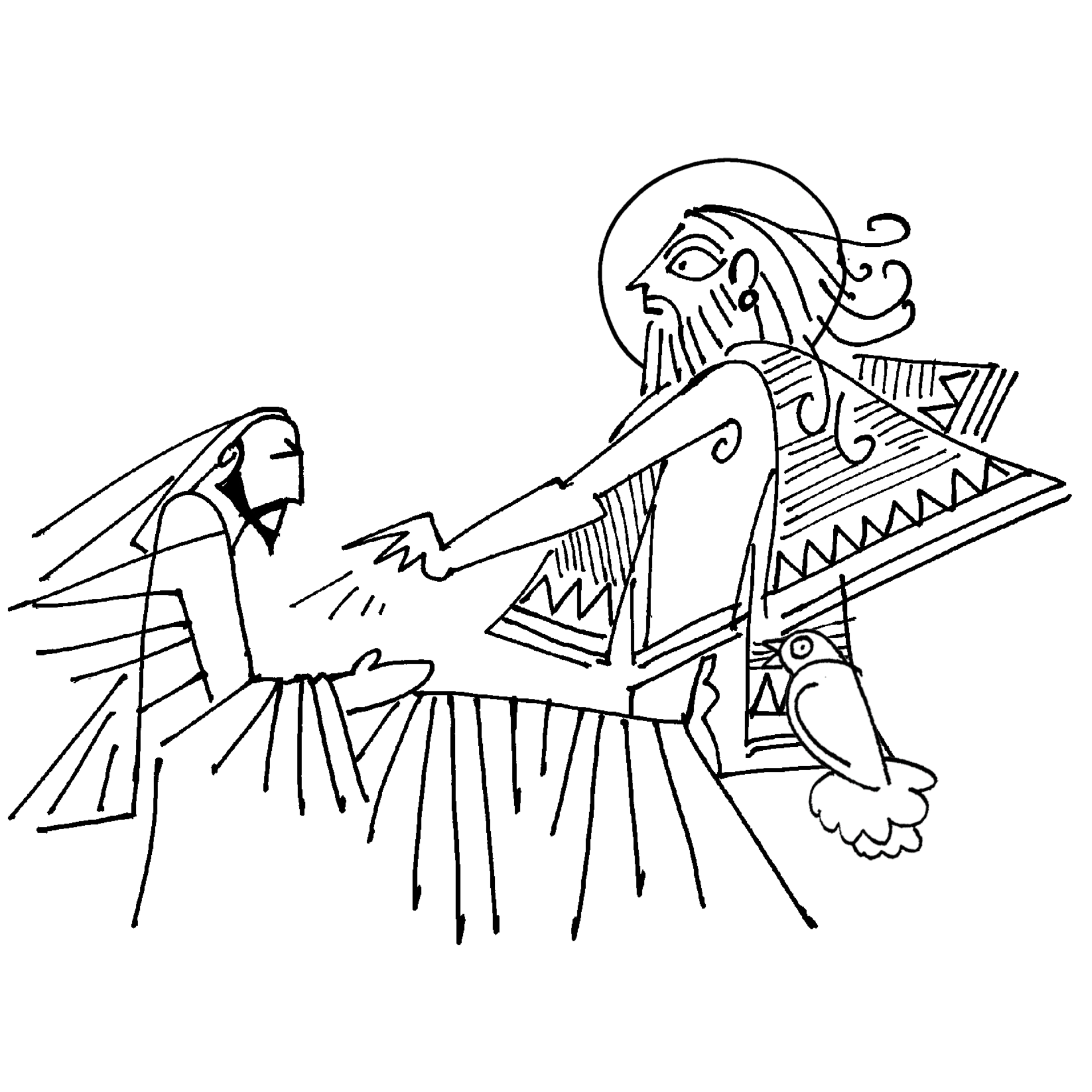
Ekalavya’s story is that of a low-born forest boy, rejected by the Brahmin teacher Drona, and who then trains alone before a clay idol, masters archery, and surrenders his thumb when Drona discovers that his own prize student Arjuna has acquired an unwanted rival. The student’s thumb-offering is presented as devotion. The violence embedded in the transaction is not presented at all. Drona is a guru, and gurus are like gods. Perfect. Never manipulative. That is how we are asked to remember Ekalavya’s story. Drona remains a teacher par excellence; we even give awards in his name to coaches.
The Adi Parva introduces Ekalavya as the son of Hiranyadhanus, chief of the Nishadas. The Harivamsa complicates this picture by portraying Hiranyadhanus not merely as a forest chief but as the commander of Jarasandha’s army. Some recensions and interpretations of the Harivamsa identify Ekalavya’s biological father as Devashravas, brother of Vasudeva, making Ekalavya a Yadava by birth who was fostered by Hiranyadhanus. This identification, however, is not accepted uniformly across all editions, and should be treated as a contested textual tradition rather than an undisputed fact.
This matters because the entire justification for Drona’s demand rests on the social logic of the simpler version. A Nishada boy who fashions a clay image of a guru who refused him and trains on stolen knowledge has no legitimate claim within the varna framework. Drona’s demand for the thumb reads, within this frame, not as cruelty but as a strategic restoration of hierarchy momentarily disturbed by presumption.
However, once Ekalavya’s actual genealogy enters, the logic collapses. Drona did not refuse a wild boy of the forests. He refused a prince whose lineage connected him to a rival nobility, then mutilated him for learning anyway.
The Sabha Parva adds what popular retellings consistently suppress. Sahadeva defeats Ekalavya during his southern digvijaya before the Rajasuya. Ekalavya then appears in the list of kings present at Yudhishthira’s coronation sacrifice, attending not as a forest tribesman grateful for the privilege of self-mutilation but as a king among kings.
The Harivamsa follows him further: he fights alongside Jarasandha in campaigns against the Yadavas, is present at the Rukmini Swayamvara, and survives his disabling to become precisely the military threat Drona had hoped to neutralise. He is eventually killed by Krishna, who in the Drona Parva names the killing alongside those of Jarasandha and Shishupala as acts of strategic contrivance performed for Arjuna’s sake. Krishna does not dress this in dharmic language. He calls it what it was. Drona’s guru dakshina and Krishna’s eventual killing are two moves in the same long game: the systematic elimination of a warrior whose abilities, politically aligned against the Pandavas, could have changed the outcome of the war.
To make the thumb demand legible as devotional transaction rather than premeditated disabling, the tradition needed Ekalavya to be nobody. The texts, read together, confirm he was not.
And then there is the echo of the tradition never formally acknowledged.
The Buddhist text Therigatha and the later Pali sources give us Angulimala, the serial killer of the road to Savatthi who wore a garland of fingers cut from his victims. His original name was Ahimsaka, the harmless one. His teacher, some versions specify, instructed him to collect a thousand fingers as the price of completing his education. The instruction arrives, as Drona’s demand does, wrapped in the language of the guru-shishya relationship, as obligation, as the legitimate cost of knowledge received.
The parallel is not exact and may not be a derivation. But the image is too precise to be entirely coincidental: a teacher, a demand for a body part, a student who complies because the teacher has defined the terms of the transaction. In the Mahabharata, it is the thumb of a student that a teacher takes. In the Angulimala story, it is the fingers of strangers that a teacher demands. In both cases, the collection of severed extremities is the mechanism by which the guru exercises and confirms power. In both cases, the violence is made pedagogical.
What the Ekalavya story tells us, stripped of its devotional packaging, is that a thumb was taken from a prince to protect a curriculum and a career. What the Angulimala story tells us is that a tradition of severing fingers in the guru’s name did not seem entirely implausible to those who heard both tales. Perhaps Drona’s demand was unusual enough to need a dark mirror, a story that named the structure plainly by carrying it to its grotesque conclusion. A teacher who takes one thumb from one student becomes, in the nightmare version, a teacher who demands a garland of a thousand fingers from the road.
The finger collector was eventually redeemed by the Buddha. The thumb was never returned.