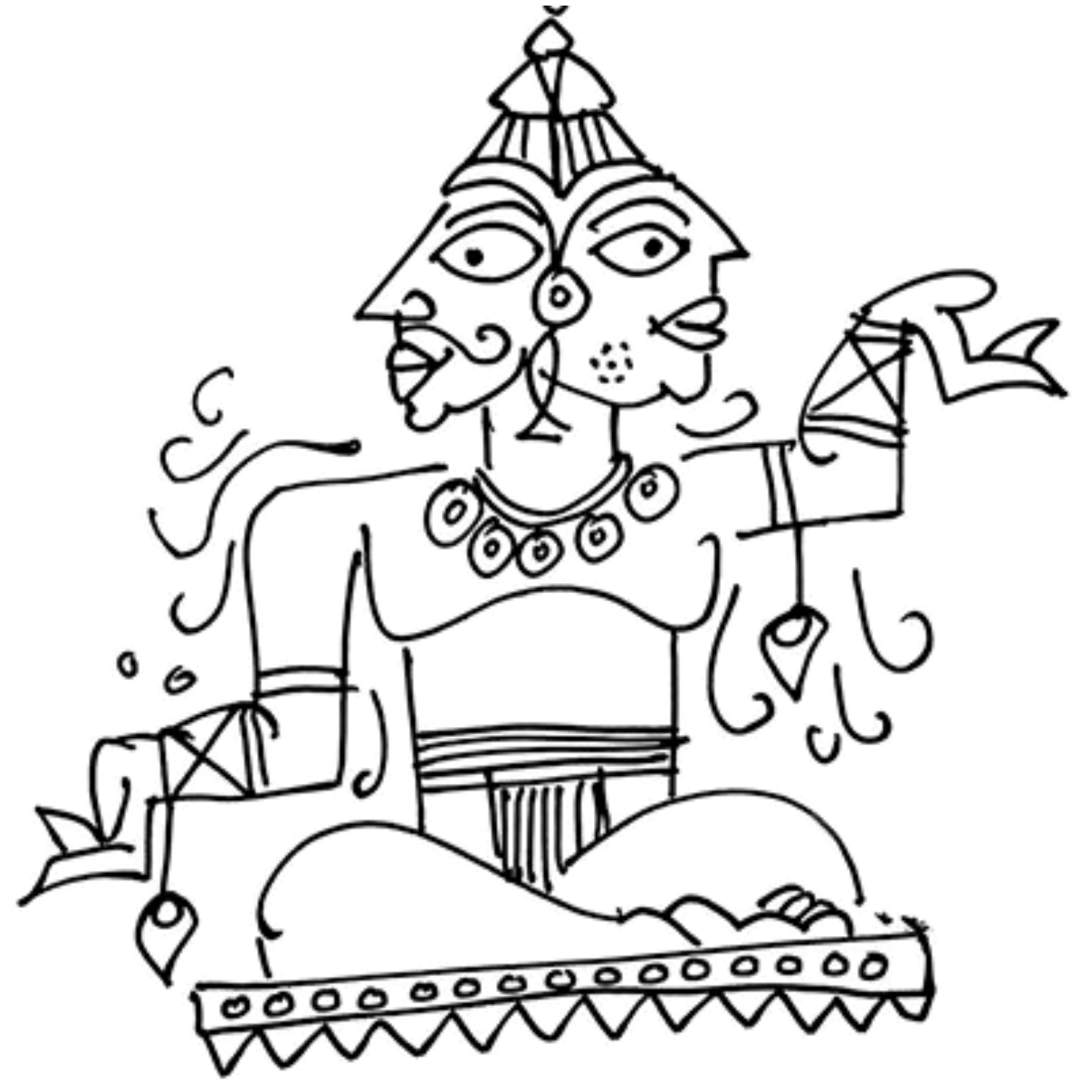
A missionary (pracharak, in Hindi) is a relentless salesman. He sells God. He sells God’s message. For centuries there have been Christian missionaries, Muslim missionaries, and Buddhist missionaries. The last century saw the rise of Hindu missionaries. Many of these call themselves sanatani today. But what exactly are these sanatani missionaries selling?
The missionary impulse rose in the ancient Near East, where certain men began to claim they were messengers of the one true god, sent to save the world. They spoke not of metaphors, but of instructions. Their god was not a concept, but a fact. Judaism remained cautious, but Christianity embraced this new idea without hesitation. Jesus asked his disciples to preach to all nations. Paul sailed across the Mediterranean with the conviction that salvation is universal and must be shared. The Christian journey thus became an outward movement, expanding territory, claiming souls, establishing the kingdom of God on earth.
Buddhism is often placed in this missionary lineage, but the tone is different. Gautama Buddha did ask his monks to go forth for the welfare of the many. Yet his impulse was not to prove one truth. It was to reduce suffering. His monks became wanderers who shared insights, not enforcers who demanded uniform belief. They travelled across India, then followed trade routes towards Sri Lanka, Central Asia, China, and Southeast Asia. They translated freely, adapted their practices, and allowed older traditions to survive. Their message was a path, not a proclamation. As a result Buddhism spread widely, but without the sharp edges of exclusivity.
But when the Roman Empire adopted Christianity, missionary work became an institution. Monks ventured across Europe to convert pagans. Later, when European ships sailed across the world after the 15th century, missionaries travelled with them to harvest souls. They believed all humans must know one god, one saviour, one story of creation. Into Africa, Asia, and the Americas they carried the conviction that they alone held the final revelation.
Islam has its own version of the missionary. While there is no perfect equivalent of the Christian missionary, the daayi, tablighi, and muballigh capture the idea of travelling teachers spreading religious instruction. The early Arab empire used political might, taxation, even violence to encourage conversion. Alongside this was a gentler, quieter spread through traders and Sufi networks. Their message positioned Islam as the completion of earlier revelations, meant for all peoples.
But missionaries rarely bring peace. Muslims fight Christians. Sunni fight Shia. Catholics fight Pentecostal. Even within Buddhism, Navayana disagrees with Theravada and Mahayana. When truth is imagined as singular and final, debate soon leads to war. Even the secular world follows this pattern. Rationalists like Richard Dawkins argue with the same certainty as prophets. Submit or be cancelled.
In the last two centuries, a new type of Hindu missionary has emerged, especially under the shadow of colonial rule. Inspired by Jesuit methods, some Hindus built schools, colleges, and hospitals. They adopted celibacy, obedience, and even vows of poverty. They argued passionately about the truth of Vedanta or Krishna. In recent times they prefer the word sanatani.
The sanatani Missionary claims Hinduism has a clear dogma. They demand that every Hindu must sing ‘Vande Mataram’ and chant ‘Jai Shri Ram’. They declare Advaita Vedanta to be the only truth. They insist Ram, Krishna, and Chanakya were historical figures whose existence cannot be questioned. They promote vegetarianism. They even urge everyone to burn incense sticks without bamboo because someone told them this is ancient and pure. Much of this sounds more Jain than Hindu, but they make no distinction between Jainism and Brahmanism. Zeal grows faster than clarity.
This energy reveals a deep misunderstanding of Hindu structure. Hinduism does not have a single message. There is a landscape of stories, rituals, philosophies, and communities that shifts with geography, caste, family, and memory. Turning this fluid tradition into a rigid institution drains it of life. That is why the idea of ‘sanatani missionary’ feels deracinated, distant from organic tradition, a tool of political propaganda, a vote-bank creator.
Historically, no one could convert to Hinduism. One is born into a Hindu caste. Joining a Hindu cult does not grant caste. It makes the initiate a follower of a guru, not a member of a jati. The structure is social, not theological. Belief plays a minor role in this arrangement. In Pakistan, for example, many who embraced Islam through missionary zeal still identify as Rajput. That label marks them as technically Hindu in the old order. Faith does not change that position. This remains the paradox of Hindu identity. It is flexible in imagination yet rigid in social boundaries. The new sanatani missionary may dream of a unified Hindu church, but Hindu civilisation continues to behave like a forest, not a fortress.