These days, people everywhere talk about mindfulness, meditation, and Buddhism as the ultimate way to find inner peace. But if we dig into the actual historical roots we find a complicated truth. Take the case of the Therigatha, a collection of ancient Buddhist poems written over 2000 years ago.
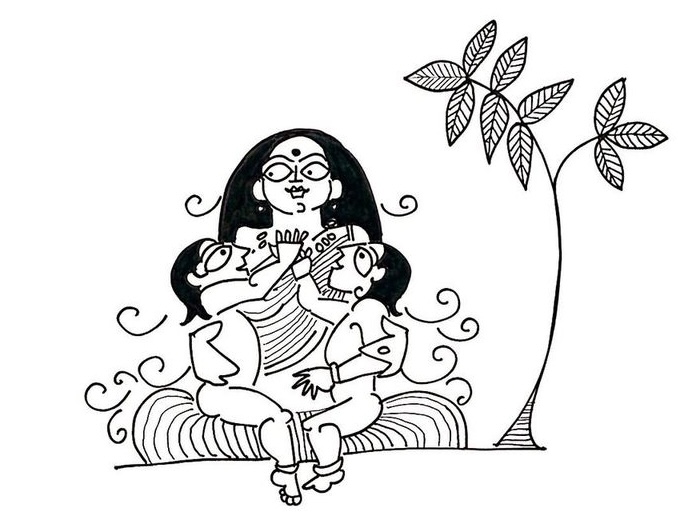
The poems feature women from all walks of life, from overworked housewives to royal courtesans. Take Sumangalamata, a housewife trapped in a brutal domestic life. In her poem, she joyfully sings about being free from her endless chores, shouting that she is finally rid of her kitchen pestle and mortar, her abusive husband, and her cooking pots. For women like her, running away to join the early Buddhist nunhood was a daring escape from the trap of traditional marriage and forced domestic labor.
But to understand the catch, we must look at what these women had to give up. To be accepted as spiritual equals, they had to shave their heads, wear identical plain robes, and strip away every single marker of their femininity. The underlying message of the text is unsettling: it teaches that womanhood itself, female bodies, and feminine desires are dirty, distracting traps. Instead of changing a society that treated women as property, the religion told women that the only way to win was to stop being women altogether.
We see this internalised disgust clearly in the verses of Ambapali, a famous royal courtesan who once lived in luxury and was desired by kings and nobles. In her old age, she writes poetry cataloging her decaying body: “her sagging breasts, her wrinkled skin, and her greying hair”. While some modern readers view this as a clever way to reject the male gaze, it actually shows how deeply these women absorbed patriarchal shame. They learned to view their own natural bodies and biological realities as disgusting hazards that needed to be destroyed and transcended.
Most frustratingly, these poems completely ignore what a woman might actually want. A nun’s freedom is defined entirely in the negative. It is a “freedom from” being used, abused, or reduced to a mother and a wife. But nowhere in these ancient verses will you find a celebration of a woman’s appetite, her creative dreams, or her desire to build, invent, and enjoy the world on her own terms. Expressing a personal hunger for life was treated as a dangerous sin.
Ultimately, these ancient texts give women the right to walk out of a burning house, but they refuse to let them build a new one. If a philosophy tells you that the only way to find peace is to starve your desires, hate your body, and erase your identity, it isn’t truly liberating. It is just an ancient system teaching women how to police themselves.
Buddhism today is often seen as the opposite of Hinduism. People point to Manusmriti as promoting patriarchy and Therigatha as promoting feminism. Such simplistic binaries are great for content creation and as rage bait. But they do not tell the full picture. Both Manusmriti and Therigatha promote a discomfort with women in different ways. Manu says women should be controlled by men. Buddha says give up the desires evoked by, and evoked in, the woman’s body.